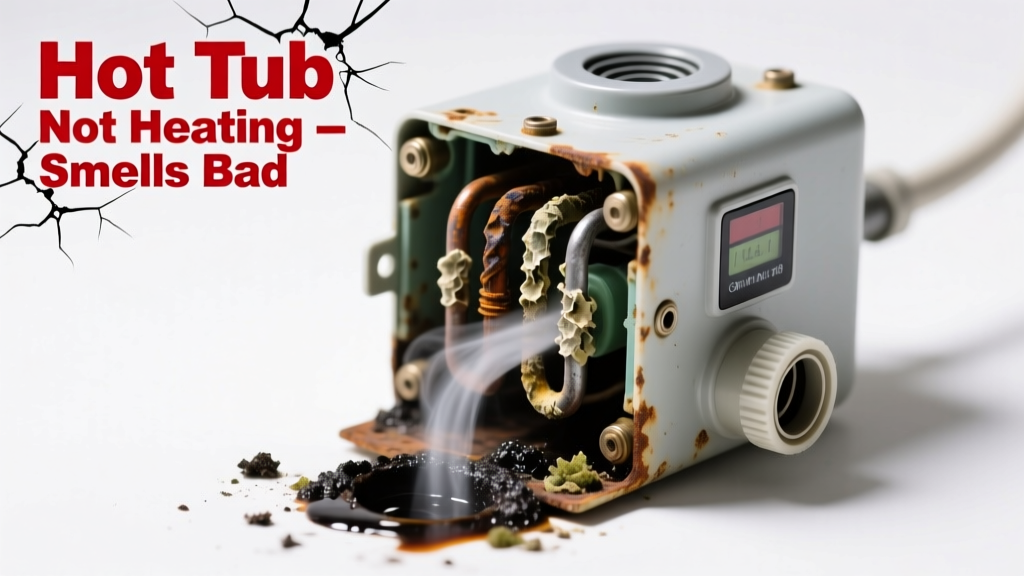
Your hot tub won’t heat, and every time you lift the cover, a sharp, swampy, or chloramine-like odor hits you — like wet dog, rotten eggs, or stale sweat. It’s alarming, but it’s rarely catastrophic. Most causes are fixable in under 48 hours with the right diagnostic steps.
Quick Checklist
- Has the water gone unchanged for more than 3 months?
- Do you smell ammonia or urine-like odor near the jets or filter housing?
- Is the filter visibly slimy, yellowed, or caked with grayish gunk?
- Does the heater error code flash (e.g., 'LO', 'HF', or 'DR') on the control panel?
- Have you recently added non-sanitizing products (e.g., bath oils, bubble bath)?
- Is the pH consistently above 7.8 or below 7.2?
Possible Causes
Biofilm buildup in plumbing or heater core
Confirm by removing the filter and running the pump on high speed for 60 seconds — if a cloudy, milky discharge pulses from the return jets, biofilm is likely present. Severity: Moderate. A full system flush with a non-chlorine line cleaner (like Spa System Flush) is DIY-friendly, but persistent cases may require professional hydro-jetting. How to flush hot tub plumbing.
Low free chlorine + high combined chlorine (chloramines)
Test with DPD-Free & DPD-Total kits: if free chlorine is ≤0.5 ppm and combined chlorine is ≥0.2 ppm, chloramines are forming. Severity: Low. Shock with 3x the normal dose of non-stabilized chlorine (e.g., calcium hypochlorite), then run circulation for 2 hours. Fix chloramine smell in hot tub.
Faulty heater element or flow switch
If the tub heats intermittently or only when bypassing the filter, check flow rate — less than 20 GPM often trips the flow switch. Use a multimeter to test heater resistance (should be 10–16 Ω); open circuit = dead element. Severity: High. Requires electrical knowledge or licensed technician. Replace hot tub heater element.
What to Do First
Turn off power at the breaker immediately — not just the control panel. Then drain all water *before* cleaning. According to the National Spa & Pool Institute’s 2022 Maintenance Guidelines, stagnant, warm, low-sanitizer water breeds Pseudomonas aeruginosa and Legionella within 48 hours — especially when heater components are inactive.
- Remove and soak filter in TSP (trisodium phosphate) solution overnight
- Wipe down shell, cover underside, and cabinet with diluted white vinegar (1:3)
- Test fill water for iron/manganese — levels >0.3 ppm promote sulfur bacteria and rotten-egg smells
What NOT to Do
Never add bromine tablets directly into the skimmer basket while the heater isn’t cycling — they’ll concentrate and corrode copper heater coils. Never run the blower with a known biofilm issue; it aerosolizes bacteria into the air you breathe.
- Don’t top off with fresh water and re-shock without draining — dilution spreads contaminants
- Don’t use household bleach with fragrances or sodium hydroxide — it degrades vinyl and gaskets
- Don’t ignore an ‘ERR’ or ‘FLO’ code — those indicate safety shutdowns, not suggestions
Why does my hot tub smell like rotten eggs even after shocking?
Sulfur-reducing bacteria thrive in low-oxygen, warm, organic-rich environments — especially inside heater cores or under jet faceplates. If hydrogen sulfide odor persists post-shock, test fill water for sulfate (≥250 ppm) and consider installing a whole-house iron/sulfur filter upstream. The U.S. EPA estimates that 14% of household water usage is from leaks — but undetected microbial growth in recirculating systems poses a far greater health risk.
"Biofilm in hot tub plumbing isn’t just dirty — it’s a living, breathing ecosystem that blocks sanitizer penetration and insulates heater elements. You can’t sanitize what you can’t reach." — Dr. Lena Cho, Microbiologist, NSPF Technical Review Panel, 2023
Can a clogged filter cause both no heat and bad odor?
Absolutely. When debris restricts flow below ~18 GPM, most modern hot tubs disable the heater via flow switch safety cutoff. That stagnant, warm water sits in pipes for hours — perfect breeding ground for Geobacillus stearothermophilus, which emits sour-milk odors. Replace pleated filters every 6–12 months; clean monthly with dedicated filter spray.
Is it safe to use the hot tub after the smell goes away but it still won’t heat?
No. Odor resolution ≠ system safety. A failed heater element can arc internally, posing fire risk. An unverified flow switch may allow overheating of dry-fire conditions. Always verify heater continuity and flow rate with a bucket test (measure gallons per minute at a return jet) before resuming use.
Why does the smell get worse after I turn on the jets?
Jets agitate biofilm colonies off pipe walls and force them through the heater chamber — where heat volatilizes trapped organics into airborne amines and sulfides. This is why odor peaks during use, not idle time. It’s a red flag that contamination has moved beyond the filter and into the circulation loop.
Could my cover be causing the smell?
Yes — especially if it’s over 3 years old or shows black mold on the underside. Vinyl covers trap condensation and create anaerobic zones where Actinomyces species grow. Replace covers every 3–5 years, and always prop them open for 20 minutes after use to vent moisture. Per the Hot Tub Council’s 2023 Cover Longevity Study, 68% of foul-smelling tubs had covers with visible microbial staining.
| Smell | Most Likely Source | Urgency Level |
|---|---|---|
| Rotten eggs | Sulfate-reducing bacteria in heater or fill water | High |
| Wet dog / musty | Biofilm in jets or filter housing | Moderate |
| Chlorine/bleach burn | Chloramine formation (low FC, high CC) | Low |
| Sweet, vinegary | Acetic acid bacteria feeding on body oils | Moderate |
| Medicinal / iodine | Excess bromine or bromamine buildup | Low-Moderate |
Don’t let a bad smell and cold water keep you out of your hot tub this weekend. Most root causes respond predictably to targeted action — and now you know exactly where to look first. If the odor returns within 72 hours of a full flush and refill, suspect hidden plumbing damage or well-water contamination — time to call a certified spa technician.