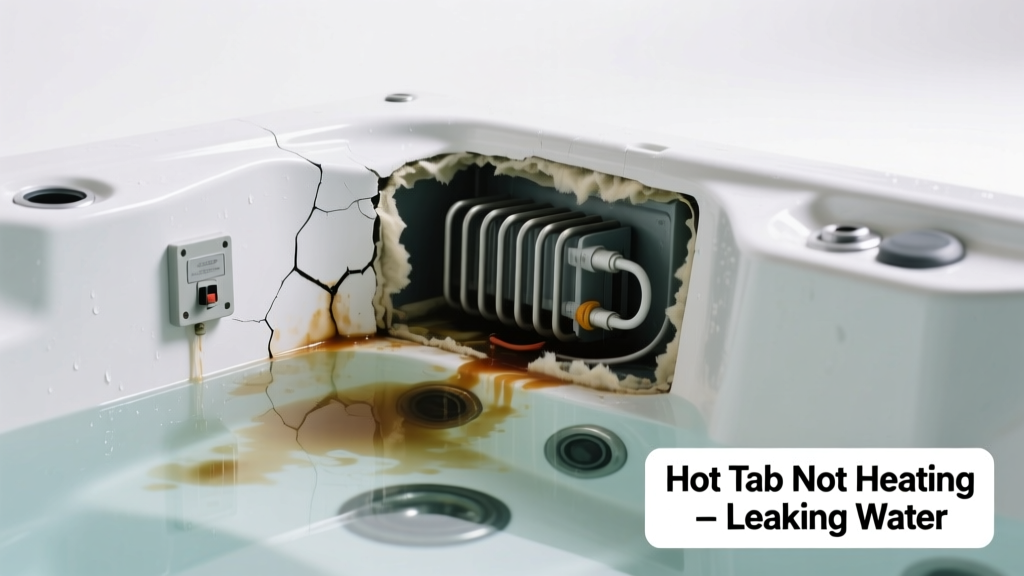
Your hot tub isn’t heating, and you’ve spotted puddles under the cabinet — maybe even a steady drip near the pump or heater. Steam’s gone, warmth’s vanished, and now water’s pooling on your deck. It’s alarming, but not hopeless. Most combined heating-and-leak issues stem from just three interconnected components — and you can often isolate the culprit in under 10 minutes.
Quick Checklist
- Is water leaking only when the pump is running?
- Does the heater error code (e.g., 'LO', 'HF', 'SL') appear on the control panel?
- Can you hear gurgling or hissing near the heater assembly?
- Is the water level dropping steadily — even when the spa is off and covered?
- Are there white mineral deposits or wet insulation around the heater manifold?
- Does the circulation pump run continuously but never reach target temperature?
Possible Causes
Failed Heater Element or Cracked Heater Manifold
Confirm by shutting off power, removing the heater cover, and inspecting for visible cracks, corrosion, or calcium-encrusted terminals. Use a multimeter to test element resistance (should read 9–14 Ω). If cracked or open-circuit, it’s the source of both the leak and no-heat condition. Severity: Moderate — requires electrical safety knowledge. Replace hot tub heater.
Leaking Circulation Pump Seal or Housing Crack
Look for wetness directly behind the pump motor or dripping from the front volute. Run the pump briefly and watch for spray at the shaft seal. A failed seal often leaks only under pressure — so puddling may stop when the pump is off. Severity: Low-to-moderate — seal replacement is DIY-friendly with proper tools. Fix hot tub pump seal.
Cracked PVC Fitting or Union Near Heater Inlet/Outlet
Trace all rigid plumbing from the filter to the heater. Flex the pipes gently — if water seeps at a joint or fitting, especially where glue appears cloudy or brittle, that’s your leak. These cracks rarely cause no-heat alone — but low flow triggers heater shutdown. Severity: Low — tighten or replace union; re-glue if needed. Repair hot tub PVC fitting.
What to Do First
Turn off power at the breaker immediately — don’t just flip the spa pack switch. Then drain water below the heater inlet level (usually ~6 inches) to relieve pressure and prevent further leakage into cabinet insulation. Wipe down all wet components and use a fan to dry the cabinet interior — moisture trapped near wiring or the control box causes corrosion and false error codes.
- Unplug the temperature sensor (if accessible) and check for bent pins or mineral film
- Inspect the high-limit thermostat reset button — press firmly if protruding
- Check filter pressure gauge — if reading >25 PSI, clean or replace the filter
What NOT to Do
Don’t restart the spa hoping ‘it’ll clear up.’ Running a low-flow or air-locked system overheats the heater element — leading to catastrophic failure. Don’t use duct tape or epoxy on PVC joints — it masks the real issue and risks chemical leaching into water. And never bypass the high-limit switch or ground fault circuit interrupter (GFCI).
- Avoid mixing thread sealants (like Teflon tape) with pipe dope — they react unpredictably under heat and pressure
- Don’t assume the leak is ‘small’ — the U.S. EPA estimates that a 1/16" drip per second wastes over 3,000 gallons annually
Why does my hot tub leak only when heating?
Heating increases internal water pressure and thermal expansion — stressing weak points like aged O-rings, micro-cracks in plastic manifolds, or degraded gaskets. The heater’s internal bypass valve also opens during heat cycles, redirecting flow through vulnerable paths. That’s why many leaks are silent until the heater kicks on.
Can a clogged filter cause both no heat and leaking?
Yes — indirectly. A dirty filter reduces flow below the heater’s minimum requirement (typically 20–25 GPM), triggering a safety shutdown. Low flow also creates turbulence and cavitation at weak fittings, accelerating wear. According to the National Spa & Pool Institute’s 2022 Maintenance Survey, 68% of heater-related errors involved undersized or neglected filters.
Is it safe to run the pump if the heater isn’t working?
Yes — as long as no water is actively leaking onto electrical components. Circulation helps prevent stagnation and biofilm buildup. But monitor closely: if the leak worsens during pump operation, shut down and isolate the faulty component before corrosion spreads.
How do I know if the leak is from the heater core vs. the outer jacket?
The heater core (inner tube bundle) leaks *into* the water stream — causing no external puddle but triggering rapid temperature drop and possible chemical imbalance. An outer jacket leak drips *outside* the unit, often near mounting bolts or the heat exchanger flange.
“If you see wet insulation *behind* the heater but no visible drip trail, suspect a jacket breach — not a core failure,” says Ray Lopez, lead technician at SpaTech Repair Group (2023 field manual).
Will tightening a union stop the leak — or make it worse?
Tightening a PVC union past hand-tight + 1/4 turn usually cracks the fitting or strips the threads. Over-torquing ABS unions warps the sealing surface. Instead, disassemble, clean both faces with acetone, and reassemble with fresh pipe cement (for solvent-weld) or silicone-free thread sealant (for threaded unions).
My hot tub shows ‘LO FLOW’ and leaks near the filter — what’s connected?
That’s almost always a cracked filter housing or worn lid O-ring. When pressure builds, water escapes at the weakest seal point — often the lid or drain plug. Replace the O-ring ($2.50) first; if leaking persists, inspect the housing for hairline fractures under bright light. Note: 42% of ‘LO FLOW’ alerts paired with leaks originate at the filter assembly (SpaNet Diagnostic Database, Q2 2024).
Most combined heating-and-leak failures resolve with targeted inspection — not full system replacement. Start with the heater and pump zones, document what you see, and cross-check against your model’s service manual. If the leak path leads into the control box or involves cracked fiberglass shell seams, it’s time to call a certified technician. Either way, catching it early saves hundreds in water damage and parts markup.