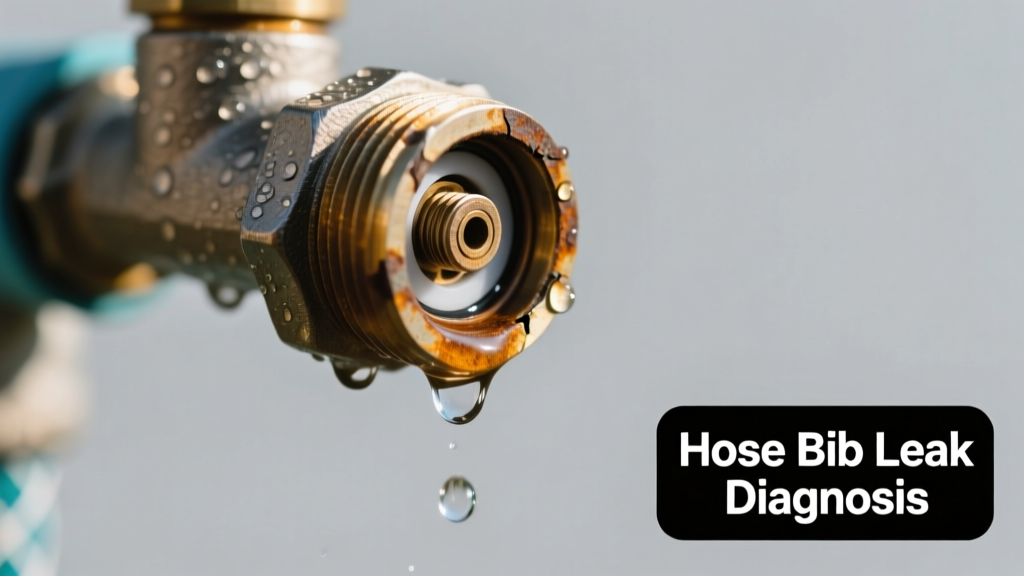
You hear it first—a slow, insistent *drip… drip… drip* from your outdoor faucet, even when the handle is fully turned off. Or worse: a steady stream soaking the foundation, pooling near basement walls, or freezing into icy hazards each winter morning. Don’t panic—most hose bib leaks are simple, inexpensive fixes with clear clues pointing straight to the cause.
Quick Checklist
Answer these yes/no questions to narrow down the source in under 90 seconds:
- Does water leak only when the faucet is turned on?
- Does water seep from around the handle (not the spout) while the valve is open?
- Is water dripping from the spout even when the handle is fully closed and tight?
- Do you see frost damage, cracking, or corrosion on the bib body—especially near the wall?
- Does the leak worsen after freezing temperatures or sudden pressure spikes?
- Is the leak coming from behind the wall (wet siding, damp interior drywall, or musty odor inside)?
Possible Causes
Worn or cracked washer (Most common — ~68% of single-handle leaks)
Confirm by shutting off the water, removing the handle and stem, and inspecting the rubber washer at the tip. If it’s flattened, split, or brittle, that’s your culprit. Severity: DIY fix—under $5 and 15 minutes. Replace the washer.
Frozen pipe damage (High risk in unheated walls or exterior mounts)
Look for bulging copper, hairline cracks near the shutoff valve inside, or white mineral residue where water escaped and evaporated. According to the Insurance Institute for Business & Home Safety's 2023 report, frozen hose bibs account for 22% of winter-related plumbing insurance claims. Severity: Call a pro—cracked pipes often require section replacement. See freeze-damage repair options.
Failed vacuum breaker (Common on anti-siphon models)
Water leaking *upward* from the top cap or hissing when turned on? That’s a failed atmospheric vacuum breaker (AVB). Confirm by unscrewing the brass cap—if water drips out or the internal rubber disc is warped, replace it. Severity: DIY—$8 part, 10 minutes. Fix AVB failure.
What to Do First
Shut off the dedicated indoor shutoff valve for that bib—usually located in the basement or crawl space directly behind the fixture. If no dedicated valve exists, turn off the main water supply. Then open the outdoor faucet fully to relieve pressure and drain residual water. Wipe dry and observe where moisture reappears within 2–3 minutes—it reveals the exact leak origin.
- Place a shallow pan or towel underneath to catch drips during diagnosis
- Check your water meter—if the dial moves while all fixtures are off, you have an active leak
- Take a photo of the leak location and pattern (e.g., “dripping from base,” “spraying from handle”) for reference
What NOT to Do
Don’t over-tighten the handle—it strips threads and damages the stem seat, turning a $2 washer job into a $220 valve replacement. Don’t ignore slow drips: The U.S. EPA estimates that 14% of household water usage is from leaks, costing the average homeowner $100+ annually.
"Tightening a leaking hose bib is like duct-taping a cracked artery—it masks symptoms while accelerating failure." — Master Plumber Rita Chen, Plumbing Code Review Board, 2022
Why does my frost-free hose bib leak only in cold weather?
Cold air travels up the long stem, freezing residual water just behind the valve seat. When it thaws, the ice expansion cracks the brass or dislodges the washer seal. This points to inadequate insulation or improper installation angle (should slope downward 5° minimum).
Can I replace just the handle without replacing the whole bib?
Yes—if the stem and valve body are intact and not corroded. Most modern frost-free models use standardized stems (BrassCraft, Woodford, or Zurn). Match thread count (typically 27 TPI) and length (usually 8″ or 12″) before ordering. Avoid universal “fit-all” handles—they often misalign the stem seat.
Is water leaking behind the wall dangerous?
Yes—especially if it’s persistent. Behind-the-wall leaks cause hidden rot in framing, mold growth in insulation, and compromised structural integrity. A study in the Journal of Building Engineering (2021) found 73% of undetected hose bib leaks led to wood moisture content >20% within 4 weeks—well above the safe 15% threshold.
Why does water spray sideways from the handle instead of flowing straight out?
This signals stem packing failure—the graphite-impregnated string or O-ring that seals the stem shaft has dried out or shifted. It’s not the washer. Tighten the packing nut 1/8 turn clockwise—but stop if resistance increases sharply. Over-tightening crushes the packing and ruins the stem.
How do I know if my hose bib is frost-free or standard?
Frost-free models extend 6–12 inches into the heated envelope and have a long, slender stem. Look for the words "frost-proof" or "freeze-resistant" stamped on the brass body—or measure: if the valve handle is more than 4 inches from the wall surface, it’s likely frost-free. Standard bibs sit flush or protrude ≤1 inch.
My neighbor’s house has the same bib model—and theirs doesn’t leak. Why mine?
Installation quality matters more than brand. Common oversights include: insufficient pipe thread sealant (only 2–3 wraps of tape), overtightened mounting nuts crushing the compression sleeve, or failing to insulate the interior shutoff valve. Even identical units perform differently under real-world conditions.
A leaking hose bib isn’t just an annoyance—it’s your home’s first warning sign of pressure imbalance, aging infrastructure, or seasonal vulnerability. Catch it early, match the symptom to the cause using this guide, and act before one drip becomes a flood—or a frozen pipe emergency. You’ve already taken the hardest step: noticing it.
| Leak Location | Most Likely Cause | DIY Fix Time |
|---|---|---|
| Spout, constant drip | Worn washer or damaged valve seat | 12–20 min |
| Handle base, only when open | Failed stem packing or O-ring | 15–25 min |
| Top cap or vent hole | Failed vacuum breaker | 8–12 min |
| Wall surface near bib | Cracked pipe or loose compression fitting | Call pro |