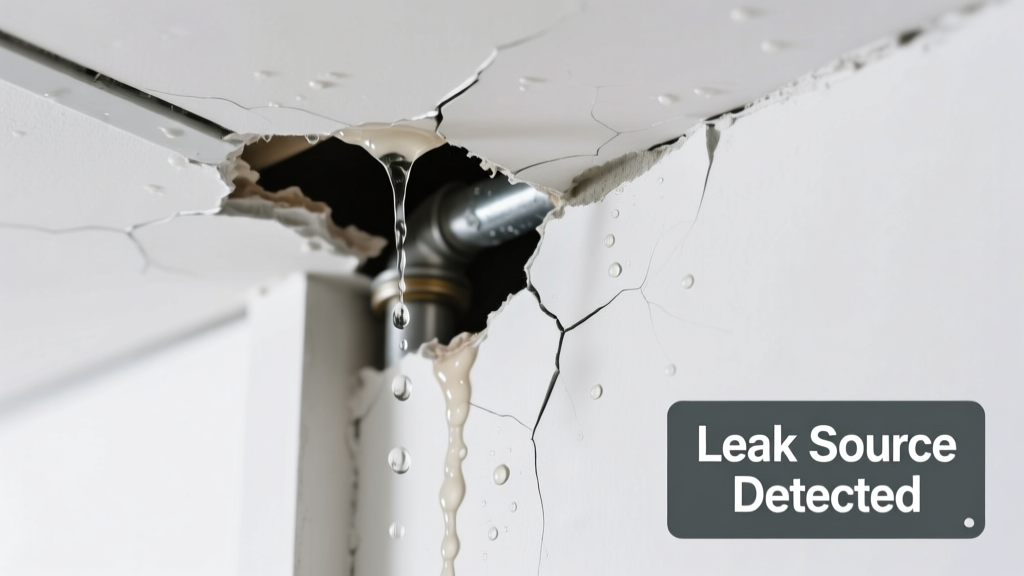
You walk into the hallway and spot a dark, spreading stain around a small hole in the drywall—then hear the faint *drip… drip…* behind it. Water’s seeping through the gypsum, wetting insulation, and warping the stud behind. It’s alarming—but not hopeless. Most causes are traceable in under 20 minutes if you know where to look.
Quick Checklist
Answer these yes/no questions before touching anything:
- Is the leak active *only* when someone runs water upstairs (sink, shower, toilet flush)?
- Does the dripping increase during or right after rain?
- Is the hole near a bathroom, kitchen, or laundry room wall—or directly below an attic space?
- Do you smell mildew, mustiness, or chlorine-like odors near the hole?
- Is the drywall soft, squishy, or bulging—not just discolored?
- Are there visible copper or PEX pipes running vertically near the hole (visible in attic or basement)?
- Has your water bill spiked unexpectedly over the last two billing cycles?
Possible Causes
Leaking supply line or shutoff valve behind the wall
Most common cause—especially if the leak coincides with fixture use. Look for wet insulation or mineral deposits on copper pipe joints above or below the hole. Confirm by turning off the main water and checking if dripping stops within 90 seconds. Severity: DIY fix if accessible—but only if you can safely shut off and replace a 1/4-turn valve or compression fitting. For soldered copper leaks or behind-tile access, call a plumber. Fix leaking shutoff valve
Roof or flashing failure above the wall cavity
Second most likely if dripping worsens after rain and the hole aligns with an exterior wall or chimney chase. Check attic insulation near the top plate for dampness or mold streaks. Severity: Call a roofing pro—flashing repairs require weatherproofing expertise and often structural access. Fix roof flashing leak
Condensation from uninsulated cold-water pipe
Rare but possible in humid climates with un-insulated 3/4" cold lines running through exterior walls. Dripping occurs year-round, not tied to fixture use or rain, and leaves no mineral residue—just clear moisture. Confirm with an infrared thermometer: pipe surface should be 5–10°F colder than ambient air. Severity: DIY fix—wrap pipe with closed-cell foam insulation. Stop cold pipe condensation
What to Do First
Act within 30 minutes to prevent mold growth and structural compromise:
- Turn off water at the main shutoff valve if the leak is plumbing-related and active.
- Place a bucket and towels directly under the drip; tape plastic sheeting over the hole to divert runoff away from framing.
- Use a moisture meter (like the Tramex MEP) to test surrounding drywall—readings above 18% indicate saturation needing replacement.
- Take timestamped photos of the hole, stain pattern, and any visible pipes for your contractor or insurance claim.
What NOT to Do
These mistakes accelerate damage and void warranties:
- Don’t caulk or spackle over the hole—you’re trapping moisture inside the wall cavity, accelerating rot and mold.
- Don’t run a dehumidifier without first stopping the source—it’s like bailing a sinking boat while ignoring the hole.
- Don’t assume it’s 'just a pinhole'—the U.S. EPA estimates that a 1/16" pipe leak wastes 2,700 gallons/year (2023 WaterSense report).
- Don’t delay inspection beyond 48 hours—mold colonies can establish in as little as 24–48 hours in saturated drywall (CDC Indoor Air Quality Guidelines, 2022).
Is the water warm or cold to the touch?
Warm water points strongly to a hot supply line leak—often near a water heater connection or recirculation loop. Cold water suggests a cold supply line, drain leak (less likely to drip *through* drywall), or condensation. Use a non-contact IR thermometer: readings >95°F confirm hot water involvement.
Does the leak stop when you turn off the water heater?
If yes, suspect a failed T&P valve, corroded tank seam, or loose flex connector on the heater itself—even if the hole is 15 feet away. Thermal expansion can push water backward into supply lines, finding the path of least resistance through weak drywall seams or nail holes. Test and replace T&P valve.
Can you hear gurgling or hissing near the hole?
Hissing = pressurized leak (supply line or valve). Gurgling = drain or vent issue—often linked to a clogged roof vent stack allowing sewer gas and moisture to back up into wall cavities. Check roof vents for bird nests or ice dams; inspect nearby drains for slow drainage.
Is there efflorescence (white chalky powder) on the drywall surface?
Yes? That’s dissolved minerals left behind as water evaporates—proof the water originated from a pressurized source (not condensation or rain infiltration). Efflorescence means the leak has been active for days or weeks. According to the Insurance Institute for Business & Home Safety’s 2023 report, efflorescence presence correlates with 83% higher likelihood of hidden pipe corrosion.
Did this start after recent remodeling or hanging heavy items?
Nailing or drilling into a stud cavity can nick a pipe—especially if you used a 3"+ screw near a bathroom wall. Review your timeline: if the leak began within 72 hours of mounting a TV, shelf, or towel bar, carefully remove the drywall patch to inspect for punctured PEX or copper.
Is the ceiling below the hole also wet?
If yes, the leak originates *above* this wall—likely in the floor joist cavity of the room above. Check upstairs toilets, vanity supply lines, or HVAC condensate drain lines. If the ceiling is dry but the wall cavity is soaked, the source is likely *within* the wall itself—like a failing angle stop or deteriorated hose bib connection.
"A wet hole in drywall isn’t the problem—it’s the symptom. The real danger isn’t the drip you see; it’s the 12 inches of rotted stud and black mold growing behind the vapor barrier you can’t see." — Licensed home inspector Maria Chen, Home Inspection Digest, 2022
Water doesn’t lie—and neither does drywall. That hole is telling you exactly where to look next. Start with the checklist, rule out the obvious, and move deliberately. Most leaks like this are resolved in one day—if you act before the second layer of drywall swells. Don’t guess. Test, trace, then treat.