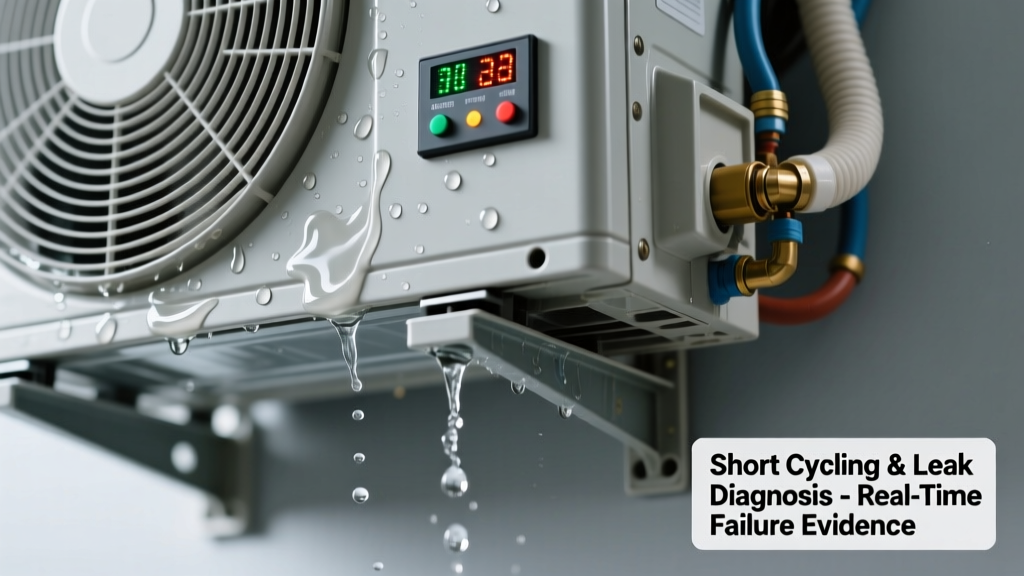
You hear the outdoor unit kick on—then shut off after 60 seconds. A minute later, it repeats. Meanwhile, a puddle spreads beneath the indoor air handler, dripping steadily onto your ceiling tile or basement floor. It’s alarming, but not always catastrophic—many causes are fixable in under an hour if caught early.
Quick Checklist
Answer these yes/no questions before digging deeper:
- Is the puddle directly under the indoor air handler (not the outdoor unit)?
- Does the drain line exit into a floor drain or condensate pump?
- Have you noticed frost or ice forming on the indoor coil or refrigerant lines?
- Is the thermostat set to 'Cool' or 'Heat', and has it been running continuously for >12 hours?
- Do you smell musty or sour odors near the air handler?
- Has the air filter been changed in the last 90 days?
- Is the outdoor temperature below 35°F while the system is in heating mode?
Possible Causes
Clogged Condensate Drain Line (Most Common)
Confirm by pouring 1/4 cup of white vinegar into the drain line access port—if it bubbles back up or doesn’t drain within 30 seconds, the line is blocked. Algae and mold buildup cause ~68% of indoor water leaks in heat pumps, per the Air Conditioning Contractors of America’s 2022 Field Service Survey.
Severity: Low — DIY fix with a wet/dry vac and vinegar flush. Link to clogged condensate drain repair.
Frozen Evaporator Coil
Look for visible frost on copper lines or the coil itself; check supply air temperature—if it’s below 50°F while cooling, suspect freezing. Often triggered by low airflow (dirty filter) or low refrigerant. According to the U.S. Department of Energy, frozen coils account for 22% of short-cycling heat pump service calls in humid climates.
Severity: Medium — Turn system off and thaw completely (4–6 hours), then replace filter. If it refreezes, call a pro. Link to frozen evaporator coil troubleshooting.
Refrigerant Leak or Undercharge
Check for hissing sounds, oil residue on copper lines, or abnormally low suction pressure (requires gauges). Short cycling + water leak often appears when low refrigerant causes coil temps to drop below freezing, then melt during off-cycles. The EPA estimates 14% of residential heat pumps operate with suboptimal charge levels due to undetected leaks.
Severity: High — Refrigerant handling requires EPA Section 608 certification. Do not attempt DIY recharge. Link to refrigerant leak diagnosis.
What to Do First
Immediate action prevents ceiling stains, mold growth, or electrical damage:
- Turn off the heat pump at the thermostat AND the circuit breaker for the indoor unit.
- Place towels or a bucket under active drips—don’t let water reach drywall or insulation.
- Inspect and replace the air filter if it’s gray, stiff, or holds no light when held to a window.
- Locate the condensate drain pan and gently tip it to see if water drains freely (if accessible).
- If using a condensate pump, verify it’s powered and the float switch isn’t stuck.
What NOT to Do
Avoid these missteps that compound damage or risk safety:
- Don’t pour bleach down the drain line—it corrodes PVC and kills beneficial bacteria that prevent biofilm.
- Don’t run the system in 'Fan Only' to dry things out—it can worsen freezing if the coil is already cold.
- Don’t poke wires or refrigerant lines with screwdrivers or coat hangers—risk of puncture or shock.
- Don’t ignore a musty odor—even if water stops leaking, mold may be growing in the drain pan or ductwork.
Why does short cycling make the water leak worse?
Each brief on-cycle cools the evaporator coil rapidly, but insufficient runtime means condensate doesn’t fully drain before shutdown. Water pools, overflows, and leaks. Longer cycles allow gravity and pump action to evacuate moisture consistently.
Can a dirty outdoor coil cause this symptom?
Yes—but indirectly. A filthy outdoor coil reduces heat rejection, raising head pressure and triggering high-pressure cutoffs. That forces short cycling, which then contributes to inconsistent drainage. Clean coils improve efficiency by up to 25%, per ASHRAE’s 2021 HVAC Systems Handbook.
Is the leak coming from the outdoor unit?
Rarely. Heat pumps only produce condensate indoors during cooling mode. In heating mode, defrost cycles melt frost off the outdoor coil—this water drains outside and shouldn’t enter your home. If you see water pooling near the outdoor unit during heating, inspect for improper grading or a damaged drain pan—but it won’t cause indoor leaks.
Could a faulty condensate pump cause both symptoms?
A failing pump rarely causes short cycling—but if it’s jammed or its float switch sticks in the 'on' position, it can trigger a safety shutoff that mimics short cycling. Test by disconnecting the pump’s power and running the system with a temporary gravity drain.
How long can I wait before calling a technician?
If the leak stops after filter replacement and vinegar flush, monitor for 48 hours. If short cycling persists beyond two full cooling cycles—or if water returns—call a technician within 24 hours. Delaying increases risk of mold in the drain pan, which grows within 48 hours of standing moisture, according to the Indoor Air Quality Association’s 2023 Moisture Response Guidelines.
"A heat pump that cycles every 60–90 seconds isn’t just inefficient—it’s a red flag for underlying stress. Treat it like a check-engine light: silence it only after diagnosing the root cause." — Sarah Lin, NATE-certified HVAC trainer, 2024
| Symptom Pattern | Most Likely Cause | First Action |
|---|---|---|
| Water only during cooling; no ice; drip near drain pipe | Clogged condensate line | Vinegar flush + wet/dry vac |
| Ice on indoor coil; weak airflow; damp filter | Frozen coil from low airflow | Power off, thaw, replace filter |
| No visible ice; loud hissing; warm supply air | Refrigerant undercharge | Call certified technician |
| Leak only during heating mode; outdoor unit steaming | Normal defrost runoff | Check ground slope & drain path |
Short cycling paired with water leakage is rarely random—it’s your system sending clear signals about airflow, refrigerant, or drainage. Most cases resolve with simple maintenance, but ignoring them risks $2,000+ in water damage repairs or premature compressor failure. Start with the checklist, act on what you confirm, and know when to bring in help.