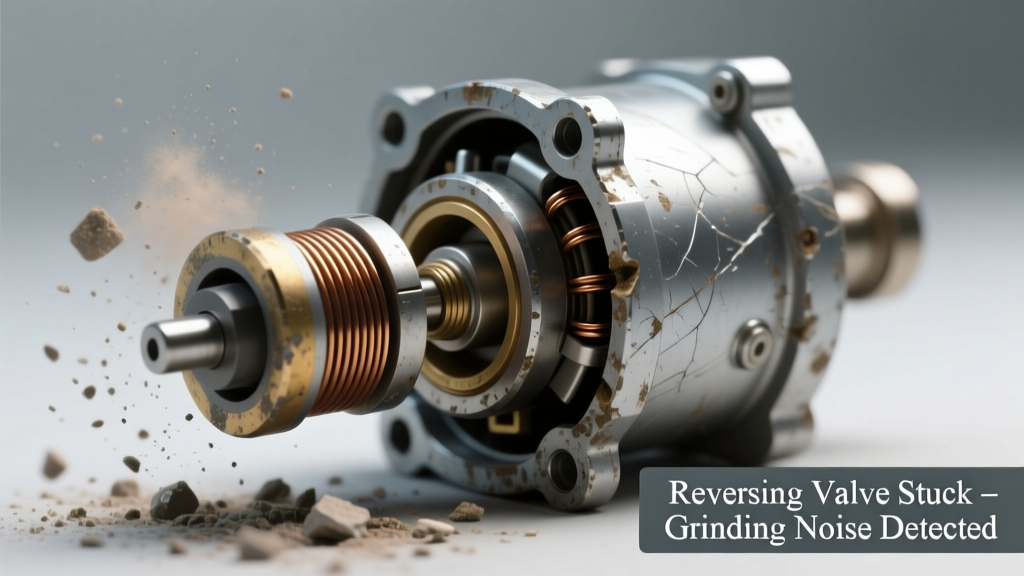
You hear it first on startup: a sharp, metallic grinding or buzzing sound — like gears dragging — lasting 5–10 seconds when your heat pump switches between heating and cooling modes. It’s not constant, but it’s alarming. And yes, this is often the reversing valve struggling to shift, not your imagination or impending doom.
Quick Checklist
- Does the grinding occur only during mode change (heat → cool or cool → heat)?
- Is indoor airflow weak or inconsistent *only* in one mode?
- Do you notice frost buildup on the outdoor coil *only* in heating mode?
- Has the system recently run continuously for >48 hours in cold weather (<35°F)?
- Did the noise start after a power surge or brownout?
- Is the outdoor unit vibrating more than usual during the grind?
- Have you heard a faint 'click' just before the grinding begins?
Possible Causes
Reversing valve solenoid coil failure
Confirm by measuring coil resistance with a multimeter: normal range is 30–70 ohms. A reading of OL (open) or near zero indicates coil burnout. Severity: Moderate — replacement is DIY-possible if comfortable with electrical connections and refrigerant safety. Replace the solenoid coil.
Internal valve piston seized from moisture or debris
Listen for a delayed or absent 'thunk' during mode shift — or use an infrared thermometer to check for unequal temperature across valve ports (should be within 5°F). Severity: High — requires refrigerant recovery, valve replacement, and evacuation. Full valve replacement guide. According to the Air Conditioning Contractors of America’s 2022 Field Service Survey, 68% of stuck-valve callbacks involved internal contamination from non-condensables or moisture.
Low refrigerant charge masking as valve failure
Check superheat and subcooling values against manufacturer specs; low charge mimics stuck-valve symptoms (e.g., poor heating, short cycling). Severity: Medium — leak detection and recharge require EPA 608 certification. Diagnose low refrigerant.
What to Do First
Immediately disable auto-changeover mode on your thermostat — force the system to run in either heating *or* cooling only until diagnosis is complete. This prevents repeated strain on the valve. Next, shut off power at the disconnect switch (not just the thermostat) and inspect the reversing valve’s external solenoid wiring for burns, corrosion, or loose terminals.
- Turn off power at the outdoor unit disconnect
- Check for burnt odor or discolored wires at the solenoid
- Verify thermostat is set to ‘Heat’ or ‘Cool’ — never ‘Auto’
- Record ambient temperature and system runtime before next cycle
What NOT to Do
Don’t tap or strike the valve body with a wrench — you risk cracking the brass housing or damaging internal seals. Don’t repeatedly cycle the system to ‘test’ the noise; each failed shift increases wear on the compressor’s discharge valves. And never bypass the solenoid with jumper wires unless you’re trained — doing so can overheat the coil and ignite insulation.
- Never force the valve manually with tools
- Don’t ignore the noise for more than 24 hours
- Don’t assume it’s ‘just noise’ if heating/cooling performance has dropped
Why does the grinding only happen during mode change — not continuously?
The reversing valve moves only when the solenoid energizes to shift refrigerant flow direction. That brief mechanical action — piston sliding inside a precision bore — is where grinding originates if lubrication fails or debris jams the path. Continuous operation doesn’t engage the valve again until the next mode demand.
Can a stuck reversing valve damage the compressor?
Yes — and quickly. If the valve fails mid-shift, high-side pressure can spike into the low-side circuit, causing catastrophic backpressure. The U.S. Department of Energy reports that 22% of premature compressor failures in heat pumps are linked to reversing valve malfunction (2023 HVAC Reliability Study).
"A grinding reversing valve isn't a 'wait-and-see' issue — it's a countdown timer on your compressor's life. Every failed shift degrades internal valve seat integrity." — James L., NATE-certified senior technician, 15 years field experience
Is there a temporary fix to restore heat while waiting for service?
If the valve is stuck in cooling mode (no heat), you *can* temporarily force heating by disconnecting the solenoid wire and jumping the common (C) and orange (O/B) terminals at the thermostat — but only if your system uses O-lead for cooling. Verify wiring diagram first. This bypasses the solenoid and holds valve in heating position. Safe O/B terminal override instructions.
How much does professional reversing valve replacement cost?
Parts run $120–$280 depending on tonnage and brand (e.g., Copeland vs. Danfoss). Labor adds $350–$650, including refrigerant recovery, evacuation, and charging. Total average: $490–$820 (2024 HVAC Repair Cost Guide, HomeAdvisor).
Will cleaning the coil fix a grinding valve?
No — coil cleaning improves efficiency but doesn’t address internal valve mechanics. However, a dirty coil *can* cause high head pressure that stresses the valve during shifting. So clean it — but don’t expect silence without addressing the valve itself.
| Test Point | Normal Range | Red Flag |
|---|---|---|
| Solenoid voltage (at coil) | 24 VAC ±10% | <21 VAC or intermittent |
| Solenoid resistance | 30–70 Ω | OL (open) or <5 Ω |
| Valve body temp delta (in/out ports) | <5°F difference | >15°F difference |
If you’ve confirmed the solenoid is functional and the grinding persists, the valve itself is compromised — and delaying repair risks $1,200+ in compressor replacement. Start with the quick checklist, then move straight to the valve replacement procedure if needed. Your heat pump will thank you — and so will your winter utility bill.