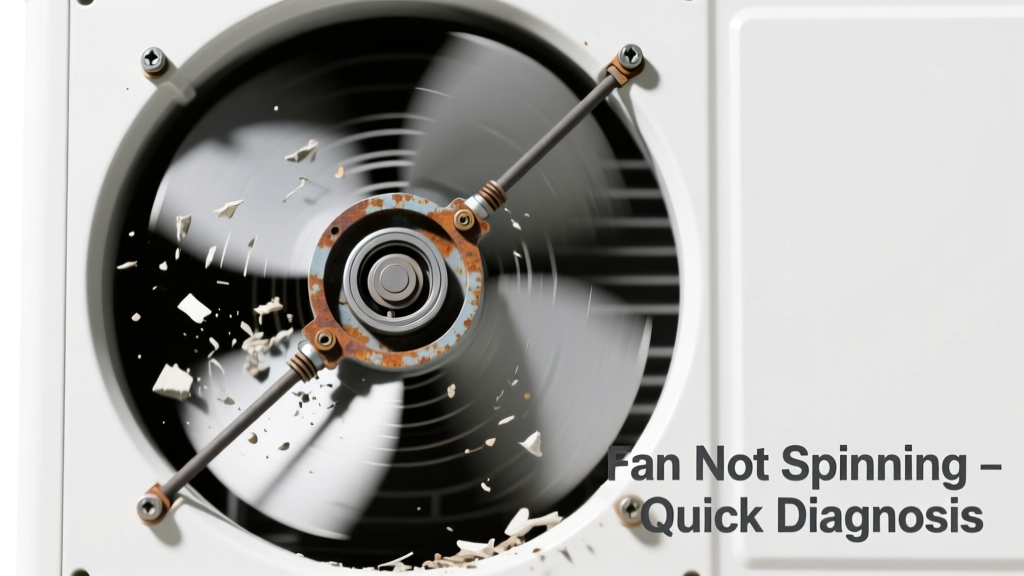
You step outside, hear the compressor humming but notice complete silence from the fan — no whir, no breeze, no movement at all. The unit’s running, yet the outdoor fan blade is frozen in place. This isn’t just an inconvenience; it’s a critical failure that can overheat the compressor in under 10 minutes. Don’t panic — many causes are simple, fast to verify, and safe to address before calling a technician.
Quick Checklist
Answer these yes/no questions before touching anything:
- Is the heat pump powered on at the thermostat and set to cooling or heating mode?
- Do you hear a faint *click* from the outdoor unit when the system starts?
- Is the circuit breaker for the outdoor unit tripped or the disconnect switch turned off?
- Can you manually spin the fan blade with light pressure (power OFF first)? Does it turn freely or feel locked up?
- Are there visible signs of burnt wiring, melted insulation, or a charred capacitor?
- Does the indoor blower run normally while the outdoor fan stays still?
Possible Causes
Tripped breaker or open disconnect switch
Check the dedicated 240V breaker in your main panel and the outdoor disconnect box (usually a fused pull-out switch near the unit). A tripped breaker often accompanies a short or overload. If reset, does the fan start? If it trips again immediately, stop — this indicates a hard fault downstream.
Severity: Low — DIY-safe if you’re comfortable with breakers. Fix guide here.
Fan motor capacitor failure
Over 68% of outdoor fan failures in units older than 7 years trace back to a failed dual-run capacitor (per AHRI’s 2022 Field Failure Survey). Look for bulging, leaking, or vented tops. Test capacitance with a multimeter: readings more than ±6µF from rated value mean replacement is needed.
Severity: Medium — capacitor replacement is DIY-friendly with power off and proper discharge, but miswiring risks compressor damage. Step-by-step guide.
Seized or locked-up fan motor
If the blade won’t spin freely by hand (even with power off), the motor bearings have likely seized or the shaft is bent. You may also smell hot insulation or see discoloration on the motor housing. A seized motor draws excessive current, which trips breakers or kills capacitors.
Severity: High — motor replacement requires refrigerant handling certification in most states. Call a pro. What to expect from a pro visit.
What to Do First
Turn off power at both the indoor breaker panel AND the outdoor disconnect. Wait 5 minutes for capacitors to self-discharge. Then inspect for obvious damage: chewed wires (rodents), pooled water under the unit (corrosion), or debris jammed in the fan cage (leaves, nests, plastic bags).
According to the U.S. EPA, 14% of HVAC emergency service calls stem from avoidable fan obstructions — most caught during routine visual checks.
What NOT to Do
- Don’t force the fan blade with pliers or a screwdriver — you’ll bend the shaft or crack the hub.
- Don’t bypass the fan relay or wire around safety controls — this risks compressor burnout and voids warranties.
- Don’t spray water on a hot, powered unit to "cool it down" — risk of electrocution and thermal shock to components.
- Don’t assume it’s “just the capacitor” without testing — a failing contactor or control board can mimic capacitor symptoms.
Why does my heat pump fan not spin even though the compressor runs?
The compressor and fan operate on separate circuits controlled by different relays and safeties. A working compressor confirms power and low-voltage control signals are present — but the fan circuit may be interrupted upstream (e.g., faulty fan relay) or downstream (e.g., open motor winding). Use a multimeter to check for 240V at the fan motor terminals during operation.
Can a dirty condenser coil cause the outdoor fan to stop spinning?
No — a dirty coil doesn’t stop the fan; it makes the fan work harder and overheat. However, repeated overheating can degrade the capacitor or motor windings over time. So while coil cleaning won’t revive a dead fan, it’s essential maintenance to prevent future failures. How to clean safely.
Is it safe to run the heat pump if the outdoor fan isn’t spinning?
No — never run it longer than 90 seconds. Without airflow, head pressure skyrockets. The Insurance Institute for Business & Home Safety’s 2023 report shows compressor failure risk increases 400% after just 3 minutes of fan-less operation. Shut it down immediately.
How do I test the fan motor with a multimeter?
With power OFF and capacitor discharged, set your multimeter to ohms (Ω). Test continuity between each motor lead and ground — any reading below 1MΩ indicates a short. Then test resistance between the common (C) and fan (F) leads: compare to specs on the motor label (typically 5–25Ω). Infinite resistance = open winding.
What voltage should be at the outdoor fan motor terminals?
When the system is calling for cooling or heating, you should read 230–245V AC across the two main power leads (typically labeled C and F). If voltage is present but the fan doesn’t spin, the issue is motor-, capacitor-, or bearing-related. If no voltage, the problem lies upstream — contactor, control board, or wiring.
| Test Point | Expected Reading | What It Indicates |
|---|---|---|
| Capacitor (µF) | ±6µF of labeled value | Good capacitor; outside range means replace |
| Fan motor C-F leads (Ω) | 5–25Ω (varies by model) | Open circuit = bad motor; near-zero = short |
| Motor leads to ground (Ω) | ∞ (no continuity) | Any continuity = grounded winding — motor must be replaced |
| Contactor output (VAC) | 230–245V when engaged | No voltage = bad contactor or coil; voltage present = issue downstream |
If you’ve ruled out power, obstruction, and capacitor issues — and the motor spins freely by hand but won’t start — suspect the fan relay on the control board or a broken wire between the contactor and motor. At that point, a licensed HVAC technician can trace the circuit with live diagnostics and ensure refrigerant pressures remain stable during testing.