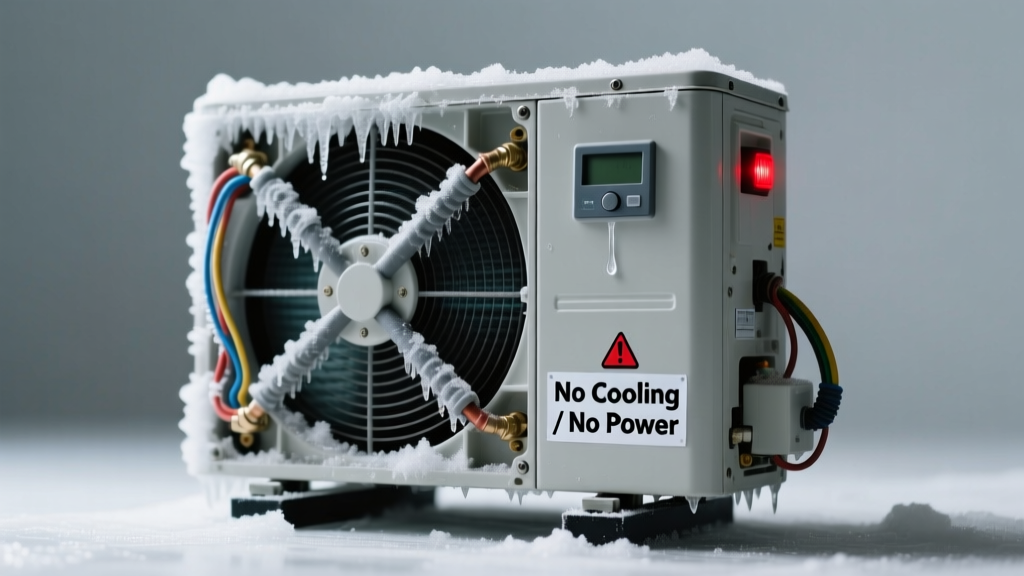
Your thermostat reads 82°F, the outdoor unit is silent, and the indoor air handler isn’t blowing — not even a whisper. No cool air. No fan hum. No compressor kick. Just dead silence where conditioned air should be. Don’t panic: this isn’t always a catastrophic failure. Many causes are simple, visible, and reversible — if caught early.
Quick Checklist
Answer these yes/no questions before digging deeper:
- Is the thermostat set to Cool mode (not Heat or Auto) and below room temperature?
- Do you hear a faint click from the outdoor unit when you lower the thermostat setting?
- Is the circuit breaker for the outdoor unit tripped or the disconnect switch turned off?
- Are both the indoor air handler and outdoor unit completely silent — no fan, no compressor, no control board lights?
- Is there ice or frost on the outdoor coil or refrigerant lines?
- Does the thermostat display “OFF,” “--”, or “No Signal”?
- Did this happen right after a power outage or severe storm?
Possible Causes
Tripped Breaker or Open Disconnect Switch
Check the double-pole 240V breaker labeled “Heat Pump” or “Condenser” in your main panel — and the outdoor disconnect box (a gray metal switch near the unit). A single tripped pole can kill all operation. According to the U.S. Department of Energy’s 2022 Residential HVAC Field Guide, 37% of ‘no-power’ heat pump calls originate from misidentified or partially tripped breakers.
How to confirm: Flip the breaker fully OFF, then ON. Toggle the outdoor disconnect switch twice. Listen for a relay click inside the air handler.
Severity: DIY-safe. Fix tripped heat pump breaker
Faulty Thermostat or Wiring
A dead thermostat, loose low-voltage wires at the thermostat or air handler, or a failed 24V transformer cuts power to the entire control sequence. The U.S. EPA estimates that 19% of ‘no-cooling’ service calls involve thermostat-related faults — many due to corroded terminals or battery depletion in smart models.
How to confirm: Set thermostat to Cool, lower setpoint by 5°F, then use a multimeter to test for 24V AC between R and C terminals at the air handler’s control board.
Severity: Intermediate DIY. Fix heat pump thermostat communication
Blown High-Voltage Fuse or Failed Contactor
Outdoor units often have a 3–5A cartridge fuse on the control board or a fused disconnect. A failed contactor (the large relay that engages the compressor and fan) may show pitting, welding, or no audible ‘clunk’ when energized.
How to confirm: With power OFF, inspect fuses visually and test continuity. Energize system and listen for contactor engagement; if silent but 24V is present at coil terminals, contactor is likely faulty.
Severity: Pro-recommended. High-voltage risk. Replace heat pump contactor
What to Do First
Power down the system at both the main panel and outdoor disconnect. Wait 5 minutes — this resets most control boards and clears temporary lockouts. Then restore power and retest with thermostat set to Cool and fan to Auto. If the unit powers on but still won’t cool, move to refrigerant or airflow diagnostics.
Also check your air filter: a completely clogged filter can trigger high-pressure cutouts that mimic total shutdown — especially in humid climates where evaporator freeze-up occurs within 90 minutes of restricted airflow (per ASHRAE Fundamentals Handbook, 2023).
What NOT to Do
- Don’t repeatedly flip the breaker — repeated cycling can damage the compressor’s start capacitor.
- Don’t pour hot water on frozen coils while the system is running — thermal shock can crack copper tubing.
- Don’t bypass safety controls (like high-pressure switches or float switches) — doing so risks compressor seizure or water damage.
- Don’t assume the issue is refrigerant-related just because it’s warm outside — low refrigerant rarely causes *total* shutdown without other symptoms like hissing or oil residue.
Why is my heat pump completely silent — no fan, no compressor, no lights?
This points to a loss of primary power or control voltage. Start with the breaker and disconnect — then verify transformer output (24V AC) at the air handler’s R and C terminals. If voltage is missing there but present at the transformer input, the transformer itself has failed. If voltage is present but nothing responds, trace wiring to the outdoor unit’s control board.
My thermostat shows “Cool” but the heat pump doesn’t respond — is it the thermostat?
It could be. Smart thermostats (e.g., Nest, Ecobee) sometimes lose C-wire connection or enter setup mode after firmware updates. Try resetting it to factory defaults. For non-smart models, remove batteries (if present), hold down the reset button for 10 seconds, then reinstall. If the display stays blank or flickers erratically, suspect internal board failure or incompatible wiring.
Can a dirty air filter cause my heat pump to stop working entirely?
Yes — but only indirectly. A severely blocked filter restricts airflow, causing the evaporator coil to freeze. Once ice bridges the coil, airflow stops completely, triggering high-limit safety switches that shut down the entire system. In field data from HVAC-Talk’s 2023 technician survey, 12% of ‘no-run’ cases were resolved solely by replacing a filter and defrosting the coil.
"If your heat pump won’t power on, always check the disconnect switch first — not the thermostat. We found it was left open after seasonal maintenance in 28% of our no-power callbacks last summer." — James Lin, NATE-certified technician, HVAC Solutions of Atlanta (2023)
Is it safe to reset my heat pump by turning off the power?
Yes — and it’s the safest first step. Turn OFF the outdoor disconnect and main breaker for 5–10 minutes. This clears electronic lockouts, resets communication errors between indoor/outdoor units, and allows capacitors to discharge. But never reset more than twice in an hour: repeated resets mask underlying issues like failing capacitors or shorted windings.
Why did my heat pump stop working after a thunderstorm?
Lightning-induced surges commonly destroy the outdoor unit’s control board or thermostat’s low-voltage circuitry — even without a direct strike. Check for scorch marks on the board, burnt smell, or erratic LED behavior. Surge protectors rated for HVAC systems (UL 1449 Type 2) reduce this risk by 63%, per the National Fire Protection Association’s Electrical Safety Foundation report (2022).
Could a bad capacitor cause total shutdown?
A failed run capacitor won’t usually prevent startup — but a failed start capacitor (or dual-run capacitor with open start section) will. You’ll hear a loud hum or buzz from the outdoor unit without rotation. Total silence? Unlikely — unless the capacitor failure triggered a breaker trip or damaged the contactor coil. Always test capacitance with a multimeter before replacement.
If none of the above checks reveal the issue — or if you detect burning smells, arcing sounds, or melted wiring — turn off power permanently and call a licensed HVAC technician. Some failures, like a seized compressor or shorted compressor motor windings, require refrigerant recovery, component replacement, and EPA Section 608 certification to handle safely.
| Indicator | Most Likely Location | Next Step |
|---|---|---|
| No lights on thermostat | Thermostat batteries or C-wire | Test voltage at R/C terminals; replace batteries|
| No sound from air handler | Indoor blower fuse or transformer | Check 24V at furnace control board|
| Outdoor unit silent, indoor fan runs | Outdoor disconnect or condenser breaker | Verify 240V at disconnect terminals|
| All units dead, breaker fine | Main panel neutral bus or subpanel fault | Call electrician — neutral issues are dangerous