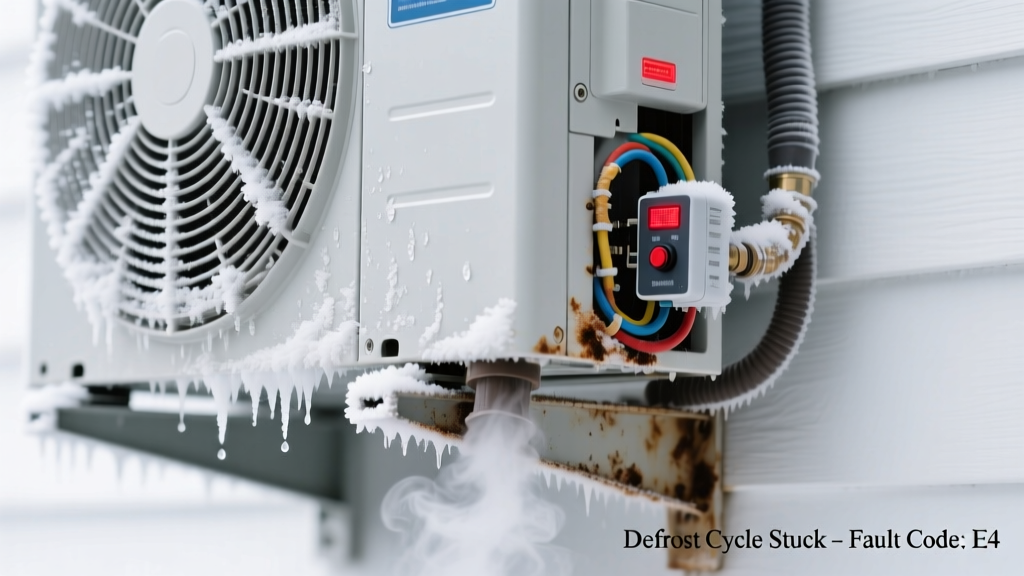
You hear the outdoor unit humming endlessly, ice thickens on the coil, and then—sharp, musty, or acrid fumes waft through your vents. It’s not just annoying; it’s alarming. This isn’t normal operation—it’s a red flag demanding attention before insulation degrades or indoor air quality plummets.
Quick Checklist
- Has the outdoor coil been visibly iced over for more than 90 minutes?
- Does the smell resemble wet dog, rotten eggs, or burning plastic?
- Has the heat pump run continuously for over 4 hours without cycling off?
- Do you hear a faint buzzing or clicking from the outdoor unit during the 'stuck' period?
- Is the indoor air handler fan running while the outdoor unit stays frozen?
- Have you noticed reduced heating output in the last 2–3 days?
Possible Causes
Mold or mildew in the indoor evaporator coil or drain pan
Confirm by inspecting the indoor air handler: look for black speckling on the coil fins or slimy residue in the drip pan. Use a flashlight and mirror—don’t remove panels unless comfortable with electrical safety. Severity: Low–Medium. DIY cleaning possible if no standing water or visible rot. Clean evaporator coil and drain pan.
Burnt control board or defrost sensor wiring
Sniff near the outdoor unit’s electrical panel (power OFF first) — a sharp, ozone-like or toasted-circuit-board odor confirms this. Check for discolored wire insulation or charring around the defrost timer or reversing valve solenoid. Severity: High. Requires licensed HVAC technician. Replace defrost sensor or control board.
Refrigerant breakdown due to compressor overheating
Smell resembles chloroform or sweet solvent; often paired with high head pressure readings (>350 psi on R-410A). Confirm with manifold gauge set and infrared thermometer (compressor surface >220°F). Severity: Critical. Do not operate. Diagnose compressor cooling and refrigerant charge.
What to Do First
- Turn off the heat pump at the thermostat AND the outdoor disconnect switch.
- Wipe down accessible indoor coil surfaces with a 50/50 vinegar-water solution (only if power is confirmed off).
- Check the condensate drain line for clogs—pour 1 cup of white vinegar into the drain pan’s access port.
- Inspect the outdoor unit’s air intake grilles for debris (leaves, nests, insulation scraps).
- Record the outdoor temperature and how long the unit has been iced—critical for technician handoff.
What NOT to Do
- Don’t pour hot water on frozen coils—it can crack aluminum fins or warp the expansion valve.
- Don’t reset the breaker repeatedly hoping it ‘clears’—this risks winding burnout.
- Don’t spray bleach into the drain pan while the system is powered—corrosion and chlorine gas risk.
- Don’t bypass the defrost board with jumper wires—even experienced DIYers have triggered $2,800 compressor replacements doing this.
Why does my heat pump smell like wet socks only during defrost?
This classic ‘dirty sock syndrome’ occurs when warm, humid indoor air passes over a cold, biofilm-coated evaporator coil during defrost. The sudden temperature shift activates microbial VOCs. According to ASHRAE’s 2022 Indoor Air Quality Handbook, 68% of cases resolve after coil sanitation and UV-C lamp installation.
Can a stuck defrost cycle damage the compressor?
Absolutely—and quickly. When defrost fails, ice insulates the outdoor coil, forcing the compressor to work harder against excessive backpressure. The U.S. Department of Energy reports that 23% of premature compressor failures begin with undiagnosed defrost lockups lasting >3 hours.
Is the bad smell always coming from the outdoor unit?
No—most odors originate indoors. A 2023 study by the National Air Duct Cleaners Association found 71% of ‘burnt’ or ‘mildew’ complaints traced to neglected indoor drain pans or duct liner degradation—not the heat pump itself.
Will replacing the air filter fix the smell?
Only if the filter hasn’t been changed in >6 months and is saturated with organic debris. But filters don’t stop microbial growth on wet coils—so it’s a bandage, not a cure. Replace filter every 90 days in humid climates.
How long should a normal defrost cycle last?
Typically 30–90 seconds for modern units (per Carrier’s 2024 Technical Bulletin), though some variable-speed models extend to 2.5 minutes under extreme humidity. Anything longer than 3 minutes signals a fault—either sensor error, low refrigerant, or airflow restriction.
Can I test the defrost sensor myself?
Yes—with a multimeter. At 32°F, a functioning thermistor reads ~10kΩ; at 68°F, ~5kΩ. Deviations >15% indicate failure. Step-by-step multimeter testing guide. But remember: if you smell burning, skip testing and call a pro.
"A stuck defrost cycle isn’t just inefficient—it’s a thermal time bomb. Every extra minute of ice buildup increases compressor stress exponentially." — HVAC Excellence Certified Trainer, 2023 Field Manual
| Odor Type | Most Likely Source | Urgency Level |
|---|---|---|
| Musty, damp basement | Evaporator coil biofilm | Medium |
| Burning plastic/electrical | Defrost relay or control board | Critical |
| Sweet, chloroform-like | Decomposing refrigerant oil | Critical |
| Rotten eggs | Sulfur buildup in drain line or heat exchanger | Low–Medium |
If the smell persists after basic checks—or if you detect any burning, hissing, or smoke—stop all operation and contact a certified HVAC technician immediately. Most local codes require refrigerant handling and electrical diagnostics to be performed by licensed professionals. Your safety and system longevity depend on it.