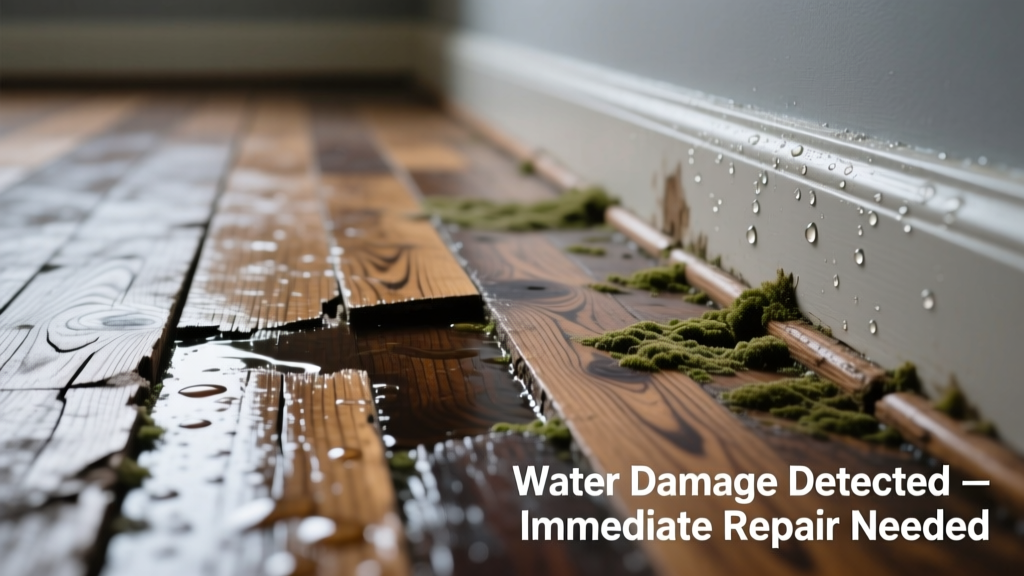
You walk into the living room and catch it—a sour, musty, sometimes sweet-rotten smell rising from beneath your oak flooring. It’s strongest near baseboards or in corners, worse after rain or high humidity. Don’t panic: this smell is a loud, urgent signal—not a death sentence for your floors.
Quick Checklist
Answer these yes/no questions to narrow the source:
- Did the smell appear within 48 hours of a known leak (e.g., dishwasher overflow, AC drain line failure)?
- Is the floor spongy, cupped, or discolored in the smelly area?
- Can you detect moisture with a non-invasive moisture meter reading above 15% in subfloor wood?
- Do you see dark staining or white efflorescence along seams or near walls?
- Does the odor intensify when you run the HVAC system—or after turning on a humidifier?
- Has the home had prior flooding, crawl space leaks, or persistent basement dampness?
Possible Causes
Mold Growth in Subfloor or Joist Cavity
Confirm by drilling a 1/8" inspection hole near the worst-smelling spot and inserting a borescope or smartphone camera—look for fuzzy green/black growth on underside of subfloor or joists. Moisture readings >19% in framing confirm active colonization. Severity: Call a pro. Mold behind flooring requires containment, air scrubbing, and certified remediation per IICRC S520 standards. How to remediate mold under hardwood.
Decaying Wood Due to Chronic Moisture Exposure
Tap the floor with a rubber mallet—if it sounds hollow *and* yields slightly, the subfloor may be soft or punky. Probe baseboard gaps with an awl: if it penetrates >1/4" into framing, decay is likely. Severity: Pro required. Structural compromise demands subfloor replacement and moisture-source correction. Replacing rotted subfloor under hardwood.
Trapped Standing Water Under Flooring
Remove one board near the perimeter and insert a shop vac hose—if water gurgles or drains out, you’ve confirmed pooling. Use a thermal camera to map cold spots indicating water saturation. Severity: Diy fix possible if caught early (<72 hrs) and no mold visible. How to extract water under hardwood.
What to Do First
Stop the moisture source immediately—even if it seems minor. Shut off supply valves for leaking appliances. Run dehumidifiers at 35–45% RH and fans aimed at baseboard gaps (not directly at floor surface). Document everything: take timestamped photos, log moisture meter readings every 12 hours, and note odor intensity on a 1–10 scale.
- Open windows only if outdoor dew point is <55°F (prevents condensation)
- Set HVAC to “fan only” mode to increase air exchange without adding humidity
- Place desiccant packs (like DampRid) inside toe-kick vents to absorb residual vapor
What NOT to Do
Sealing over the smell with polyurethane or wax traps moisture and accelerates decay. Sanding the floor without identifying the moisture source spreads mold spores into the air. Using bleach on hardwood surfaces doesn’t kill mold roots in subfloor—it only masks odor temporarily and damages wood fibers.
- Don’t cover affected areas with rugs—they insulate moisture and hide worsening conditions
- Don’t delay testing: According to the U.S. EPA, mold can begin growing within 24–48 hours of water exposure
- Don’t assume ‘just airing it out’ fixes it—the average hardwood floor assembly takes 6–10 weeks to dry naturally after saturation
Why does my hardwood floor smell like mildew even though it looks fine?
Surface appearance is misleading. Mold grows where moisture lingers—in the 3/4" gap between hardwood and subfloor, or inside joist cavities. A 2022 study in Journal of Building Engineering found 68% of homes with ‘visually intact’ hardwood reported microbial volatile organic compounds (MVOCs) detectable by smell before visible growth appeared.
Can pet urine cause a similar smell under hardwood floors?
Yes—but the odor profile differs. Urine smells sharp, ammoniacal, and often concentrates near entryways or pet beds. Water-damage mold smells earthy, damp, and pervasive. Confirm with a blacklight scan: urine fluoresces yellow-green; mold does not. Also, urine rarely causes cupping or discoloration unless repeated and uncleaned for months.
Will the smell go away if I just wait and let it dry?
Unlikely—and dangerous. Once microbial growth establishes, drying alone won’t eliminate MVOCs or spores.
“Odor persistence after drying is a red flag for embedded biofilm—surface cleaning won’t reach it,” says Dr. Lena Cho, indoor air quality researcher at UC Berkeley’s Center for Environmental Research, 2023.You’ll need targeted antimicrobial treatment or material removal.
How long until water-damaged hardwood must be replaced?
If moisture readings exceed 20% in solid oak for >7 days, irreversible fiber swelling and glue failure occur. Engineered hardwood tolerates slightly higher readings (up to 18%) but fails faster if core layers delaminate. Monitor daily: a drop of <0.5% per day indicates recovery; flatlining or rising means hidden water remains.
Can I test for mold myself without hiring someone?
You can use ERMI (Environmental Relative Moldiness Index) test kits ($120–$180), but they require lab analysis and don’t locate the source. A better first step: rent a FLIR ONE thermal camera ($249) to identify cold, wet zones behind walls or under floors. Pair with a pin-type moisture meter (e.g., Delmhorst BD-2100) for precise wood readings.
Is it safe to live in the house while fixing smelly water-damaged hardwood?
It depends on symptom severity. If occupants report headaches, nasal congestion, or new asthma symptoms—especially children or immunocompromised individuals—vacate during remediation. The CDC advises limiting exposure to moldy environments when visible growth covers >10 sq ft or air sampling shows Stachybotrys or Chaetomium above background levels.
That sour, stagnant odor isn’t just unpleasant—it’s your home’s distress call. Identifying the source early prevents structural loss, health risks, and costly replacements. Whether it’s a slow drip behind the fridge or a compromised crawl space barrier, acting now preserves both your floors and your indoor air quality. Start with the checklist, grab your moisture meter, and move deliberately—you’ve got this.