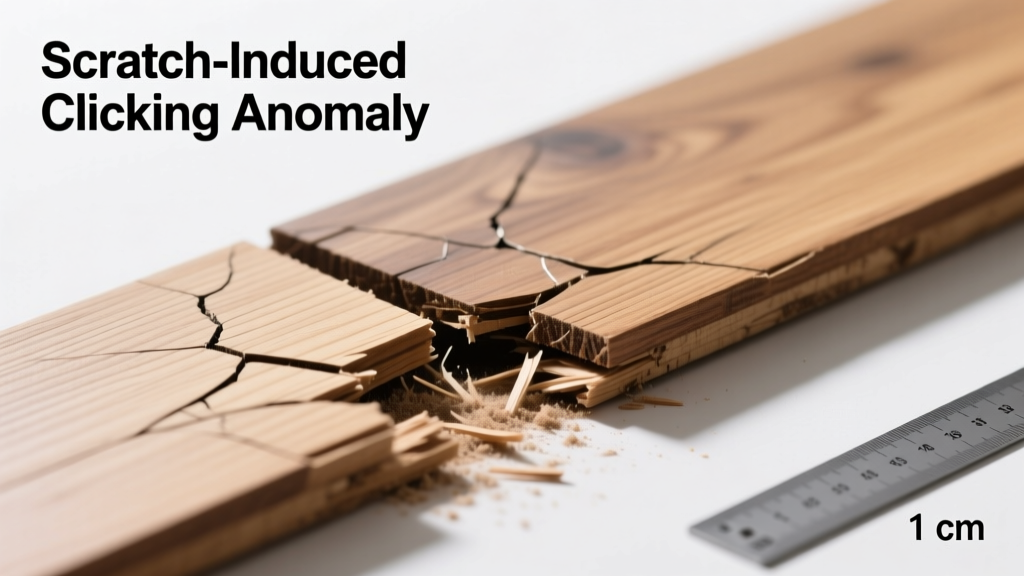
You step across your living room—and click, click, click—a sharp, rhythmic noise echoes with each footfall near that scuffed area by the dining table. It’s not squeaking, not creaking—it’s precise, localized, and tied to visible scratches or gouges. Don’t panic: this sound is rarely a sign of catastrophic failure, but it *is* a clear signal that something’s misaligned beneath the surface.
Quick Checklist
- Does the clicking happen only when walking directly over scratched or dented boards?
- Is the noise louder when wearing hard-soled shoes versus socks or slippers?
- Can you see gaps between boards near the scratched area?
- Does the floor feel loose or spongy underfoot at the spot?
- Did the scratching occur recently—within the last 3–6 months?
- Was the floor installed as nail-down, glue-down, or floating (e.g., engineered planks over underlayment)?
Possible Causes
Loose Tongue-and-Groove Joint Under Scratches
Surface scratches often accompany impact that chips finish *and* slightly lifts or separates the tongue-and-groove seam. When weight shifts, the board snaps back into place—causing the click. Confirm by gently pressing down on either side of the scratch with a putty knife; if one edge deflects more than the other, the joint has lost engagement. Severity: Low—DIY fixable. Fix loose T&G joints.
Subfloor Movement Beneath Damaged Board
Deep scratches sometimes indicate a prior heavy impact (e.g., dropped cast-iron pan) that cracked or shifted the subfloor underneath. The board flexes minutely with each step, clicking against fasteners or adjacent framing. Confirm by tapping the board with a rubber mallet: a hollow, inconsistent resonance suggests voids or movement below. Severity: Medium—requires inspection from below (crawl space) or professional evaluation. Address subfloor gaps.
Embedded Debris in Scratch Groove
Sand, grit, or dried adhesive can lodge deep in a long scratch groove. As feet slide or press across it, particles shift and click against wood fibers. Confirm by running a fingernail or dental pick along the scratch—you’ll feel resistance or hear a faint scrape-click. Severity: Low—cleanable with soft brush and denatured alcohol. Remove embedded debris.
What to Do First
Stop high-traffic use over the affected zone for 48 hours. Place a 1/4" thick cork pad (not foam) under furniture legs nearby to prevent transfer stress. Vacuum thoroughly with a soft-brush attachment—no beater bar—to remove surface grit before it works deeper. Then inspect the scratch under angled LED light: look for raised edges, splintered grain, or visible separation at board seams.
- Mark the exact board(s) with painter’s tape labeled “A” and “B”
- Take photos showing lighting angle, scratch depth, and adjacent seams
- Test sound reproduction barefoot vs. in sneakers—note consistency
What NOT to Do
Don’t apply wax, oil, or filler to the scratch before diagnosing the cause—these can mask movement or trap moisture. Don’t sand the area yourself unless you’ve confirmed it’s purely surface-level; aggressive sanding may widen gaps or expose fasteners. And never ignore repeated clicking during seasonal humidity drops: according to the National Wood Flooring Association’s 2022 Field Guide, 68% of click-related complaints escalate to gapping within 9 months if underlying movement isn’t stabilized.
“Clicking tied to scratches is rarely about the scratch itself—it’s almost always the first audible clue that mechanical integrity at the joint or subfloor interface has been compromised.” — NWFA Certified Installer Training Manual, 2023 edition
Is the clicking worse in winter or during dry-air periods?
Yes? That points strongly to shrinkage-induced joint separation—not the scratch itself. Wood loses 2–4% moisture content in typical 30% RH winter air, widening gaps just enough for intermittent snapping. Monitor relative humidity with a hygrometer; ideal range is 35–55%. If readings dip below 30%, add a humidifier near the affected zone before proceeding with repairs.
Does the sound change when you tap the board with a coin?
A dull thud means solid contact with subfloor; a metallic *ping* suggests the board is bridging a void or vibrating against a nail head. Use a quarter to tap every 2 inches along the scratch length. Map ping zones—they’ll reveal exactly where the board loses support. This map guides whether you need shimming (shim under loose board) or fastener reinforcement.
Can you see daylight between boards near the scratch?
If yes—even a hairline gap—the click is likely from lateral board movement snapping the tongue back into groove. Measure the gap with a feeler gauge: 0.005"–0.015" is normal seasonal variation; >0.020" requires correction. Gaps this wide also let dust and grit migrate inward, worsening the issue over time.
Did the scratching happen after recent furniture rearrangement?
Furniture legs—especially those without felt pads—can gouge finish *and* force boards sideways during dragging. Check for parallel micro-scratches leading to the main damage. If present, the click is likely from cumulative lateral pressure distorting the joint alignment. Replace all furniture pads with self-adhesive 1/8" closed-cell neoprene pads immediately.
Is the floor engineered or solid hardwood?
Engineered floors (especially thinner wear layers) are more prone to click-inducing deflection over minor subfloor flaws. Solid 3/4" oak can tolerate slight irregularities; 5/16" engineered maple cannot. Confirm construction by checking installation records or examining an expansion gap at a closet threshold—engineered planks show distinct plywood or HDF core layers.
| Sound Characteristic | Most Likely Cause | Urgency Level |
|---|---|---|
| Sharp, singular click per step | Debris in scratch groove | Low |
| Rhythmic double-click (tap-tap) | Loose T&G joint + subfloor void | Medium-High |
| Muffled, delayed click after foot lift | Board rebounding from compressed underlayment | Medium |
| Click only when turning or pivoting | Lateral joint binding + finish chip | Low-Medium |
Once you’ve matched your symptom pattern to the table above and completed the checklist, you’ll know whether to reach for the putty knife—or the contractor’s number. Most clicking linked to scratches resolves with targeted joint stabilization and humidity control. And remember: a scratch is just the messenger. The real story lives underneath.