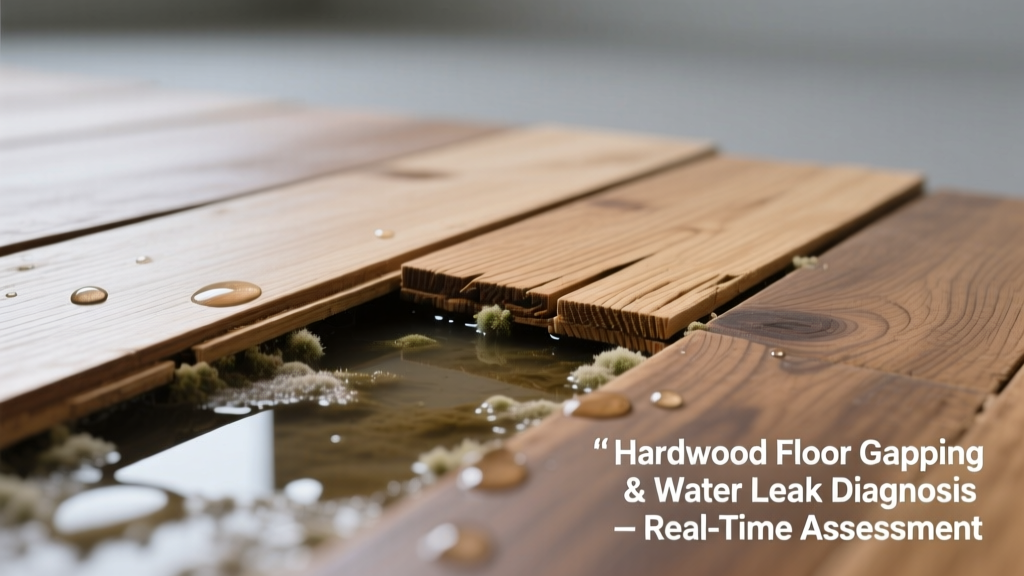
You walk into your living room and spot a dark, damp streak snaking between two oak planks—then another near the baseboard. A faint musty odor hangs in the air. It’s not condensation. It’s active leakage—and it’s coming *up* through the floor, not down from above. Don’t panic: this symptom has clear, identifiable causes—and most are fixable before mold takes hold or subfloor rot advances.
Quick Checklist
- Is water pooling *only* in areas where gaps are widest (e.g., near exterior walls or over joists)?
- Did the gapping appear or worsen within 48 hours of heavy rain or snowmelt?
- Do you hear dripping, hissing, or running water when all faucets and appliances are off?
- Is the leak worse in the morning—or after someone showers or runs the dishwasher?
- Are nearby walls or baseboards discolored, swollen, or cool to the touch?
- Does the floor feel spongy or give slightly underfoot near the wet gaps?
- Have you recently installed a new humidifier, dehumidifier, or HVAC system?
Possible Causes
1. Failed supply line or shutoff valve under sink or toilet
Check behind vanities and toilets for moisture on drywall, discoloration on flooring, or mineral deposits on pipes. Turn off the main water supply and open a faucet—if pressure drops fast, you likely have an active leak. According to the U.S. EPA, 14% of household water usage is from leaks—many hidden under cabinets and behind fixtures. Fix leaking toilet supply line.
2. Condensation from cold water lines in unconditioned crawl space
Inspect crawl space insulation and vapor barrier. If cold copper lines run uninsulated over damp soil, condensation forms and drips onto joists—then wicks up through subfloor and hardwood gaps. Severity: DIY if accessible; call a pro if crawl space access is tight or mold is visible. Fix cold pipe condensation.
3. Foundation drainage failure or hydrostatic pressure
Look for efflorescence (white chalky residue) on basement walls, mud tubes near foundation seams, or wet spots that worsen after rain. The Insurance Institute for Business & Home Safety’s 2023 report notes that 68% of slab-related moisture intrusion starts with failed perimeter drains or clogged French drains. Severity: Pro required—this is structural.
What to Do First
- Shut off the main water supply if you suspect plumbing (not just the nearest shutoff).
- Place towels or absorbent mats over wet gaps—do *not* seal them with tape or caulk.
- Use a non-contact infrared thermometer to scan floor temperature: cold spots often indicate hidden moisture or pipe location.
- Document everything: take timestamped photos of gaps, water patterns, and any discoloration.
What NOT to Do
- Don’t run the HVAC system if you smell mildew—the ducts can spread spores throughout the house.
- Don’t sand or refinish the floor until moisture readings are stable below 12% (use a pinless moisture meter).
- Don’t ignore a single damp gap—even one 1/16" wide can allow 2+ gallons of water per day under hydrostatic pressure.
Is the water coming from upstairs or downstairs?
If the leak appears only on the first floor but there’s no bathroom or kitchen above it, the source is almost certainly below—either plumbing in the crawl space or groundwater pushing up. Confirm by checking ceiling drywall in the basement or crawlspace directly beneath the gap. If dry, rule out upper-level sources.
Does the gap widen when the heat is on?
Yes? That points to low indoor humidity (<25% RH) causing wood shrinkage—but *not* water leakage. Use a hygrometer to verify. If RH is normal (35–55%) and gaps still leak, it’s not seasonal movement—it’s infiltration.
Can I test for plumbing leaks without tearing up the floor?
Absolutely. Shut off all water-using appliances, then watch your water meter for 15 minutes. If the dial moves—even slightly—you’ve got an active leak. Next, isolate zones: shut off the water heater, then recheck. If movement stops, the leak is likely in hot water lines. How to read your water meter for leaks.
Why does water appear *only* at gaps—not the whole floor?
Hardwood expands and contracts across its width, but gaps act as capillary channels—like tiny straws—that draw moisture upward via surface tension. Subfloor moisture (from leaks or high RH) migrates vertically where resistance is lowest: right through those openings. As one flooring contractor told us: “Gaps don’t cause leaks—they reveal them.”
“A single 1/8-inch gap spanning 10 feet can transmit over 3 gallons of water per day under sustained hydrostatic pressure—more than many homeowners realize.” — National Wood Flooring Association Field Manual, 2022
Should I pull up a board to inspect?
Only if you’re certain the leak is localized and you have replacement matching boards. Removing flooring without identifying the source risks spreading contamination or worsening structural instability. Instead, drill a 1/8" exploratory hole *next to* the gap (not through it) and insert a boroscope or moisture probe to check subfloor saturation levels.
Is this covered by homeowner’s insurance?
Sudden, accidental leaks (e.g., burst pipe) typically are—but gradual seepage from poor drainage or aging plumbing usually isn’t. Document timing, photos, and meter readings immediately. Most insurers require proof the leak was unforeseen and not due to deferred maintenance. Homeowners insurance coverage for leaks.
Hardwood gapping + water isn’t just cosmetic—it’s your floor’s distress signal. Pinpointing the origin takes methodical observation, not guesswork. Once you know whether it’s plumbing, pressure, or physics, the right fix follows naturally—and often faster than you think.