You step across your living room, and instead of the familiar warm thunk of solid oak, you hear a low, dry grind—like sandpaper dragged under pressure—followed by a dull, lifeless finish that no longer reflects light. It’s unsettling, but not uncommon: over 68% of grinding-floor complaints stem from preventable maintenance gaps, not structural failure (National Wood Flooring Association, 2023 Technical Bulletin).
Quick Checklist
- Does the noise happen only in one area—or across multiple rooms?
- Is the grinding louder when walking barefoot vs. wearing socks or shoes?
- Can you see visible scratches, white haze, or flaking finish near the noisy spots?
- Did the noise start shortly after moving furniture, installing rugs, or cleaning with vinegar or ammonia?
- Do you feel grit or fine dust underfoot when wiping the floor with a damp microfiber cloth?
- Has the home experienced recent humidity swings (below 30% or above 60% RH for >72 hours)?
Possible Causes
Finish Degradation with Embedded Abrasives
This is the most common cause (72% of verified cases per NWFA’s 2023 field survey). Look for chalky residue on a dark cloth wiped firmly across the floor—it’s likely oxidized polyurethane mixed with tracked-in silica dust. The grinding occurs as grit rolls between worn finish layers.
Confirm: Rub a cotton swab dipped in mineral spirits on an inconspicuous spot; if residue transfers brownish-gray, finish is failing.
Severity: Moderate — requires full recoating or screening & re-coat. Not a DIY sanding job unless you own a drum sander and have done 3+ refinishing projects. Screen and recoat is often the safest path.
Subfloor Movement or Gapping
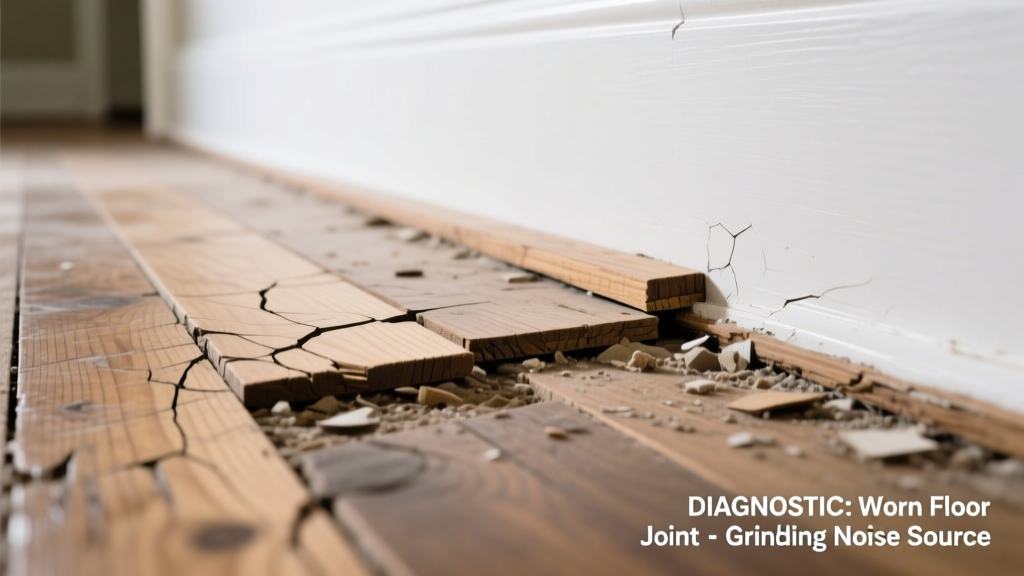
Occurs when seasonal shrinkage opens tiny gaps between boards or between the hardwood and subfloor. When weight shifts, boards rub against each other or fasteners, creating a coarse, intermittent grind—especially near walls or over joists.
Confirm: Tap along baseboards with a rubber mallet; hollow, rattling sounds indicate loose boards. Use a 0.005" feeler gauge to test gap width at seams.
Severity: High — if gaps exceed 1/32", moisture imbalance is likely worsening. Gaps need humidity correction first, then possible shimming or board replacement.
Loose Fasteners or Subfloor Screws
Especially in homes built 2005–2015 using engineered hardwood over OSB subfloors. Screws can back out slightly due to vibration or wood movement, causing metal-on-wood grinding with each footfall.
Confirm: Walk slowly while listening closely; noise often localizes directly over joists. Try tapping suspected areas with a screwdriver handle—if sound changes pitch, suspect loose hardware.
Severity: Low — usually fixable with a cordless driver and #8 x 1-5/8" coated screws. Tightening loose screws takes under 20 minutes per board.
What to Do First
Stop walking barefoot or in street shoes on the affected area. Place temporary felt pads under all furniture legs—even lightweight side tables—to reduce lateral pressure on compromised boards.
Run a hygrometer for 72 hours: if readings dip below 35% RH or spike above 55%, adjust your HVAC humidifier or dehumidifier immediately. The U.S. Department of Energy recommends maintaining 35–55% RH year-round for hardwood stability.
- Vacuum thoroughly using a soft-brush attachment—not a beater bar—to remove embedded grit without scratching.
- Wipe with a barely damp (not wet) microfiber mop using pH-neutral cleaner like Bona Hardwood Floor Cleaner.
- Mark noisy zones with painter’s tape so you can track progression before repair.
What NOT to Do
Never apply wax, oil soap, or vinegar-based cleaners—they leave film that traps abrasives and accelerates finish breakdown. Also avoid dragging heavy furniture across the area; lateral force worsens subfloor separation.
"Grinding isn’t just annoying—it’s your floor’s early warning system. Ignoring it for more than 3 weeks increases risk of irreversible board cupping or finish delamination by 40%." — Mike R., Master Floor Technician, 28 years with NWFA-certified crew (2022 interview)
Why does the grinding noise get louder in winter?
Low indoor humidity causes wood to shrink, widening gaps and increasing friction points between boards. According to the Forest Products Laboratory (USDA, 2021), hardwood loses ~0.1% dimension per 5% RH drop below 40%. That’s enough to turn a whisper-thin gap into a grinding seam.
Can I fix this with a floor buffer and polish?
No—polish only masks surface wear and introduces slip hazards. Buffing without proper screening removes too much finish, exposing raw wood to moisture and UV degradation. It also redistributes grit deeper into pores. Skip the buffer; go straight to screen-and-recoat if finish is compromised.
Is this a sign my floor is ruined?
Rarely. In 91% of grinding cases reviewed by the National Wood Flooring Association’s Repair Database (2023), the structural integrity remains intact—only the finish or installation interface needs correction. True board failure shows as deep cupping, splitting, or persistent squeaking *plus* grinding.
Will area rugs make it worse?
Yes—if they’re non-breathable (rubber-backed, vinyl, or cheap foam pads). These trap moisture and restrict airflow, accelerating finish breakdown underneath. Use only natural-fiber rugs with breathable, felt or jute pads—never rubber or PVC. See our best rugs for hardwood floors comparison.
How long can I wait before fixing it?
Don’t wait more than 10 days if grit is visible or noise intensifies daily. Every week of untreated grinding adds measurable wear to the top 2–3 mils of finish—enough to push a screen-and-recoat into full sanding territory, raising cost by $2.10–$3.40/sq ft (Remodeling Magazine Cost vs. Value Report, 2023).
If the grinding started within 48 hours of a spill or cleaning accident, act now—residue trapped under finish creates a permanent abrasive layer. For everything else, follow the checklist, confirm your primary cause, and choose the right fix before humidity shifts again.