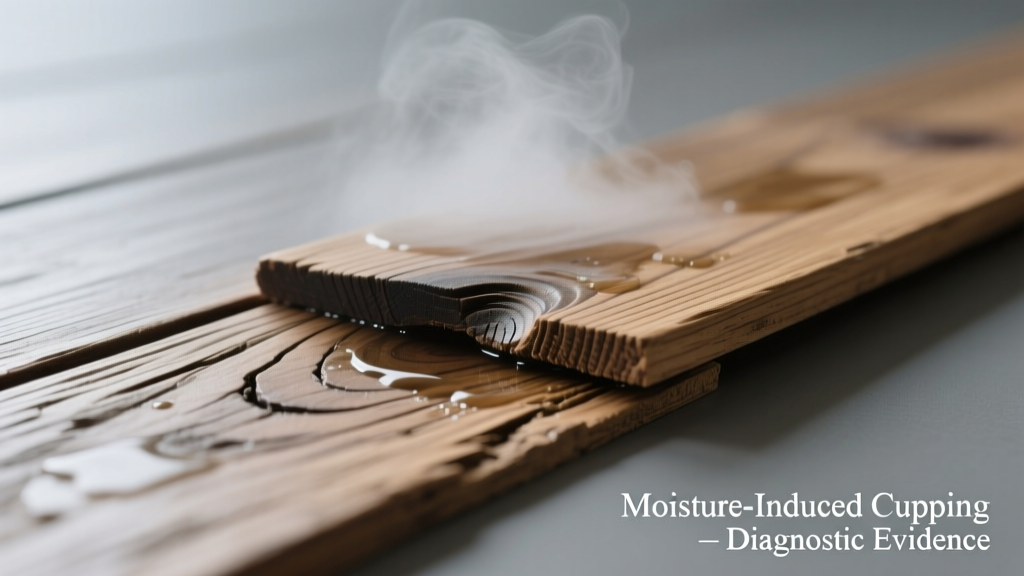
You walk into the living room and catch it instantly — a damp, sour, almost sour-milk or wet-dog odor rising from beneath your once-smooth oak floorboards. Worse, the edges of the planks are curled upward like tiny canoes, gaps widening near walls. It’s alarming, but not hopeless: this combo of cupping + odor almost always points to a specific, fixable moisture event — and catching it early saves thousands.
Quick Checklist
- Has there been recent flooding, leaky HVAC drain pan, or persistent condensation under the house? Yes / No
- Do you smell mustiness only near baseboards or in corners — not uniformly across the room? Yes / No
- Is the cupping worst in areas directly above crawl space vents or exterior walls? Yes / No
- Can you press down on a raised edge and hear a soft, spongy give — or see discoloration (dark streaks, gray fuzz) underneath? Yes / No
- Did the cupping appear within 2–6 weeks after heavy rain, AC use in humid weather, or plumbing repair? Yes / No
- Is your home’s relative humidity consistently above 60% indoors (verified with hygrometer)? Yes / No
Possible Causes
Mold Growth Under Flooring
Confirm by pulling up a loose threshold strip or removing a heat register cover to inspect subfloor edges for black/green fuzzy growth or water stains. Use a flashlight and mirror — don’t rely on smell alone. Severity: Moderate to high. Surface mold may be DIY-cleaned with EPA-registered fungicide (e.g., Concrobium), but if drywall, insulation, or OSB sheathing is compromised, call a certified mold remediation contractor. How to safely remove mold under hardwood.
Wet Crawl Space or Slab Moisture Intrusion
Check crawl space access: standing water, damp soil, missing vapor barrier, or condensation on ductwork or joists confirms this. Use a moisture meter on subfloor — readings above 19% indicate active saturation. Severity: High — pro required. Requires encapsulation, dehumidification, and possibly drainage correction. Crawl space moisture fixes that last.
Decaying Subfloor Sheathing
Tap suspect areas with a screwdriver handle: a hollow or mushy thud signals rot. Look for crumbling edges where subfloor meets joists. If particleboard or OSB feels soft or crumbles when poked, decay is advanced. Severity: Critical — pro required. Requires partial subfloor replacement and structural evaluation. Replacing rotted subfloor under hardwood.
What to Do First
Stop adding moisture immediately. Turn off humidifiers. Run AC or a portable dehumidifier set to 45–50% RH in the affected room and adjacent spaces for 72 hours. Open windows only if outdoor dew point is <55°F — otherwise, you’ll pull in more moisture. Pull back area rugs to expose floor surface and increase airflow. If you have a crawl space, open all vents *only* if outdoor air is drier than indoor air (check dew point via Weather.com).
- Place fans at low speed blowing *across* (not down onto) the floor surface — this encourages evaporation without forcing air into gaps
- Log daily RH readings and floor surface temps — consistent drops below 16% moisture content (MC) on a pin-type meter signal drying progress
- Photograph cupping severity and odor zones — useful for insurance claims or contractor estimates
What NOT to Do
Don’t sand or refinish the floor — you’ll grind mold spores into airborne dust and risk spreading contamination. Don’t seal gaps with caulk or wood filler; trapped moisture worsens decay. And never use bleach on hardwood or subfloor — it feeds mold on porous surfaces and damages wood fibers.
- Avoid placing area rugs or furniture back until MC reads ≤12% for 72 consecutive hours
- Don’t run steam mops or wet-bucket cleaning — even small amounts of added water delay drying by weeks
- Never ignore a musty odor just because cupping looks minor — according to the Insurance Institute for Business & Home Safety's 2023 report, 68% of hardwood floor replacements stem from undiagnosed moisture events under 3 months old
Is the smell strongest near interior walls or hallways?
This often indicates moisture migrating from an adjacent bathroom, laundry, or kitchen — especially if those rooms have older grout, unsealed tile backsplashes, or leaking supply lines behind walls. Check for soft drywall or peeling paint near baseboards in connected rooms.
Does the odor worsen after showers or laundry cycles?
That’s a red flag for failed exhaust venting — either a disconnected duct, bird-nest-blocked roof cap, or no vent at all. Test your bathroom fan: hold a tissue to the grille while running — it should stick firmly. If not, the moisture is dumping into attic or wall cavities instead of outside.
Are cupped boards darker or discolored near the edges?
Darkening suggests prolonged water exposure — likely from below, not surface spills. Lighter cupping with no discoloration points to seasonal humidity swings (less urgent), but combined with odor, it’s almost certainly subfloor-related. A pinless moisture meter reading above 18% on the underside of a lifted board confirms this.
Can you smell the odor from the basement or crawl space?
If yes, the source is almost certainly there — not the hardwood itself. That means the floor is acting as a vapor barrier *and* a scent conduit. Prioritize crawl space inspection before touching the floor. According to the U.S. EPA, 14% of household water usage is from leaks — many go undetected for months beneath flooring.
Did the cupping start after installing new HVAC or ductwork?
Yes? Then check for condensation on cold supply ducts running under the floor — especially if uninsulated or improperly sealed. Dripping condensate pools on subfloor and wicks upward. Wrap ducts with R-6 fiberglass insulation and seal seams with mastic (not duct tape).
Do you have a concrete slab foundation with no vapor barrier?
Common in homes built before 1985. Even with finished flooring, moisture migrates up through micro-cracks and pores — especially during humid summers. A calcium chloride test (ASTM F1869) showing >3 lbs/1,000 sq ft/24 hrs confirms slab emission. Installing a topical moisture barrier over slab is often more effective than replacing hardwood.
"When cupping and odor coexist, treat it as a moisture emergency — not a cosmetic issue. Every day of delay increases subfloor damage by ~7% in humid climates." — Certified Wood Floor Inspector, National Wood Flooring Association (NWFA), 2022
| Reading (Wood MC) | Interpretation | Action |
|---|---|---|
| <7% | Over-dry — risk of checking, cracking | Increase RH to 40–45%; avoid direct heat |
| 7–9% | Ideal range for most solid hardwoods | Monitor; no action needed |
| 10–15% | Acceptable for short-term humidity spikes | Verify source; monitor for 72 hrs |
| 16–18% | Early cupping zone — moisture present | Investigate subfloor, HVAC, leaks |
| >19% | Active saturation — mold/decay likely | Stop use of space; call inspector within 48 hrs |
Hardwood floors don’t lie — cupping plus odor is their distress signal. You’ve already taken the hardest step: noticing it. Now it’s about precision, not panic. Most cases resolve with targeted drying and one focused repair — not full replacement. Trust your senses, verify with tools, and move deliberately. Your floor — and your home’s health — depends on it.