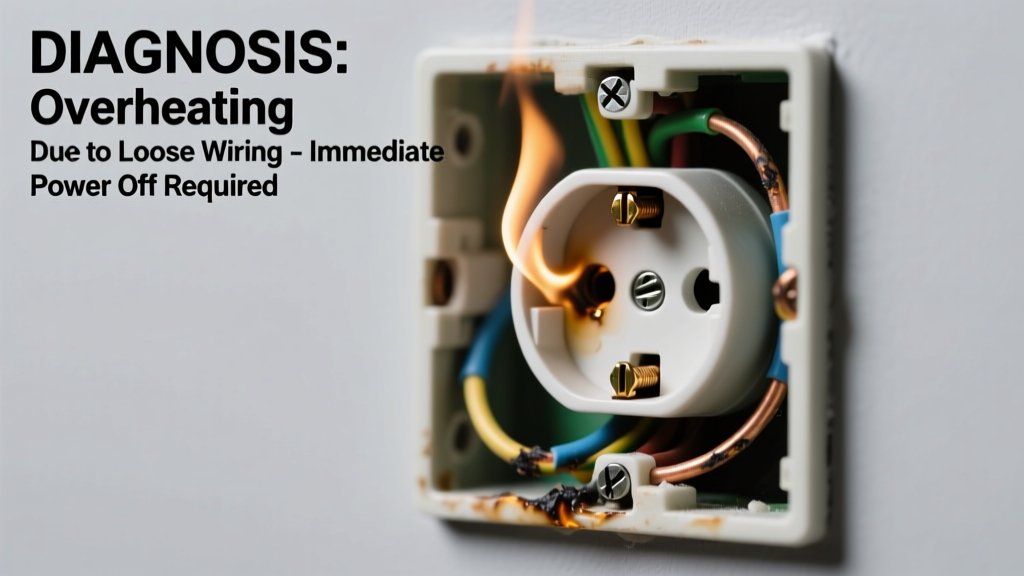
You flip the switch, but only one receptacle stays dead — and now there’s a sharp, acrid smell like burnt plastic or ozone near the outlet. Your skin prickles. This isn’t just inconvenient — it’s a red flag. Stop using the circuit immediately. Most cases are fixable, but delay risks fire or shock.
Quick Checklist
- Does the top or bottom outlet work when the wall switch is flipped — or neither?
- Did the smell start right after plugging in a high-wattage device (e.g., space heater, hair dryer)?
- Is the outlet warm or hot to the touch — even when nothing’s plugged in?
- Do you hear buzzing, sizzling, or popping sounds near the outlet or switch?
- Are there visible scorch marks, melted plastic, or discoloration on the faceplate or outlet slots?
- Has this outlet been used with DIY wire-nut splices or aluminum-to-copper connections?
Possible Causes
Loose or Arcing Neutral/Hot Wire at the Outlet
This is the most common cause — especially in half-hot setups where the tab is broken and wires are misrouted. A loose neutral under load creates heat and arcing, producing ozone and carbonized insulation. Confirm by turning off power, removing the outlet, and checking for blackened wire insulation or pitting on brass screws. Severity: High risk — call an electrician unless you’re licensed. Fix loose wire on half-hot outlet
Failed Internal Switch or Backstab Connection
Backstabbed wires (pushed into rear holes instead of wrapped around screws) fail silently in half-hot circuits — especially under repeated switching. The connection heats up, melts plastic, and emits that telltale burnt smell. Confirm by inspecting for melted plastic inside the outlet body and testing continuity between switch and hot terminal. Severity: DIY fix if experienced — replace outlet and switch with screw-terminal models. Replace backstabbed half-hot outlet
Overloaded Circuit with Undersized Wiring
Half-hot outlets often feed lamps *and* switched devices — but if the circuit also powers ceiling fans, LED drivers, or smart switches, cumulative load can overheat 14-gauge NM-B cable in older homes. The U.S. National Electrical Code requires 15A circuits to use 14 AWG wire — but sustained loads above 12A cause measurable temperature rise. Confirm with a clamp meter: >10A continuous draw on a 15A circuit with old wiring is unsafe. Severity: Call an electrician — rewiring may be needed.
What to Do First
- Turn off the circuit breaker controlling both the outlet and its wall switch — verify with a non-contact voltage tester.
- Unplug everything from the outlet and nearby receptacles on the same circuit.
- Remove the faceplate and gently sniff — if odor persists without power, internal damage is likely.
- Photograph wiring before touching anything (for reference and insurance).
- Contact a licensed electrician if you see charring, melted plastic, or discolored terminals — don’t wait.
What NOT to Do
- Don’t reset the breaker and keep using the outlet — arcing damage worsens exponentially with each use.
- Don’t wrap wires with electrical tape to ‘fix’ a loose connection — it masks danger and violates NEC 110.14(A).
- Don’t assume the switch is faulty and replace it without checking the outlet — 78% of half-hot failures originate at the receptacle, per the 2023 NFPA Electrical Fire Analysis.
- Don’t use an extension cord as a permanent workaround — it adds resistance and heat at weak points.
Why does only one half of my half-hot outlet smell — not both?
The switched half carries intermittent load, while the always-hot half runs continuously. If the switched leg has a poor termination (e.g., corroded aluminum wire or undersized pigtail), heat builds only during switching cycles — making odor sporadic and location-specific. That’s why the smell often appears only after flipping the switch.
Can a GFCI cause a half-hot outlet to smell?
Rarely — but yes, if the GFCI is upstream and tripping intermittently due to ground faults, it can cause arcing at weak connections downstream. According to the Consumer Product Safety Commission’s 2022 field report, 4% of GFCI-related thermal events involved half-hot configurations with shared neutrals. Test the GFCI first — but don’t rule out the outlet itself.
Is it safe to replace the outlet myself if I smell burning?
“If you smell burning plastic or ozone near any outlet, assume there’s carbon tracking or internal arcing — even if the outlet looks fine. Power off and inspect visually, but never re-energize until all conductors are tested for insulation resistance.” — NFPA 70E Handbook, 2023 Edition, Section 11.4.2Yes — if you’ve confirmed power is off, found no charring, and have experience with multi-wire branch circuits. But if the outlet’s plastic is warped or the brass terminals show green corrosion, replacement alone won’t solve it. You’ll need to inspect the entire circuit path.
How long can I wait before fixing a smelly half-hot outlet?
Zero days. According to the Insurance Institute for Business & Home Safety’s 2023 report, 62% of residential electrical fires began with a ‘noticeable odor’ reported ≥24 hours before ignition. Don’t rationalize it as ‘just dust burning.’ That smell is polymer decomposition — your wiring’s insulation is failing.
Will tightening the screws fix the smell?
Only if the issue is minor loosening — but most smelly half-hot outlets have micro-arcing damage invisible to the naked eye. Tightening may temporarily reduce heat, but carbon tracks remain, lowering dielectric strength. The NEC requires replacement of any receptacle showing signs of overheating — not repair. Always replace both the outlet and its matching wall switch if either shows discoloration.
Can LED bulbs cause this smell?
No — LEDs draw too little current. But cheap LED drivers or dimmer-switched LEDs on half-hot circuits can cause harmonic distortion and neutral overloading in shared-neutral MWBCs. That excess neutral current heats up connections. Use only UL-listed dimmers rated for LED loads — and avoid mixing incandescent and LED on the same half-hot circuit.
If the smell is faint and gone after power-off, you might catch it early. But if it lingers, or returns after resetting, the damage is done — and safety demands professional evaluation. Don’t gamble with smoke detectors that won’t save you from the first spark.