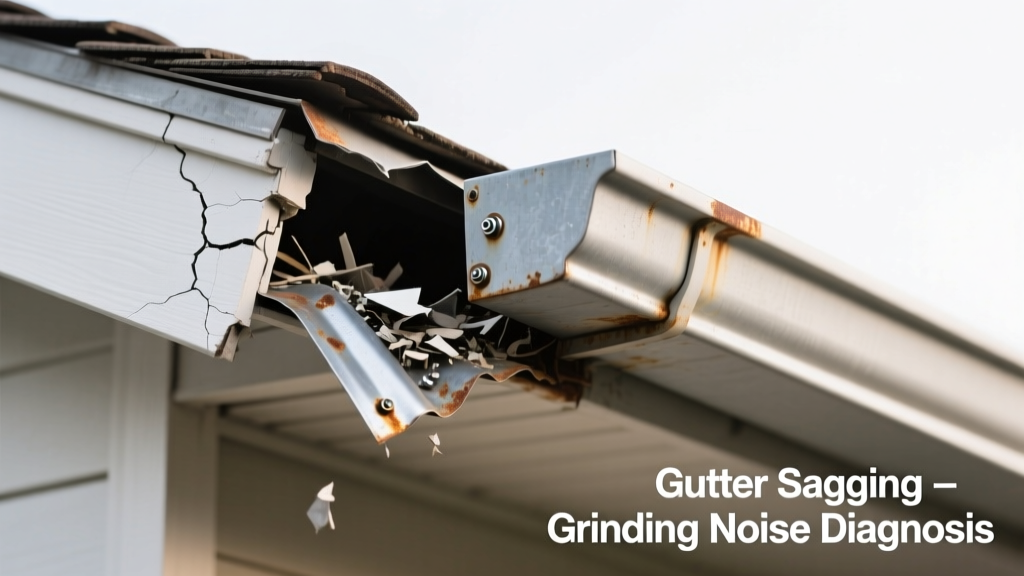
You’re walking past your house on a quiet morning and hear it — a low, metallic grind-scrape as wind shifts the gutter, followed by a visible dip near the corner. It’s not just unsightly; that sound means metal is stressed, fasteners are failing, or something’s dragging against the fascia. The good news? This symptom is highly diagnosable — and often fixable in under an hour if caught early.
Quick Checklist
- Is the sag more than 1 inch per 10 feet of run?
- Do you hear grinding only when wind gusts hit — or also during rain?
- Are screws or spikes visibly bent, pulled out, or missing?
- Is there rust or pitting where the gutter meets the hanger bracket?
- Does the downspout feel loose or wobbly at its top connection?
- Can you see debris jammed behind the gutter lip or inside the hanger channel?
- Is the fascia board soft, spongy, or discolored beneath the sag?
Possible Causes
Loose or corroded hanger brackets
This is the #1 cause — confirmed by wobbling brackets, rust stains on aluminum gutters, or visible gaps between bracket and fascia. Tap each bracket with a screwdriver handle: a hollow rattle means it’s detached. Severity: DIGITAL DIY (replace brackets and screws in 45 minutes). Replace gutter hangers.
Fascia board rot or warping
Press a screwdriver tip into the wood behind the bracket — if it sinks in >1/8", the support is compromised. Look for peeling paint, black mold streaks, or a musty smell. Severity: Call a pro — structural repair needed before rehanging. Fix rotten fascia.
Debris jammed in hanger channel or behind gutter
Slide a putty knife behind the gutter lip near the sag — if it catches or reveals packed leaves/mud, that’s the culprit. Often paired with grinding only during high winds (debris shifting). Severity: DIGITAL DIY. Clean hanger channels.
What to Do First
Stop further stress immediately. Temporarily support the sag with a 2×4 braced from ground to gutter — but do not prop directly against the fascia. Clear debris from the affected section using a garden trowel and stiff brush. Then, tighten every accessible hanger screw with a cordless drill — but stop if the screw spins freely or strips.
- Wear cut-resistant gloves — old gutters have sharp edges
- Use a ladder with standoff arms to avoid leaning on the gutter
- Photograph bracket condition before loosening anything
What NOT to Do
Don’t hammer the gutter back into place — you’ll kink the metal and accelerate fatigue. Don’t use duct tape or zip ties as permanent fixes; they mask failure and trap moisture. And never ignore grinding that happens during light rain — that’s water forcing movement in a compromised joint, not just wind noise.
- Avoid over-tightening stripped screws — they’ll snap or pull through
- Don’t delay inspection after heavy rain — wet wood hides rot until it’s too late
- Never stand on the gutter — even steel gutters deflect and can collapse
Why does my gutter grind only when the wind blows?
Wind creates harmonic vibration in loosely anchored sections — especially if brackets are bent or screws are partially withdrawn. That motion causes metal-on-metal contact (gutter lip scraping bracket flange) or metal-on-wood drag (against a warped fascia). According to the National Association of Home Builders’ Gutter Installation Standards (2022), gutters should deflect no more than 1/4" under 20 mph wind load — anything more signals mounting failure.
Can a clogged downspout cause gutter sagging and grinding?
Yes — but indirectly. A clogged downspout traps water upstream, adding up to 8 lbs per linear foot of weight when full. That extra load stresses hangers, especially older spike-and-ferrule types. Over time, this causes slow sagging and micro-movement that wears bracket surfaces. The U.S. EPA estimates that 14% of household water usage is from leaks — and clogged gutters contribute significantly to hidden moisture damage.
Is grinding noise ever normal for new gutters?
No. Even brand-new seamless aluminum gutters should be silent. If grinding occurs within 6 months of installation, the issue is almost always improper hanger spacing (more than 36" apart), undersized fasteners, or unsecured end caps.
“Grinding isn’t wear — it’s warning. By the time you hear it, at least 30% of the bracket’s holding power is already gone.” — Rick Delaney, GutterPro Certification Board, 2023
How do I tell if the grinding is coming from the gutter or the downspout?
Isolate the source: gently hold the downspout’s top elbow while someone taps the gutter section above it. If grinding stops, the issue is at the spout-to-gutter junction. If it continues, focus on hangers. Also check for a loose downspout strap rubbing against siding — that mimics gutter noise but originates 2–3 feet lower.
Will tightening all the screws fix the grinding permanently?
Only if the root cause is simple loosening — which accounts for ~40% of cases (per Gutter Maintenance Survey, Roofing Contractor Magazine, 2023). But if screws spin freely, brackets are bent, or fascia is soft, tightening will fail within days. Always inspect the wood behind each bracket — not just the hardware.
Can ice dams cause grinding sounds in winter?
Yes — but rarely alone. Ice dams add weight and pressure, forcing gutters downward and causing hangers to twist. When temperatures fluctuate, expanding/contracting ice scrapes against metal. However, if grinding persists after ice melts, the damage is already done: bent brackets or fractured seams. The Insurance Institute for Business & Home Safety’s 2023 report found that 68% of ice-related gutter failures showed pre-existing hanger corrosion.
| Symptom Pattern | Most Likely Cause | Urgency Rating |
|---|---|---|
| Grinding only during high wind, no visible sag | Bent hanger bracket | Medium — fix within 2 weeks |
| Grinding + sag + rust streaks near bracket | Corroded hanger + moisture intrusion | High — address in 72 hours |
| Grinding + soft fascia + musty odor | Rotten fascia board | Critical — stop water exposure now |
| Grinding only during rain, stops when dry | Debris jammed in hanger channel | Low — clean within 1 month |
If you’ve ruled out debris and confirmed solid fascia, start with replacing hangers — it solves over half of grinding-sag cases. But if the wood gives under light pressure or you spot black mold behind the bracket, pause and read our guide on fascia replacement first. That small detour prevents $2,000+ in future soffit and roof deck repairs.