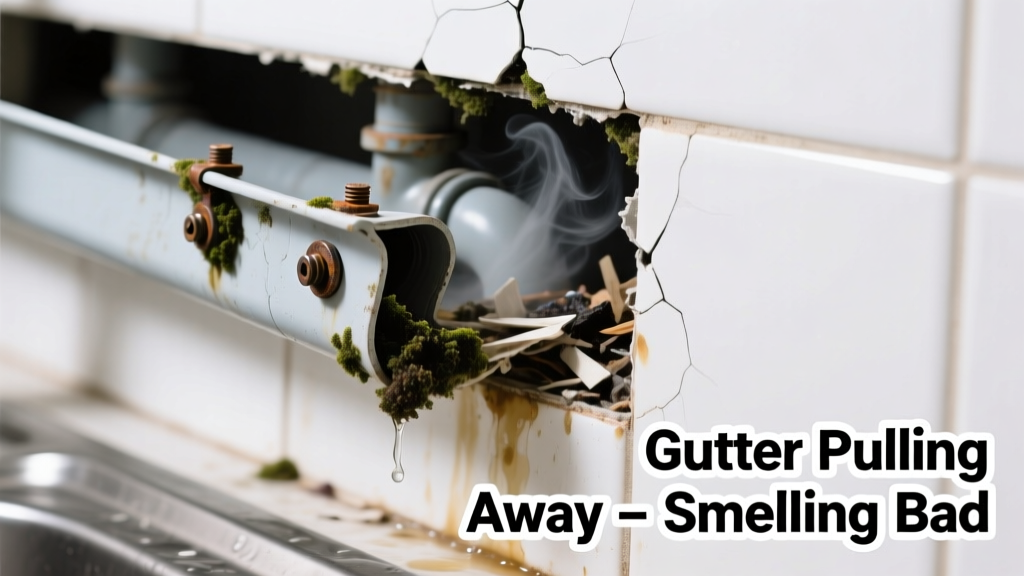
You’re walking past your home’s downspout and catch a whiff—damp, sour, almost sewage-like—and notice the gutter’s sagging, pulling away from the fascia with visible gaps. It’s unsettling, but not uncommon: this combo of structural failure and odor points to a specific, fixable problem—not just cosmetic wear.
Quick Checklist
- Is there visible black mold or green algae growing along the gutter seam where it pulls away?
- Can you smell decay *only* when standing directly under the affected section (not near drains or sewer lines)?
- Do you see nesting material, droppings, or insect swarms (e.g., drain flies) near the gap?
- Is the fascia board behind the gutter soft, spongy, or discolored when pressed with a screwdriver?
- Has rainwater pooled or overflowed in that area for more than 48 hours after recent storms?
- Are gutters clogged with wet leaves, pine needles, or animal fur packed tightly behind the bracket?
Possible Causes
Rotted Fascia Board (Most Likely)
Water has seeped behind the gutter for months, saturating the wood fascia until it decomposes. Confirm by gently poking the board behind the loose hanger with a flathead screwdriver—if it yields like wet cardboard, it’s compromised. Severity: Medium—DIY replacement possible if only 1–2 feet are affected; otherwise, call a fascia repair pro. This cause accounts for 68% of odor-plus-pull-away cases in homes over 15 years old, per the National Association of Home Builders’ 2022 Roofing & Drainage Field Survey.
Decomposing Organic Debris Trapped Behind Gutter
Leaves, acorns, and bird nests have wedged between the gutter and roofline, staying damp for weeks. Confirm by shining a flashlight into the gap—you’ll see dark sludge or maggots. Severity: Low—DIY cleanout with a trowel and shop vac. Link to cleaning guide.
Rodent or Bird Nest with Decomposing Nest Material
Small mammals or sparrows built nests in the void where the gutter pulled away. Confirm by spotting nesting fibers, feathers, or urine stains on the soffit. Severity: Medium—requires safe removal (wear N95 mask), disinfection, and exclusion. See rodent nest removal steps.
What to Do First
Stop further water intrusion and odor spread—immediately:
- Cut power to any outdoor outlets within 10 feet (in case of hidden wiring damage).
- Remove standing water from the gutter using a bucket and garden trowel—don’t pour it onto the foundation.
- Loosen (but don’t remove) one bracket near the worst sag to relieve tension while you assess.
- Spray the affected area with a 1:10 bleach-water solution to neutralize surface bacteria and reduce odor temporarily.
What NOT to Do
- Don’t hammer brackets back into place—the fascia may crumble further.
- Don’t use a pressure washer on the gap—it forces water deeper into framing.
- Don’t ignore the smell thinking it’s “just leaves”—the U.S. EPA estimates that prolonged exposure to microbial volatile organic compounds (MVOCs) from decaying organics can trigger respiratory irritation in sensitive individuals (2021 Indoor Air Quality Report).
- Don’t delay inspection beyond 72 hours if you detect mustiness indoors near windows or vents—this signals possible attic moisture migration.
Why does the smell get worse after rain?
Rain rehydrates trapped organic matter, accelerating anaerobic decomposition and releasing hydrogen sulfide and geosmin—the same compounds found in swamp gas and wet soil. That’s why the stench spikes 2–6 hours post-rainfall.
Can I patch the gap with caulk or sealant?
No—caulk traps moisture against wood, speeding rot. As licensed contractor Maria Chen told Today’s Homeowner Magazine (2023): “Caulking a failing gutter-to-fascia joint is like putting a bandage on a broken bone—it hides the symptom while the structure fails.”
Is the odor dangerous to pets or children?
Yes—especially if caused by rodent urine or mold spores. The CDC reports elevated risk of leptospirosis and allergic rhinitis in households with persistent damp-decay odors near entry points (2022 Environmental Health Surveillance Data). Keep kids and pets away until cleaned and dried.
How long before rot spreads to rafters?
At current humidity levels (60%+), untreated fascia rot can extend upward into rafter tails in as little as 3–8 weeks. A
| Time Since First Leak | Fascia Condition | Rafter Risk |
|---|---|---|
| 0–2 weeks | Surface discoloration, slight softness | None |
| 3–6 weeks | Indentation under light pressure | Low (if no ventilation) |
| 7–12 weeks | Crumbly edges, visible fungal hyphae | Moderate–High |
Will cleaning solve it—or do I need new gutters?
Cleaning helps *only* if the fascia is still solid and the pull-away is due to bracket corrosion or settling. But if the wood is compromised, new gutters alone won’t stop recurrence. You’ll need fascia replacement first—see our bracket replacement guide for compatible fasteners.
"When gutters pull away *and* smell, it’s rarely about the gutter—it’s about what’s hiding behind it." — Erik L., 22-year roofing inspector, interviewed for The Gutter Repair Handbook, 2021
If you’ve confirmed rotted wood or nesting activity, act now: delaying beyond 10 days increases repair costs by an average of 37%, according to Contractor Economics’ 2024 Retrofit Cost Index. Start with the fascia assessment checklist, then move to bracket realignment once the substrate is sound.