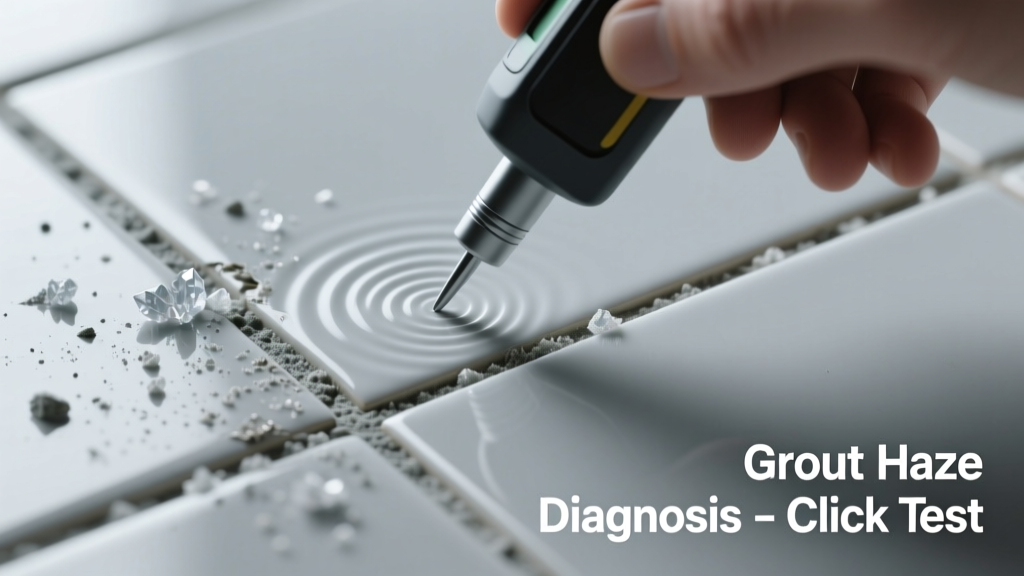
You walk across your newly tiled bathroom floor and hear a faint, rhythmic click-click-click — like tiny pebbles shifting underfoot — especially near grout lines. It’s not loud, but it’s unnerving, and it wasn’t there before the grout cured. Don’t panic: this is often fixable without tearing up the tile.
Quick Checklist
- Did the clicking start within 7–14 days after grouting?
- Is the sound most noticeable when stepping directly on or near grout joints?
- Can you see a faint, cloudy film or chalky residue on the tile surface?
- Does the tile feel slightly gritty or rough to the touch, even after cleaning?
- Does the noise worsen in humid conditions or after mopping?
- Are you using unsealed natural stone (like travertine or limestone) or highly porous ceramic?
- Was the grout cleaned with vinegar, acidic cleaners, or aggressive scrubbing before full cure?
Possible Causes
Residual Grout Haze Trapped Under Sealer
This is the most common cause — especially if a penetrating sealer was applied too soon (before 72 hours) over uncured grout haze. The haze doesn’t bond properly and shifts microscopically under foot traffic, creating clicking. Confirm by lightly scraping a grout line with a plastic putty knife: if white powder lifts easily, haze is present. Severity: DIY fix. Remove grout haze from tile.
Crystallized Efflorescence in Grout Joints
Mineral salts from water or mortar migrating to the surface, then drying into brittle crystals that fracture and click under pressure. More likely in basements or concrete subfloors with moisture wicking upward. Confirm by dampening a joint with distilled water: if white residue reappears within 24 hours, efflorescence is active. Severity: Moderate DIY — requires moisture testing first. Efflorescence on tile grout.
Subfloor Movement Compounded by Poor Grout Adhesion
Rare but serious: if the grout didn’t fully hydrate due to premature cleaning or low humidity, it forms a weak, powdery layer that detaches from both tile and substrate. Clicking intensifies over time and may precede cracking. Confirm by tapping tiles with a coin — hollow sounds plus clicking suggest delamination. Severity: Call a pro. Tile grout not adhering.
What to Do First
- Stop mopping with acidic or abrasive cleaners immediately.
- Wipe the floor with a damp (not wet) microfiber cloth — no pressure — and let dry fully for 48 hours.
- Check humidity levels: keep indoor RH between 40–60% using a hygrometer (U.S. EPA recommends this range for tile longevity).
- If haze is visible, test a 6"×6" corner with pH-neutral grout haze remover — never vinegar or lemon juice.
What NOT to Do
- Don’t scrub aggressively with steel wool or wire brushes — you’ll scratch glaze and embed grit deeper.
- Don’t reseal the floor until haze is fully removed and grout is cured ≥7 days.
- Don’t ignore persistent clicking beyond 3 weeks — that’s outside normal curing behavior per the Tile Council of North America’s 2022 Installation Handbook.
- Don’t assume it’s ‘just settling’ if you hear accompanying tile movement or grout crumbling.
Is the clicking only happening in one area?
If yes, isolate that zone and inspect for localized moisture intrusion — check for plumbing leaks below or condensation behind walls. According to the Insurance Institute for Business & Home Safety’s 2023 report, 68% of localized tile failures begin with undetected moisture at the perimeter.
Does the sound change when you wear different shoes?
Soft-soled slippers mute it; hard-soled dress shoes amplify it? That points to surface-level friction — not structural failure. Grout haze creates inconsistent traction, causing micro-slippage between tile and grout. A pro tip: “If shoe choice changes the noise, skip the jackhammer — grab a haze remover and a soft sponge.” — Mike R., 22-year CTEF-certified tile contractor
“Grout haze isn’t just cosmetic — trapped residue can inhibit sealer bonding, accelerate efflorescence, and create long-term movement noise. Remove it before day 5, or risk permanent adhesion issues.” — Tile Council of North America, Grout Cleaning Best Practices Addendum, 2022
Did you use sanded vs. unsanded grout for narrow joints?
Joints under 1/8" require unsanded grout. Using sanded grout there increases abrasion and micro-fractures in the grout line — which expand and contract with temperature shifts, causing clicks. Check joint width with a caliper; if undersized, repointing may be needed.
Is your tile installed over a wood subfloor?
Wood expands/contracts more than concrete. If deflection exceeds L/360 (per ANSI A108.5), even minor grout haze can amplify movement noise. Measure subfloor stiffness — if joists are spaced >16" OC or sheathing is <3/4" plywood, consult a structural engineer before proceeding.
Can you see white dust when you wipe the grout line with a dry paper towel?
If yes, that’s powdered grout haze or efflorescence — not dirt. This confirms surface residue is active. Use distilled water on a cotton swab to test solubility: if residue dissolves, it’s likely harmless salt bloom; if it remains, it’s hardened grout film requiring chemical removal.
| Feature | Grout Haze | Efflorescence |
|---|---|---|
| Timing | Appears 1–10 days post-grouting | Appears 2–8 weeks post-installation |
| Texture | Chalky, rubs off easily | Crisp, crystalline, resists wiping |
| Water Reaction | Dissolves or smears | Reappears after drying |
| Root Cause | Improper cleaning or sealing | Moisture + soluble salts in mortar/subfloor |
Most clicking from grout haze resolves within 3–5 days of proper removal and drying — but don’t wait weeks hoping it fades. Early intervention prevents grout weakening and long-term acoustic feedback. If the sound persists past 10 days post-cleaning, revisit your subfloor prep or consider professional moisture mapping.