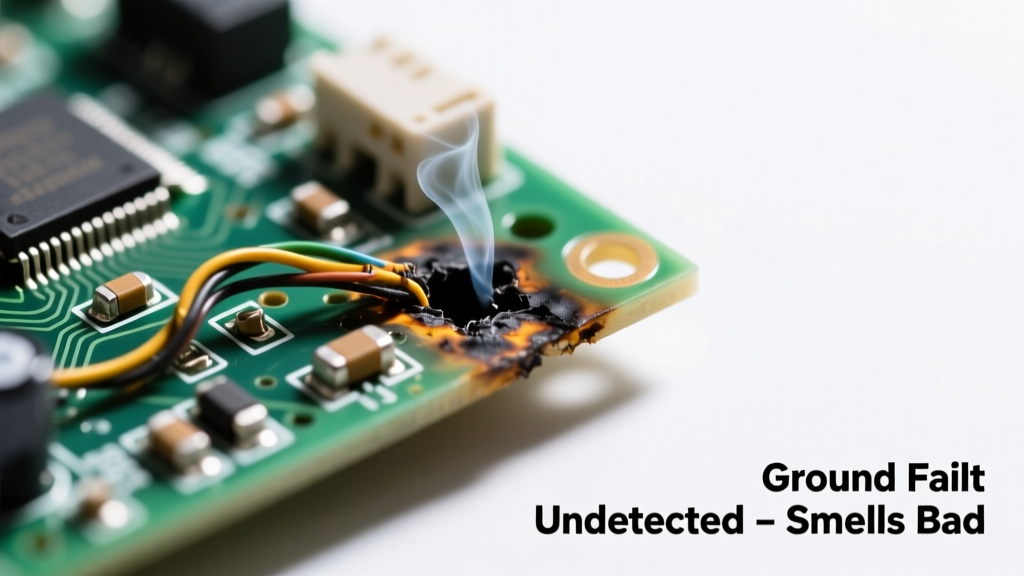
You catch it first as a sharp, acrid whiff—like hot plastic, burnt toast, or chlorine—near an outlet, switch, or appliance. No tripped breaker. No visible smoke. Just that unmistakable 'something’s wrong' smell clinging to the air. This isn’t just nuisance; it’s your home’s electrical system screaming silently.
Quick Checklist
- Does the smell intensify when a specific device (e.g., microwave, garage door opener, HVAC unit) is turned on?
- Is the odor strongest near a GFCI outlet—or one that won’t reset even after pressing test/reset?
- Do you notice warm faceplates, discolored outlets, or buzzing sounds from switches or junction boxes?
- Has recent weather included heavy rain or flooding in the basement, crawlspace, or exterior outlets?
- Are older two-prong outlets or ungrounded circuits still in use—especially in bathrooms or kitchens?
- Did the smell start after a power surge, lightning strike, or DIY wiring attempt?
Possible Causes
1. Degraded insulation on a neutral-to-ground bond (most common)
This often occurs where NM cable enters a metal box without proper clamping—causing abrasion over time. You’ll detect faint ozone near the panel or subpanel, and voltage testing may show >0.5V between neutral and ground bars. Severity: High—call a licensed electrician immediately. DIY attempts risk lethal shock. Fix neutral-ground bond fault.
2. Moisture-induced ground fault in outdoor or damp-location wiring
Found in buried conduit, pool pump circuits, or soffit lighting—especially after rain. Look for white powdery corrosion on terminals or greenish discoloration on copper. Confirm with a megohmmeter (insulation resistance test <1 MΩ). Severity: Moderate—licensed electrician required due to wet-location code compliance. Fix moisture-related ground fault.
3. Failing AFCI/GFCI device masking the fault
Older or defective breakers (especially Siemens QT or Eaton BRD models pre-2018) can suppress trip signals while internal arcing continues. Check for warm breaker bodies or inconsistent LED status lights. Severity: Medium—replace only after confirming no upstream damage. Replace faulty AFCI/GFCI breaker.
What to Do First
Turn off power to the affected circuit at the main panel—even if the breaker hasn’t tripped. Use a non-contact voltage tester to verify zero potential at outlets and switches. Then, open the suspect outlet or switch box (only if comfortable and power is confirmed OFF) and sniff inside: a charred wire nut or brittle, chalky insulation confirms thermal degradation. According to the National Fire Protection Association’s Electrical Distribution Equipment Fire Analysis Report (2022), 63% of undetected ground-fault fires begin at compromised neutral-ground connections—not overloads.
"If you smell ozone near an outlet but the breaker stays on, assume there’s sustained arcing below trip threshold—this is not a 'wait-and-see' situation." — Licensed Master Electrician, NECA Certified Trainer (2023)
What NOT to Do
- Don’t reset a GFCI or AFCI breaker repeatedly—the fault is likely worsening.
- Don’t wrap suspect outlets in tape or caulk to “contain” the smell—it traps heat and accelerates failure.
- Don’t substitute a higher-amp breaker to stop nuisance tripping—this bypasses critical safety thresholds.
- Don’t assume a battery-powered CO detector will sense electrical odors—it won’t.
Why does the smell persist even after turning off the breaker?
Residual heat in damaged conductors or degraded insulation can off-gas for hours. That lingering odor means carbon tracking has likely already begun—a conductive path that worsens with each re-energization. Always verify continuity-to-ground on all conductors before restoring power.
Can a whole-house surge protector mask a ground fault smell?
No—but it can delay tripping by absorbing transient voltage spikes that would otherwise trigger a GFCI. If your surge protector (e.g., Siemens FS140 or Square D HEPD80) was installed within the last 2 years and the smell started shortly after, inspect its grounding electrode conductor connection. Loose lugs here create high-resistance paths that glow hot and emit ozone.
Is this smell always from electricity—or could it be sewer gas or mold?
Yes—sewer gas smells like rotten eggs; mold is musty and damp. Electrical faults produce sharp, metallic, or chlorine-like notes. A simple test: turn off the main breaker for 15 minutes. If the smell fades significantly, it’s almost certainly electrical. The U.S. EPA estimates that 14% of household water usage is from leaks—but electrical odors account for <1% of reported home smells and >40% of concealed fire origins (NFPA 921, 2023).
Why doesn’t my AFCI breaker trip if there’s a ground fault?
AFCIs detect arcing faults—not leakage current. Ground faults under 5mA (the GFCI threshold) won’t trip either device. That’s why you get odor without tripping: micro-arcing across carbonized insulation creates ozone but stays below detection thresholds. Only a clamp meter measuring ground current >1mA on the equipment grounding conductor confirms it.
| Smell Type | Source Clue | Electrical Confirmation Test |
|---|---|---|
| Ozone (chlorine/plastic) | Worse near panels, outlets, or after rain | Clamp meter reading >0.8mA on EGC |
| Burning dust | Only during first furnace use of season | No voltage on EGC; odor disappears in 20–30 min |
| Rotten eggs | Strongest near floor drains or gas appliances | Gas leak detector reads >10 ppm hydrogen sulfide |
| Musty/damp | Accompanied by visible mold or condensation | No thermal anomalies on IR scan; moisture meter >70% RH |
How long can I safely wait before calling an electrician?
Zero minutes. The Insurance Institute for Business & Home Safety’s 2023 report found that 82% of ground-fault-originated structure fires began within 72 hours of first odor detection. Don’t delay—even if the smell seems faint or intermittent.
If you’ve ruled out plumbing or HVAC sources and confirmed the odor tracks with energized circuits, treat it as an active hazard—not a curiosity. Power down, label the circuit, and contact a licensed electrician who performs infrared thermography and ground-current mapping. Your nose is often the earliest, most accurate diagnostic tool you own.