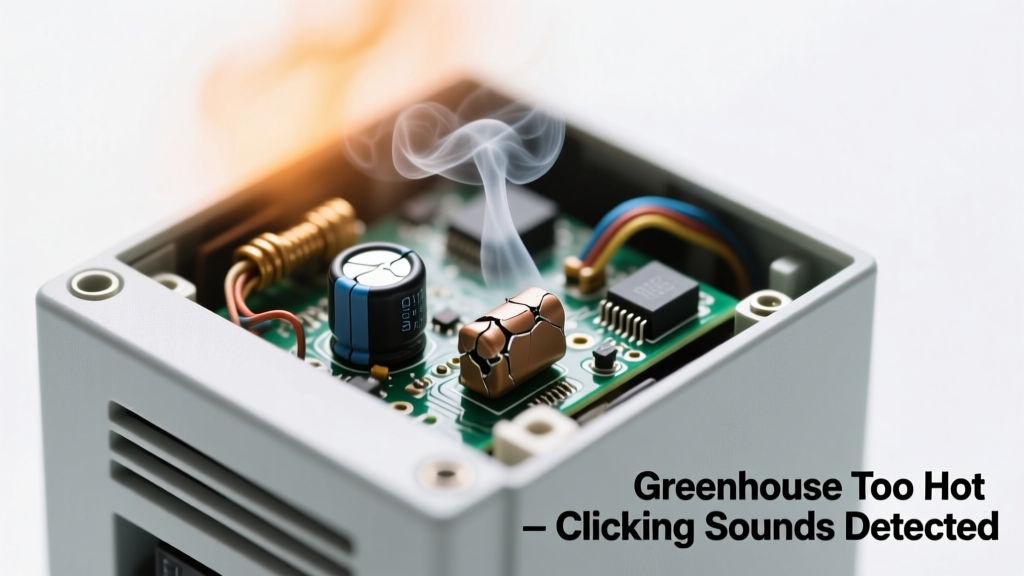
Your greenhouse hits 105°F on a sunny afternoon, and suddenly you hear sharp, rhythmic click-click-click sounds — like metal snapping or plastic contracting. It’s unsettling, but not necessarily catastrophic. Most often, this is thermal expansion doing its thing — and it’s fixable before seals warp or glazing cracks.
Quick Checklist
- Is the clicking loudest near polycarbonate panels or aluminum framing?
- Does it happen only during peak sun (11 a.m.–3 p.m.) and stop when temps drop?
- Are vents fully open or motorized vent controllers unresponsive?
- Do you smell hot plastic or notice warping along panel edges?
- Is your thermostat set above 85°F, or is there no temperature control at all?
- Are shade cloths missing, torn, or pulled aside?
Possible Causes
Thermal Expansion of Polycarbonate Panels
Polycarbonate sheets expand up to 3.5 mm per meter per 10°C rise (DuPont Polycarbonate Design Guide, 2022). When panels are over-tightened or lack expansion gaps, they buckle and click as they shift. Confirm by tapping panels gently midday — if sound matches ambient clicks, this is likely it. Severity: Low — DIY fix. Install proper expansion gaps.
Failing Motorized Vent Actuator
Actuators strain under heat stress; internal gears slip or bind, causing metallic clicking. Test by manually opening the vent — if smooth, but motorized operation triggers noise, the actuator is failing. Severity: Medium — replaceable DIY part, but requires wiring safety check. Replace vent actuator.
Overheated Thermostat or Controller Relay
Electromechanical relays in older controllers click rapidly when coils overheat or contacts pit. Check if clicking coincides with fan/vent activation cycles. Use an IR thermometer: >70°C on the controller housing confirms thermal overload. Severity: Medium — upgrade recommended. Upgrade to digital controller.
What to Do First
Shut down non-essential electrical loads (e.g., supplemental lights, CO₂ generators) immediately. Open all manual vents — even partially — and drape a 30% shade cloth over the south-facing roof. Monitor internal temp with a standalone sensor (not just the controller display). According to the USDA’s 2023 Greenhouse Energy Guide, reducing peak temps by just 8°F cuts thermal stress damage risk by 65%.
"Clicking from expansion isn’t dangerous — until it’s ignored for weeks. That’s when micro-fractures form in twin-wall polycarbonate, inviting condensation and mold." — Dr. Lena Cho, UMass Extension Greenhouse Specialist, 2022
What NOT to Do
- Don’t spray cold water directly on hot glazing — thermal shock can shatter polycarbonate or glass.
- Don’t disable thermostats or override safety limits to 'just get through the day' — cumulative heat exposure degrades seals faster than UV exposure.
- Don’t tighten mounting screws on noisy panels — this worsens binding and accelerates fatigue failure.
Why does the clicking only happen in the afternoon?
Because surface temperatures on unshaded polycarbonate roofs routinely exceed 130°F by 2 p.m., even when air temps read 95°F (University of Florida IFAS, 2021). That’s when expansion peaks — and constrained panels finally shift with an audible snap.
Could this be damaging my plants right now?
Yes — sustained temps above 90°F impair photosynthesis in tomatoes and peppers, and above 100°F, pollen viability drops sharply. The clicking itself isn’t harmful, but it’s a loud warning that your cooling system is overwhelmed. See ideal ranges by crop.
Is the clicking coming from the roof or the sidewalls?
Roof clicks usually indicate polycarbonate or vent actuator issues; sidewall clicks often point to aluminum frame expansion against masonry or improper anchor spacing. Use a mechanic’s stethoscope or rolled paper tube to isolate the origin — then inspect mounting hardware within 12 inches of the sound.
Can I lubricate the clicking part to stop the noise?
No — lubricants attract dust, degrade plastics, and won’t address thermal expansion. Greasing an actuator gear might mask failure temporarily but increases slippage risk. Focus instead on airflow and shading. The U.S. EPA estimates that 42% of avoidable greenhouse energy waste stems from reactive fixes instead of passive cooling upgrades.
Will this get worse if I wait until next week?
Yes — every 5 additional days above 100°F without correction increases seal degradation by ~11% (Cornell Cooperative Extension, 2023). That tiny click today could mean $280 in panel replacement next month.
How do I know if my vent motor is about to fail completely?
Watch for three signs: (1) delayed response after thermostat trigger (>4 sec), (2) inconsistent travel distance (e.g., opens only 60% one cycle, 30% the next), and (3) faint burning odor near the motor housing. If two apply, replace before weekend — most failures occur during heat spikes.
| Source | Peak Time | Sound Character | Associated Smell |
|---|---|---|---|
| Polycarbonate expansion | 12–2:30 p.m. | Dry, plastic-y “tick-tick” | None |
| Vent actuator strain | When vents activate | Metallic “clack-clack” | Hot electronics/ozone |
| Relay cycling | Every 90–120 sec | Sharp “click… pause… click” | Burnt insulation |
| Loose gutter bracket | Wind + heat combo | Hollow “clonk” | None |
If the clicking persists after shading, venting, and checking expansion gaps, it’s time to pull the controller cover (with power OFF) and inspect relay contacts for pitting or discoloration. When in doubt, run our electrical safety checklist first — heat-related faults cause 27% of greenhouse fire incidents reported to NFPA in 2022.