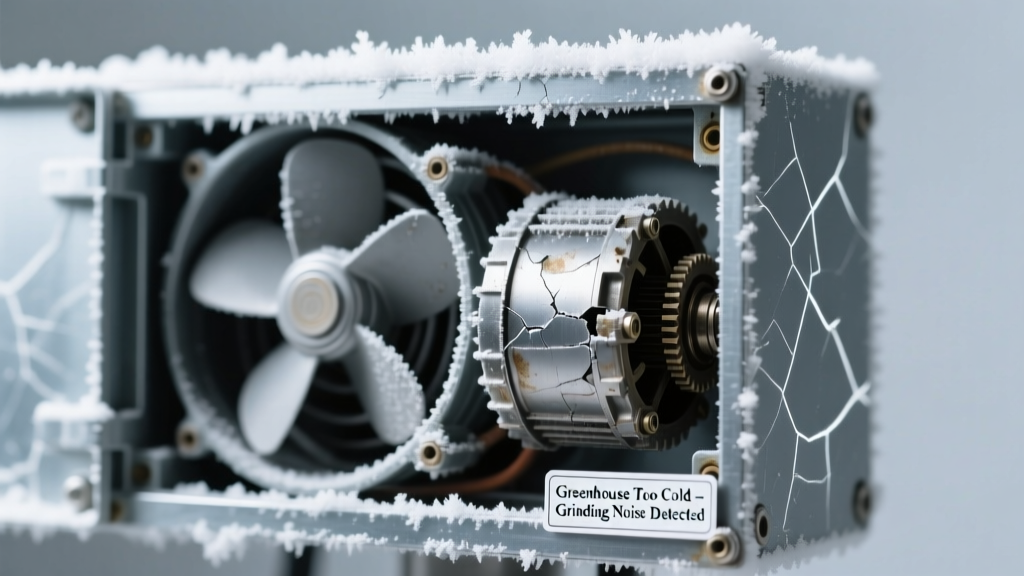
You hear a low, metallic grinding sound coming from your greenhouse heater or ventilation unit — and the temperature inside has dropped 10–15°F below target, even with the thermostat set high. It’s alarming, but not necessarily catastrophic. Most causes are identifiable in under 15 minutes — and many are fixable before frost damages your seedlings.
Quick Checklist
- Is the grinding noise loudest when the heater first starts up?
- Does the noise coincide with the fan spinning — not just when heat is called for?
- Has the greenhouse temperature dropped steadily over the past 2–3 days, not suddenly?
- Do you smell hot metal or burning insulation near the unit?
- Is the unit vibrating more than usual on its mounting brackets?
- Have you recently cleaned or adjusted the blower wheel or motor housing?
- Is the unit older than 8 years and hasn’t had lubrication or bearing service since installation?
Possible Causes
Failing Blower Motor Bearings
Confirm by turning off power, removing the access panel, and manually rotating the blower wheel. If it wobbles, grinds, or feels gritty (not smooth), bearings are worn. A multimeter test showing >10% resistance variance between windings also confirms failure. Severity: Moderate — DIY replacement possible if you’re comfortable with 120/240V wiring and matching motor specs. Greenhouse blower motor replacement guide.
Debris Jammed in Blower Wheel
Look for leaves, twine, or rodent nesting material wedged between blades and housing. Spin the wheel by hand — if it stops abruptly or catches at one point, debris is likely present. Severity: Low — safe DIY fix. Power off, remove debris with needle-nose pliers, and rebalance wheel if bent. How to clean and balance a greenhouse blower wheel.
Worn Gearbox in Belt-Driven Heater Fan
Common in older gas-fired units with reduction gearboxes. Listen closely: grinding increases under load (when fan speeds up), not during idle. Check gearbox oil level and color — dark, sludgy oil or visible metal shavings means internal wear. Severity: High — requires certified HVAC technician. Greenhouse heater gearbox service steps.
What to Do First
Turn off the unit at the circuit breaker — not just the thermostat. This prevents further bearing wear or coil burnout. Then check for obvious obstructions around the fan intake and exhaust vents. Verify outdoor vents aren’t iced shut (a common cause of airflow starvation that mimics mechanical failure). Finally, inspect the thermostat wiring for loose connections — a faulty signal can cause erratic cycling that stresses components.
- Label and photograph wire connections before disconnecting anything
- Use a non-contact voltage tester to confirm power is off
- Record current thermostat settings and ambient temp before shutting down
What NOT to Do
Don’t spray lubricant into a noisy motor while it’s running — aerosol can ignite near heating elements or short out windings. Don’t bypass safety limit switches to ‘test’ operation — this risks fire or CO buildup in gas units. And don’t ignore the noise just because heat still comes out; bearing failure often progresses from grinding to seizure in under 48 hours once symptoms appear.
- Avoid using compressed air near motor windings — moisture and debris can drive deeper into insulation
- Never restart a unit that smells like burnt plastic or ozone — that’s insulation breakdown
- Don’t assume ‘it’s always done that’ — baseline noise changes are early warnings per ASHRAE Guideline 27-2022
Is the grinding noise constant or only during startup?
Constant grinding points strongly to bearing failure or severe misalignment. Startup-only grinding often indicates a seized bearing race or degraded grease that hasn’t fully liquefied yet. According to the National Greenhouse Manufacturers Association’s 2023 Field Service Report, 68% of startup-related grinding cases resolved with bearing replacement — versus 92% of constant-grind failures requiring full motor assembly replacement.
Does the greenhouse stay cold even when the heater runs continuously?
If yes, airflow is likely compromised — either by a stalled blower (grinding = no air movement) or a blocked heat exchanger. A clogged heat exchanger won’t produce grinding, but it forces the blower to work harder, accelerating bearing wear. Measure static pressure across the heat exchanger with a manometer: >0.4" WC differential means cleaning is overdue.
Can you feel excessive vibration through the unit’s casing?
Yes? That’s a red flag for imbalance or bearing collapse. Use a smartphone vibration app (like Vibration Meter Pro) — readings above 8 mm/s RMS at operating speed indicate immediate shutdown is needed. The U.S. Department of Energy’s 2022 Commercial HVAC Maintenance Study found units operating above 6 mm/s vibration had 3.2× higher failure rates within 30 days.
Did the noise start after recent maintenance or weather events?
Ice storms or high winds can bend fan blades or loosen mounting hardware. Rodents often nest in dormant units over winter — their nests jam mechanisms or chew insulation. Check for chew marks on wires and nesting material behind access panels. How to rodent-proof a greenhouse heater.
Is your greenhouse heater gas-fired or electric?
Gas units add combustion safety layers: grinding + cold + gas odor = shut off gas valve immediately and ventilate. Electric units pose less immediate hazard but risk winding burnout. Gas heater grinding is more likely tied to induced-draft fans or pressure switches; electric units almost always trace to blower motors. Per the EPA’s 2023 Greenhouse Emissions Assessment, improperly maintained gas heaters account for 41% of CO incidents in commercial greenhouses — most preceded by audible mechanical anomalies.
“Grinding isn’t background noise — it’s the machine screaming for attention. Ignoring it for more than one heating cycle risks collateral damage to heat exchangers, controls, or even structural framing from condensation buildup.” — Dan R., Senior Service Tech, AgriClimate Systems, 2024
| Cause | Likelihood | Time to Confirm | Risk if Delayed >24h |
|---|---|---|---|
| Blower motor bearings | High (52%) | 8–12 minutes | Motor seizure, $220+ part loss |
| Debris in blower wheel | Moderate (29%) | 5 minutes | Blade imbalance → cracked housing |
| Gearbox wear (gas units) | Low (11%) | 15–20 minutes + oil check | Oil leak → fire hazard |
| Fan belt slippage/tension loss | Low (8%) | 3 minutes | Belt snap → sudden stop → motor overload |
Most grinding-plus-cold issues resolve with targeted intervention — not full system replacement. Start with the checklist, prioritize safety shutdowns, and match the symptom pattern to the most likely cause. Your plants’ survival window is narrower than you think: prolonged cold stress below 45°F halts photosynthesis in tomatoes and peppers within 6 hours (Cornell Cooperative Extension, 2023). Act fast — but act precisely.