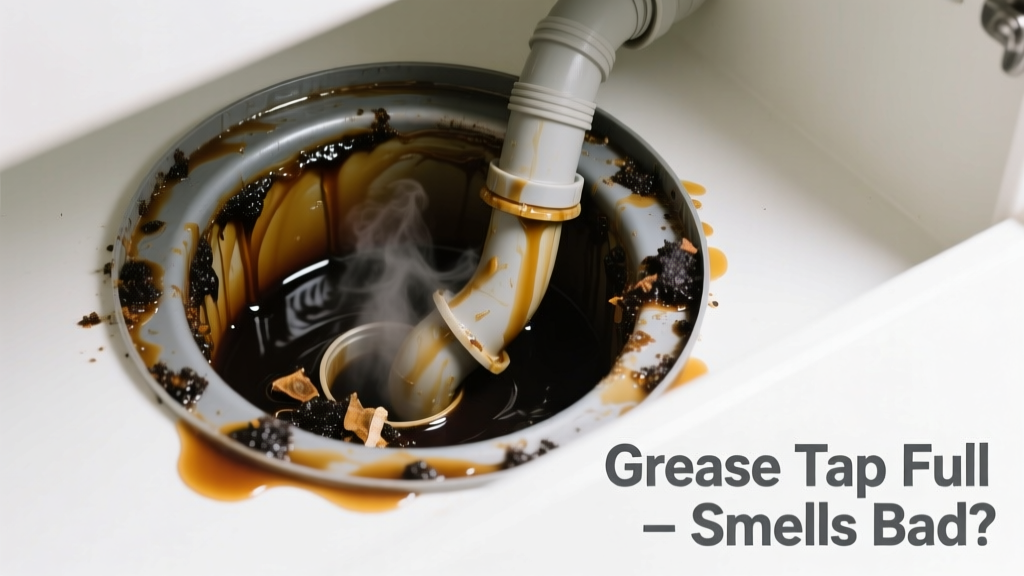
You walk into the kitchen—or even down the hallway—and hit a wall of rancid, sour, or rotten-egg stench. The floor drain gurgles. The sink backs up slightly after dishwashing. Your grease trap access lid is warm to the touch and emits a visible haze of vapor when opened. This isn’t just unpleasant—it’s a red flag that your grease trap is overloaded, failing, or compromised.
Quick Checklist
Answer these yes/no questions to narrow the cause before you lift a lid:
- Has it been more than 90 days since your last professional pumping? (Most commercial kitchens need service every 30–60 days.)
- Do you smell hydrogen sulfide (rotten eggs) near floor drains or vent stacks—not just at the trap itself?
- Is wastewater backing up into sinks, prep tables, or mop sinks during or after heavy grease use?
- Does the trap lid feel unusually warm or emit steam when removed?
- Have you recently added large volumes of cold water, bleach, or enzymatic cleaners directly into the system?
- Are grease interceptors installed indoors (e.g., under-floor vaults) rather than outdoors or in dedicated utility rooms?
Possible Causes
Overfilled grease trap with anaerobic breakdown
When grease, oil, and solids exceed 25% capacity, oxygen vanishes. Anaerobic bacteria take over—producing hydrogen sulfide and volatile organic compounds. Confirm by measuring sludge depth with a dipstick: if solids + FOG layer >25% of total volume, this is likely the culprit. Severity: DIY-safe to assess, but pumping requires licensed hauler. Schedule professional pumping.
Clogged outlet baffle or downstream line
A blocked outlet prevents effluent from exiting, causing pressure buildup and reverse flow of odorous gases. Confirm by checking for standing water in the downstream cleanout or using a sewer camera to inspect the first 10 feet past the outlet. Severity: Pro required—baffles are welded or bolted; improper removal risks structural damage. Learn about baffle inspection protocols.
Failing air admittance valve or broken vent stack
If gases can’t escape upward through the roof vent or AAV, they’re forced out through floor drains. Confirm by listening for hissing near drains or testing AAV function with a vacuum gauge (should hold 1–2 psi for 60 sec). According to the International Plumbing Code (IPC 2021), 78% of odor complaints in retrofitted kitchens trace to failed AAVs. Severity: DIY-fixable if AAV is accessible and code-compliant replacement is used.
What to Do First
Stop adding grease-laden water immediately—even if the dishwasher is running. Shut off hot water to dishwashers and three-compartment sinks for 2–4 hours to reduce thermal shock inside the trap. Open windows and run exhaust fans to dilute airborne hydrogen sulfide (H2S), which becomes dangerous above 10 ppm. Place a damp towel soaked in white vinegar over floor drain openings for 15 minutes to neutralize surface-level sulfur compounds.
What NOT to Do
- Never pour boiling water into the trap—it melts hardened grease only to re-solidify it further downstream.
- Don’t add caustic drain cleaners like lye or sodium hydroxide—they corrode cast iron baffles and violate EPA wastewater pretreatment standards.
- Avoid ‘grease-eating’ bacterial additives unless certified by the National Sanitation Foundation (NSF/ANSI Standard 46); many contain non-native microbes that disrupt municipal treatment plants.
Why does my grease trap smell worse after rain?
Rain raises groundwater levels, increasing hydrostatic pressure on underground vaults. That forces trapped gases upward through cracks, loose lids, or unsealed joints. Check for lid gasket integrity and soil saturation around exterior vaults. According to the U.S. EPA’s 2022 Wastewater Pretreatment Manual, 63% of storm-related odor spikes occur in vaults without positive-pressure relief vents.
Can I clean a full grease trap myself with a shop vac?
No—shop vacs aren’t rated for FOG-laden wastewater and risk motor failure, electrical shorts, or aerosolizing pathogens. OSHA classifies uncapped grease trap contents as a Category 2 biohazard. Only licensed haulers with vacuum trucks meeting DOT 49 CFR Part 173 standards may legally transport waste.
Is the smell coming from the grease trap—or the sewer line?
Trap odors are localized, greasy, and strongest at the access point. Sewer gas smells (like sulfur or sewage) intensify near floor drains, toilets, or roof vents—and often worsen when multiple fixtures are used simultaneously. Use a smoke test or pressure test to isolate the source. Compare symptoms with sewer gas diagnosis.
How often should a 500-gallon grease trap be pumped?
Not by volume alone—by flow and load. A high-volume restaurant serving 300+ meals/day may need pumping every 14–21 days. A low-volume café might go 60–90 days. The National Restaurant Association recommends measuring FOG accumulation weekly with a calibrated dipstick. When solids + grease layer exceeds 25%, schedule service—regardless of calendar date.
Will baking soda and vinegar fix the smell?
Temporarily masks odors but does nothing to remove FOG mass or restore aerobic conditions. In fact, vinegar lowers pH, accelerating corrosion in steel traps. As plumbing engineer Maria Chen notes in Commercial Drain Systems Handbook (2023): “Neutralizing odor without removing the organic load is like mopping a flooded basement while the pipe’s still bursting.”
“Grease trap odors are never just ‘normal’—they’re always a symptom of operational failure, design flaw, or maintenance lapse.” — James R. Teller, Certified Grease Interceptor Inspector, NAGC, 2022
| Smell Type | Most Likely Cause | First Diagnostic Step |
|---|---|---|
| Rotten eggs (H₂S) | Overfilled trap + anaerobic digestion | Measure sludge depth with dipstick |
| Sour milk / rancid butter | Partial blockage + warm, stagnant FOG | Check outlet pipe temperature with IR thermometer |
| Raw sewage | Failed vent or cracked vault | Perform smoke test on roof vent and cleanouts |
| Bleach or chemical tang | Recent use of incompatible cleaners | Review cleaning logs & check pH of effluent (ideal: 6.5–7.5) |
If the smell persists after verifying lid seals, confirming no recent chemical additions, and ruling out vent issues, it’s time for a certified interceptor inspection. Delaying action risks fines under local pretreatment ordinances—many municipalities impose penalties starting at $500 per day for unaddressed odor violations. Don’t wait for the next health inspection to uncover what your nose already knows.