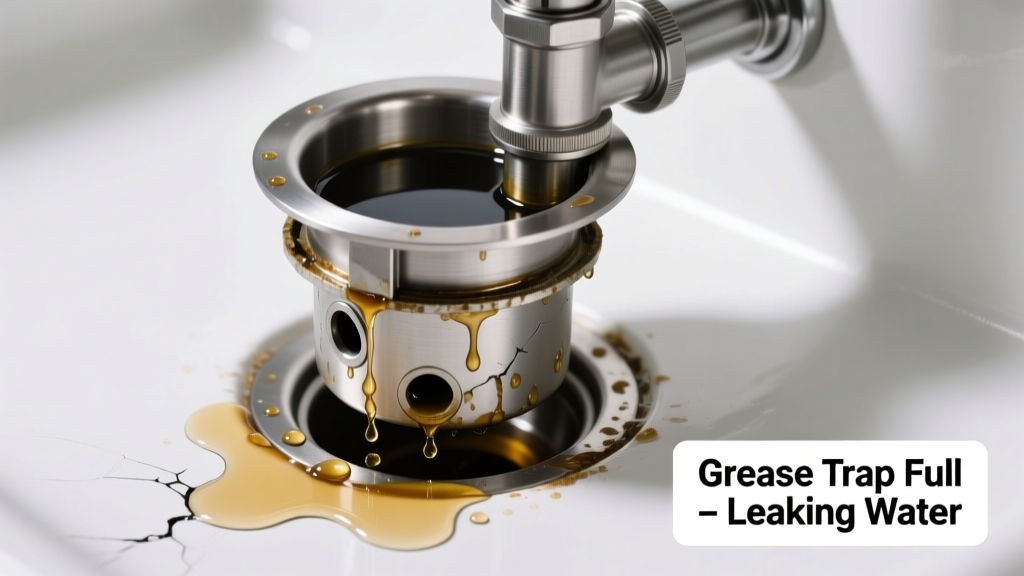
You walk into the kitchen and hear a faint gurgle, then spot a slow but steady puddle near the floor drain or beneath the grease trap access cover — warm, oily water pooling on the concrete. It’s not sewage, but it’s definitely not clean. Don’t panic: this is a common, fixable symptom — and diagnosing it correctly within 10 minutes can save you hundreds in emergency service calls.
Quick Checklist
- Is the leak coming from around the lid gasket or seam?
- Does the trap smell strongly of rancid grease or fermented food waste?
- Has the trap gone more than 90 days without pumping? (Most commercial kitchens need pumping every 30–60 days)
- Are sinks draining slower than usual — especially after dishwashing or fryer cleanup?
- Can you see standing water or grease layer above the normal outlet baffle height when you open the lid?
- Is there visible cracking or corrosion on the trap body or inlet pipe?
- Did the leak start immediately after heavy use — like catering a large event or back-to-back fryer runs?
Possible Causes
Overfilled trap with hydraulic overload
When grease, solids, and FOG (fats, oils, grease) exceed 25% of tank volume, wastewater backs up and overflows through the lowest point — often the lid seal or vent. Confirm by opening the lid: if the grease layer is within 6 inches of the outlet pipe, it’s overloaded. Severity: DYI-safe — pump immediately; no structural repair needed. Schedule professional pumping.
Failed or warped lid gasket
Aged, cracked, or improperly seated gaskets let pressurized effluent escape at the seam. Test by tightening lid bolts evenly and checking for immediate reduction in leakage. Severity: DYI-fixable — replace gasket ($12–$45); requires shutting off flow for 20 minutes. Step-by-step gasket replacement guide.
Cracked or corroded trap body
Older concrete or steel traps develop hairline cracks near inlet/outlet ports due to thermal cycling and acid buildup. Look for white efflorescence or rust streaks near joints. Severity: Pro required — patching rarely holds; replacement is usually necessary per local health code. When to replace vs. repair.
What to Do First
Stop all grease-laden discharges immediately — shut off dishwashers, fryers, and pre-rinse sprayers. Place absorbent booms or oil dry around the leak to contain spread and prevent slip hazards. Then, verify if the leak is active only during use (hydraulic pressure) or constant (structural failure). According to the National Association of Wastewater Technicians’ 2022 Field Manual, 68% of grease trap leaks escalate to floor damage within 48 hours if flow isn’t halted.
"A leaking grease trap isn’t just a plumbing issue — it’s a health code violation waiting to happen. Even 1/4 inch of overflow can trigger a Level 2 violation during routine health inspections." — Maria Chen, Certified Grease Interceptor Inspector, NAFTC, 2023
What NOT to Do
- Don’t pour degreasers or hot water down drains — they emulsify grease, pushing it downstream where it re-solidifies and blocks sewer laterals.
- Don’t ignore the smell — hydrogen sulfide gas from anaerobic breakdown poses respiratory risk above 10 ppm (U.S. OSHA PEL: 5 ppm ceiling).
- Don’t attempt welding or epoxy patching on a pressurized, FOG-filled trap — fumes are flammable and adhesion fails under oily conditions.
- Don’t assume it’s ‘just a loose bolt’ — uneven torque on cast-iron lids causes gasket extrusion, not sealing.
Why does my grease trap leak only when the dishwasher runs?
That’s classic hydraulic overload. Dishwashers discharge 10–15 gallons of hot, grease-suspended water in under 90 seconds — enough to lift the grease cap and force effluent past the outlet baffle. The trap isn’t broken — it’s full. Pumping restores proper separation dynamics.
Can a full grease trap cause backups in other sinks?
Yes — especially if your system uses a shared 4-inch building drain. A saturated trap acts like a dam, raising the hydraulic grade line. That’s why prep sinks or bar sinks may gurgle or overflow first. The U.S. EPA estimates that 14% of commercial kitchen sewer backups originate from underserviced grease interceptors.
Is the water leaking from my grease trap safe to touch?
No. Even ‘clear’ effluent contains coliform bacteria, residual detergents, and dissolved FOG. Wear nitrile gloves and eye protection when inspecting. Never use shop vacs — suction can aerosolize pathogens.
How often should I pump a 750-gallon grease trap?
Not by volume alone — by measured FOG accumulation. Per the Uniform Plumbing Code Appendix H, pumping is required when FOG + solids reach 25% of total capacity. For a 750-gallon unit, that’s ~187 gallons — roughly every 4–8 weeks in a busy deli, but up to 16 weeks in a low-volume coffee shop. Download our free inspection log template.
Will shutting off water stop the leak?
Only if the leak is pressure-driven (e.g., from active discharge). If water continues leaking after 30 minutes with all fixtures off, you likely have a structural breach — not an overflow. That means immediate containment and professional assessment.
Can I use a camera inspection to diagnose the leak source?
Yes — but only after the trap is pumped and deodorized. Inserting a sewer camera into a full, unvented grease trap risks equipment damage and inaccurate readings due to reflective grease film. Certified technicians use steam-cleaned, nitrogen-purged scopes for reliable imaging.
If the puddle hasn’t grown in the last hour and your kitchen remains operational, you’ve likely caught this early — and that makes all the difference. Most full-trap leaks resolve with timely pumping and gasket maintenance. Keep your inspection log updated, and remember: when in doubt, measure the grease depth before assuming it’s time for a service call.