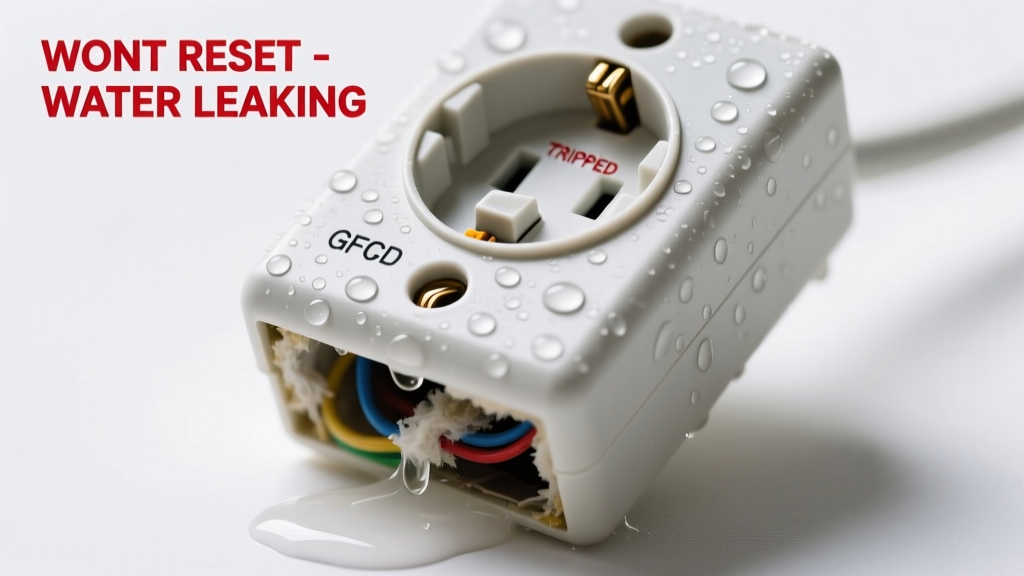
Your GFCI outlet is dripping water near the faceplate, won’t hold a reset, and maybe even trips instantly when you press the button — or worse, emits a faint sizzle or burnt-plastic smell. This isn’t just an inconvenience; it’s a serious electrical hazard that demands immediate attention.
Quick Checklist
- Is water visibly pooling around the outlet box, behind the cover plate, or dripping from the wall?
- Did the GFCI stop working after rain, plumbing work, or a nearby appliance leak (e.g., dishwasher, sink, HVAC drain pan)?
- Does the GFCI trip immediately upon reset — even with nothing plugged in?
- Can you smell ozone, burning plastic, or wet insulation near the outlet?
- Is the outlet installed outdoors, in a garage, basement, bathroom, or near a laundry room?
- Has the GFCI been exposed to condensation (e.g., unheated crawlspace, humid attic)?
Possible Causes
Water Intrusion into the Outlet Box
Look for damp drywall, rust on screws, mineral deposits on terminals, or moisture inside the box when safely de-energized. Use a non-contact voltage tester first, then remove the cover plate in dry conditions only. If water is present, this is the most common cause — especially in exterior or basement locations. Severity: High risk — do not reset. Requires drying + replacement. Replace water-damaged GFCI.
Failed Internal GFCI Sensor or Tripped Lockout
If the outlet was submerged or repeatedly wet, its internal electronics may be permanently compromised — even if dried. Try pressing reset firmly for 5 seconds while holding the test button down first (some models require this sequence). If no click or light, sensor failure is likely. Severity: DIY replacement OK if dry and de-energized. GFCI replacement guide.
Ground Fault Downstream (Wet Appliance or Wiring)
Unplug everything downstream (including outdoor lights, garage tools, or sump pumps), then try resetting. If it holds, reconnect devices one at a time. A leaking garbage disposal or faulty pool pump cord often triggers this. Severity: Moderate — isolate source before repair. Track down ground-fault appliances.
What to Do First
Turn off power at the breaker — verify with a non-contact tester. Remove the cover plate *only* if surfaces are completely dry and you’re wearing insulated gloves. Wipe visible moisture with a lint-free cloth. Place silica gel packs inside the box (with power OFF) for 12–24 hours if minor condensation is suspected. Never use heat guns or hair dryers — they can melt insulation or warp components.
- Label the breaker clearly so others don’t accidentally restore power
- Photograph wiring before disconnecting anything
- Check adjacent outlets — water often migrates through stud cavities
What NOT to Do
Do not force the reset button repeatedly — this can weld internal contacts or ignite arcing. Do not spray silicone, WD-40, or electrical cleaner into a wet GFCI. Do not reinstall the device without verifying full dryness and inspecting for corrosion on brass terminals and the neutral bar. And never bypass the GFCI with a standard receptacle — you’ll lose life-saving protection.
- Don’t assume “it’s fine after it dries” — moisture leaves conductive residue that causes latent failures
- Don’t ignore discoloration: brown or black scorch marks mean thermal damage has already occurred
Is the GFCI located within 6 feet of a sink, tub, or shower?
Per NEC 2023 Article 210.8(A)(1), GFCIs in bathrooms must be rated for damp locations — but many older units aren’t. If yours lacks a weather-resistant (WR) rating and shows white chalky residue (efflorescence) on the faceplate, water vapor is likely penetrating seals over time. Replacement with a WR-rated GFCI is required.
Did the leak start after recent roof or siding work?
Water infiltration often travels far from the entry point. A missing flashing or improperly sealed exterior conduit can channel rainwater down wall studs directly into outlet boxes — even on interior walls. Inspect above and behind the outlet for staining or soft drywall. According to the Insurance Institute for Business & Home Safety's 2023 report, 68% of water-related electrical failures originate from undetected envelope breaches.
Is there a musty odor or visible mold behind the outlet?
Mold growth indicates prolonged moisture exposure — meaning the box has been wet for days or weeks. That level of saturation almost always compromises the GFCI’s internal circuitry and surrounding NM cable insulation. The U.S. EPA estimates that 14% of household water usage is from leaks — many hidden behind walls.
"If you see mold on the back of an outlet cover, assume the entire circuit segment needs inspection — not just the device." — Licensed Master Electrician, NECA Technical Bulletin #427 (2022)
Does the GFCI have a green indicator light that’s now off or flickering?
Most modern GFCIs use LED status indicators. A dead or erratic light often signals failed electronics — especially if combined with physical moisture signs. But note: some models (e.g., Leviton SmartlockPro) require a firmware reset via app after moisture exposure. Check manufacturer instructions before assuming hardware failure.
Are other GFCIs on the same circuit also malfunctioning?
Trace the circuit using your breaker panel map or a tone tracer. If multiple GFCIs trip together, the fault is likely upstream — possibly in a shared junction box, damaged underground feeder, or wet subpanel enclosure. This scenario requires thermal imaging or megohmmeter testing — best left to a licensed electrician.
Was the outlet ever submerged — even briefly — during flooding or a burst pipe?
Submersion destroys GFCIs irreversibly. UL 943 requires complete replacement after any immersion event — no exceptions. Even if it appears to function after drying, internal corrosion will accelerate failure within weeks. The National Fire Protection Association (NFPA 70E, 2023 Ed.) explicitly prohibits reuse of submerged protective devices.
| Exposure Level | Visible Signs | Recommended Action |
|---|---|---|
| Light condensation | Fogged faceplate, no pooling | Power OFF → 24-hr silica treatment → inspect terminals → replace if corroded |
| Surface moisture | Damp drywall, wet screws, droplets | Power OFF → dry thoroughly → replace GFCI & inspect wiring insulation |
| Submersion or pooling | Standing water, mineral crust, mold | Power OFF → call electrician → replace GFCI, box, and affected cable segments |
Water and electricity demand respect — not guesswork. If you’ve confirmed moisture and taken safe initial steps, the next move is clear: replace the GFCI with a new, properly rated unit. But if water keeps returning, or you find wet insulation or discolored Romex, it’s time to bring in a professional who can trace the source and prevent recurrence. Your safety isn’t worth skipping that step.