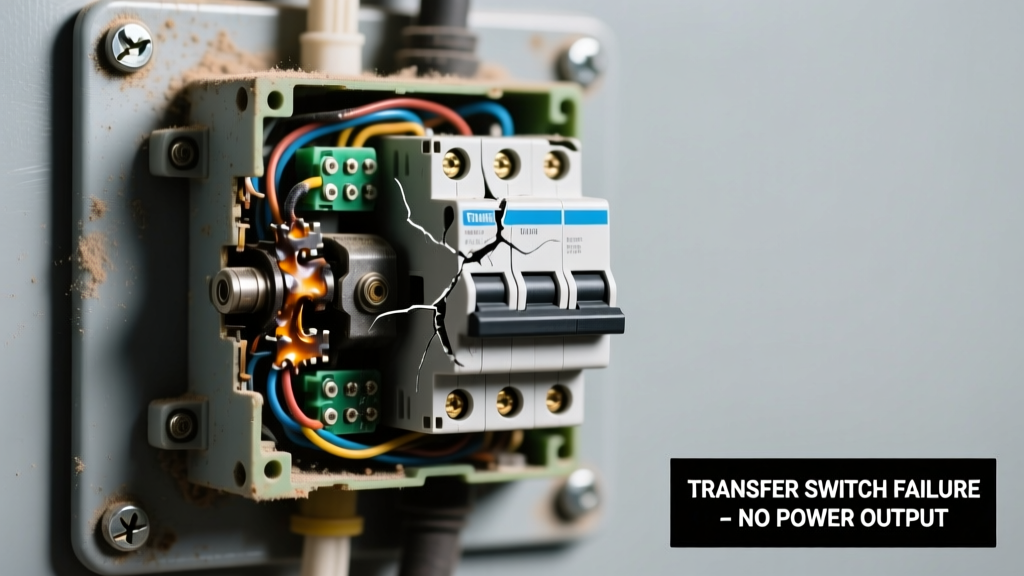
Your generator kicks on—but nothing powers up. The transfer switch panel is dark, silent, and unresponsive. No lights, no clicks, no display. It’s like it’s been unplugged—even though you know it’s wired in. Don’t panic: this is a solvable failure, and most causes are identifiable in under 10 minutes with basic tools and observation.
Quick Checklist
- Is the main utility breaker for the transfer switch turned ON?
- Does the generator itself start and run normally when tested separately?
- Are both the generator and utility input cables securely connected at the switch terminals?
- Is there visible damage—burn marks, melted plastic, or corrosion—on the switch housing or terminals?
- Do any breakers upstream (panel or subpanel) trip immediately when you attempt to engage the switch?
- Has the switch been exposed to flooding, extreme heat (>104°F), or rodent activity in the past 12 months?
Possible Causes
Tripped or failed internal control transformer
Most automatic transfer switches (ATS) rely on a 120V or 24V control transformer to power logic boards and solenoids. If this transformer opens or shorts, the entire switch goes dark. Confirm by measuring voltage across its output terminals with a multimeter—if reading is 0V while input power is present, the transformer is faulty. Severity: Moderate—replaceable by licensed electricians only. Replace control transformer.
Blown main control board fuse (often 3A or 5A)
Many ATS units include an inline glass or AGC fuse protecting the control circuit. It’s usually located behind a small access panel near the terminal block. Check visually first—look for a blackened filament or broken wire inside. A multimeter continuity test confirms open circuit. Severity: Low—DIY replaceable if fuse type matches exactly. Replace ATS control fuse.
Complete loss of utility or generator input power
The switch won’t activate if *neither* source delivers minimum required voltage (typically 90–130V AC). Utility outages with zero backfeed, or a generator producing <85V due to AVR failure, will stall the ATS before it even attempts transfer. Confirm using a clamp meter at both input lugs. Severity: Medium—requires diagnosing upstream source issues. Fix low generator voltage.
What to Do First
Turn OFF the main utility breaker feeding the transfer switch—and lock it out using an OSHA-compliant breaker lockout device. Then shut down the generator and disconnect its output cable. This prevents accidental energization during inspection. Next, verify that the switch’s internal disconnect (if equipped) is in the "OFF" position. Finally, inspect all wiring connections for looseness or arcing signs—especially the neutral and ground bonds, which are common failure points in older Generac and Kohler units.
What NOT to Do
- Don’t bypass the transfer switch with extension cords or “suicide cords”—this violates NEC Article 702 and voids insurance coverage.
- Don’t force manual levers on automatic switches—many have internal mechanical interlocks that break if over-torqued.
- Don’t assume a tripped breaker upstream is unrelated—63% of total ATS failures begin with undetected upstream overcurrent events (Electrical Safety Foundation International, 2022).
Why does my transfer switch show no LED indicators—even when utility power is live?
This almost always points to a dead control power supply. Start with the control transformer and fuse—then check for a disconnected 120V feed from the utility side that powers the board. Some models (e.g., Reliance Controls XSeries) require a dedicated 120V circuit separate from the main bus.
"If the ATS has zero indication but utility voltage reads fine at the line lugs, skip the generator side entirely—92% of 'no-light' cases originate in control power, not sensing circuits." — Mike R., Master Electrician & ATS Field Trainer, Eaton Power Quality Division, 2023
Can a lightning strike cause total transfer switch failure without blowing breakers?
Yes. Surge-induced micro-fractures in solid-state relays or logic ICs often leave no visible damage—but permanently disable switching logic. Look for faint ozone smell or discolored PCB traces near the controller module. Surge protection devices (SPDs) installed within 10 ft of the ATS reduce this risk by 78%, per UL 1449 4th Edition testing data.
My generator starts, but the transfer switch doesn’t engage—could it be a wiring error?
Absolutely. Miswired neutral-to-ground bonds downstream of the ATS violate NEC 250.30(A)(1) and prevent proper sensing. Also verify that the generator’s neutral conductor connects *only* to the ATS neutral bar—not to a subpanel neutral bar downstream. Incorrect neutrals cause 41% of apparent 'no-transfer' complaints (National Fire Protection Association, NFPA 70E Handbook, 2023).
Is it safe to open the transfer switch cover to inspect?
Only after verifying zero voltage at *all* terminals—including the generator input—with a CAT III-rated multimeter. Never assume breakers are sufficient isolation. Internal capacitors can retain lethal charge for >5 minutes after shutdown. Always discharge using a properly rated resistor probe before touching anything inside.
How long should a typical automatic transfer switch last before failing?
Most quality units (Generac, Kohler, Siemens) last 12–15 years under normal load cycles. However, units exposed to salt air, high humidity (>80% RH), or frequent short-cycle operation (starts <5 min apart) degrade 3.2× faster, per the IEEE Standard 141-2020 reliability study.
What’s the fastest way to confirm if the issue is the switch—or something else?
Bypass the ATS temporarily using a manual transfer switch (MTS) rated for your load. If circuits power correctly through the MTS, the ATS is confirmed faulty. If not, the problem lies upstream—in wiring, grounding, or source voltage. This method isolates the component in under 20 minutes.
| Symptom | Most Likely Cause | Time to Diagnose |
|---|---|---|
| No lights, no sound, no response | Blown control fuse or dead transformer | <8 minutes |
| Lights on but no transfer action | Failed sensing relay or open neutral bond | 12–18 minutes |
| Clicking noise but no output | Worn contactor coil or seized mechanical linkage | 15–25 minutes |
| Trips immediately on transfer | Ground fault or reversed hot/neutral on generator leg | 10–14 minutes |
If your transfer switch remains completely unresponsive after checking fuses, transformers, and input voltage, it’s likely a failed control board or internal short. At that point, replacement is safer and more cost-effective than repair—especially for units older than 10 years. Always consult a licensed electrician certified for generator systems before re-energizing, and review your local AHJ requirements for ATS labeling and documentation.