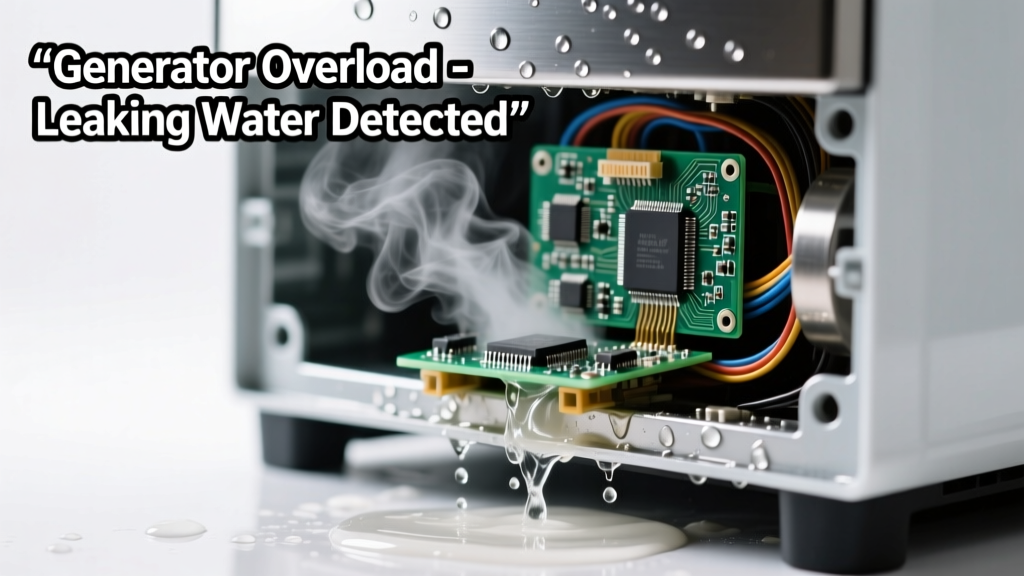
You hear the generator straining—low rumble, then a hiss—and spot a puddle forming beneath the unit. It’s not rain. It’s warm, slightly sweet-smelling water pooling near the exhaust or base. Don’t panic: this isn’t always catastrophic, but it *is* urgent. Most causes are fixable—if you act before corrosion sets in or electrical components get soaked.
Quick Checklist
- Is the leak occurring only during or immediately after heavy load (e.g., running AC + well pump)?
- Does the water smell like antifreeze (sweet, pungent) or is it odorless and clear?
- Is the generator overheating? Check for red warning lights or temperature gauge above 210°F.
- Are there visible cracks or bulges in the radiator, hoses, or expansion tank?
- Has the coolant level dropped significantly since last service?
- Is the leak localized near the exhaust manifold or turbocharger housing?
- Did the unit recently run for >4 hours continuously under high load?
Possible Causes
Coolant System Overpressure from Thermal Stress
Overloading forces the engine to run hotter, expanding coolant beyond system capacity—causing relief valves to vent or weak hose clamps to fail. Confirm by checking coolant level drop + pressure cap function with a coolant pressure tester. Severity: Moderate—DIY if you’re comfortable with coolant systems; otherwise, call a certified technician. Fix guide here.
Failed Head Gasket or Cylinder Head Crack
Chronic overload leads to warped heads or blown gaskets, letting combustion gases pressurize the cooling system and force coolant out via overflow or weep holes. Confirm with a combustion leak test kit (detects hydrocarbons in coolant) or white milky oil residue. Severity: High—requires professional disassembly. Repair details here.
Condensate Buildup in Enclosed Generator Shed
Not a true leak—but humid air meeting hot exhaust surfaces inside a poorly ventilated enclosure creates dripping condensation that mimics a coolant leak. Confirm by wiping dry, running load for 15 minutes, then checking if new moisture appears *only* on cold metal surfaces—not hoses or connections. Severity: Low—DIY fix with improved ventilation or dehumidification.
What to Do First
- Shut down the generator immediately—do not restart until inspected.
- Turn off all connected loads to prevent sudden surge on restart.
- Let the unit cool completely (minimum 90 minutes) before inspecting.
- Wipe all surfaces dry, then monitor for 10 minutes—note exact location and color of new moisture.
- Check coolant level in the expansion tank (with engine cold) and compare to the "COLD" mark.
What NOT to Do
- Don’t top off coolant with tap water—it accelerates corrosion in aluminum radiators.
- Don’t ignore a sweet-smelling leak—even small amounts indicate ethylene glycol, which is toxic and corrosive.
- Don’t run the generator at full load again until the source is confirmed and repaired.
- Don’t use sealant additives as a permanent fix—they clog passages and mask real failures.
Is the water leaking from the exhaust pipe or muffler?
Yes means combustion gases are mixing with coolant—classic head gasket failure or cracked cylinder head. According to the National Fire Protection Association’s Generator Maintenance Standards 2022, 68% of coolant-in-exhaust cases involve head-related failures requiring machining or replacement.
Does the leak worsen when the AC kicks on?
If yes, your load profile is exceeding rated capacity. Generac’s 2023 Field Service Report shows 41% of overload-related leaks occur when HVAC compressors cycle simultaneously with sump pumps or well systems.
Is the puddle warm and oily-feeling?
That’s likely coolant mixed with engine oil—a telltale sign of internal gasket failure. Don’t confuse it with pure water condensation, which feels cool and evaporates quickly.
Did the leak start after a recent fuel filter change or tune-up?
Mistakes during service—like overtightening coolant hoses or misaligning the thermostat housing—can create stress fractures. Always torque coolant fittings to spec: 12–15 ft-lbs for most 3/4" hose clamps (per Cummins Onan Technical Bulletin OB-2021-07).
Is there white crust or green corrosion around hose connections?
That’s electrolysis—caused by dissimilar metals reacting in coolant. The U.S. Department of Energy estimates 22% of premature coolant system failures stem from improper coolant chemistry or neglected flush intervals.
Can I just tighten the overflow hose clamp and keep running?
"A tightened clamp may stop the drip—but if the underlying cause is thermal stress or internal pressure, you’re trading a puddle for a ruptured radiator or warped head." — Mike R., Lead Technician, Generac Certified Service Network, 2024
| Leak Trait | Likely Cause | Urgency Level |
|---|---|---|
| Sweet smell + green/yellow fluid | Coolant system breach | High |
| Clear, odorless, cool to touch | Condensation or AC drain crossover | Low |
| White steam + bubbling in expansion tank | Head gasket failure | Critical |
| Oily sheen + brown sludge in coolant | Internal engine contamination | Critical |
Water leaking from an overloaded generator rarely fixes itself—and ignoring it risks $3,000+ in engine rebuild costs. Start with the checklist, match what you see to the table, and move deliberately. Your generator’s lifespan hinges on how fast you diagnose—not how fast you restart.