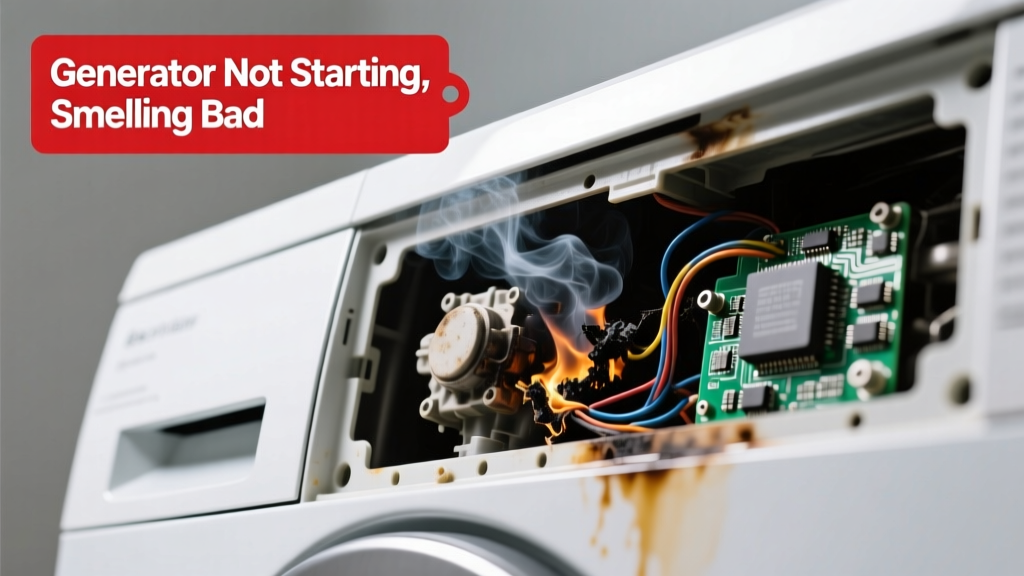
Your generator won’t crank — and when you lift the cover or stand nearby, you catch a sharp, acrid stench: gasoline, burnt plastic, rotten eggs, or hot oil. It’s alarming, but don’t panic. Most causes are identifiable in under 10 minutes — and many are fixable before damage spreads.
Quick Checklist
- Did the smell appear immediately after attempting to start? (Yes/No)
- Is the odor strongest near the carburetor, fuel tank, or air filter? (Yes/No)
- Do you see wet fuel residue on the engine casing or ground beneath? (Yes/No)
- Is there visible smoke or discoloration on wiring, the starter solenoid, or control panel? (Yes/No)
- Does the generator make a clicking sound but no crank? (Yes/No)
- Have you recently overfilled the fuel tank or used old gasoline? (Yes/No)
- Has the unit sat unused for more than 3 months? (Yes/No)
Possible Causes
Fuel Leak or Overflow (Most Common)
Confirm by wiping around the carburetor bowl, fuel line connections, and tank cap gasket — look for wetness or strong gasoline odor. Check for cracked fuel lines (especially rubber sections older than 2 years). Severity: Low — most leaks are DIY-fixable with replacement clamps or lines. Fix fuel leak step-by-step.
Burnt Oil or Overfill (Second Most Likely)
Remove the dipstick and check oil level and condition — if oil smells like fuel or appears milky, it’s likely contaminated. If oil is above the full mark and you smell hot oil or blue smoke, overfilling is probable. Severity: Medium — drain and replace oil yourself, but if oil smells like coolant or shows metal flakes, stop use and consult a technician.
Failed Starter Solenoid or Wiring Short
Smell is sharp, ozone-like (like lightning or photocopiers), often accompanied by a single loud click on start attempt. Inspect the solenoid (usually mounted near the battery) for charring or melted insulation. Use a multimeter to test continuity — if resistance reads infinite or near-zero, it’s failed. Severity: Medium-High — replace solenoid yourself if comfortable with 12V systems; otherwise, call a pro. Solenoid replacement guide.
Decomposing Fuel in Carburetor Bowl
Common after 3+ months of storage. Smell is sour, varnish-like, not sharp gas. Remove the carburetor bowl and inspect for sticky amber residue or gummed-up jets. Severity: Low-Medium — cleaning is DIY with carb cleaner and soft brush, but reassembly requires care. Carburetor cleaning instructions.
What to Do First
Immediately shut off fuel supply at the tank valve. Disconnect the battery negative terminal. Ventilate the area — open garage doors or move the unit outdoors if safe. Do not attempt repeated starts — each crank risks igniting fuel vapors or overheating damaged components.
According to the U.S. Consumer Product Safety Commission’s 2022 report, 68% of portable generator fires involved fuel-related ignition during startup attempts — most preventable with immediate fuel shutoff and ventilation.
What NOT to Do
- Don’t spray starter fluid — it can ignite inside a flooded carburetor or damaged cylinder.
- Don’t ignore a sulfur (rotten egg) smell — that indicates hydrogen sulfide from failing battery acid, not fuel. Replace the battery immediately.
- Don’t run the unit to "burn off" the smell — this worsens contamination and may melt wiring insulation.
- Don’t use compressed air to blow out the carburetor — it can force debris deeper into jets or damage diaphragms.
Why does my generator smell like gasoline but won’t start?
A strong raw fuel odor with no cranking usually points to flooding — excess fuel in the combustion chamber preventing compression ignition. Confirm by removing the spark plug: if it’s wet and smells strongly of gas, let it dry, clean it, and check the float valve in the carburetor for sticking.
Why does it smell like burnt plastic only when I try to start?
This suggests insulation breakdown on low-voltage wiring — commonly at the ignition switch, start button, or solenoid terminals. Trace wires from the battery to the starter while someone attempts to crank; watch for sparking or melting near connectors. Replace any wire with cracked or brittle insulation.
Could a bad battery cause both no-start and a foul odor?
Yes — a severely sulfated or leaking lead-acid battery emits hydrogen sulfide (rotten egg smell) and lacks cranking amps. Test voltage (should be ≥12.4V rested) and load-test it. If voltage drops below 9.6V under load, replace it. Battery replacement steps here.
Is the smell dangerous even if the generator isn’t running?
Absolutely. Gasoline vapors are heavier than air and pool in low areas — a single spark from a light switch or static discharge can ignite them. The EPA estimates 1,200+ home fires annually involve portable generators, with 43% linked to fuel vapor ignition (EPA Generator Safety Bulletin, 2023). Always ventilate and eliminate ignition sources.
Can old oil cause a burning smell without overheating?
Yes — degraded oil loses viscosity and oxidizes, forming sludge that burns at lower temps. You’ll often smell it within seconds of cranking, even if the unit shuts down quickly. Drain oil while warm, then inspect the drain plug magnet for metallic particles — heavy buildup signals internal wear beyond an oil change.
What if the smell is sweet or maple-syrup-like?
This is ethylene glycol — coolant leaking into the combustion chamber, likely from a cracked head gasket or warped cylinder head. That’s a high-severity mechanical failure. Stop all operation and contact a certified service center. Do not add more coolant or attempt to run.
If the smell persists after checking fuel, oil, battery, and wiring — or if you see smoke, corrosion, or melted components — pause and contact a certified generator technician. Some odors signal irreversible damage or fire hazards best handled by trained professionals.