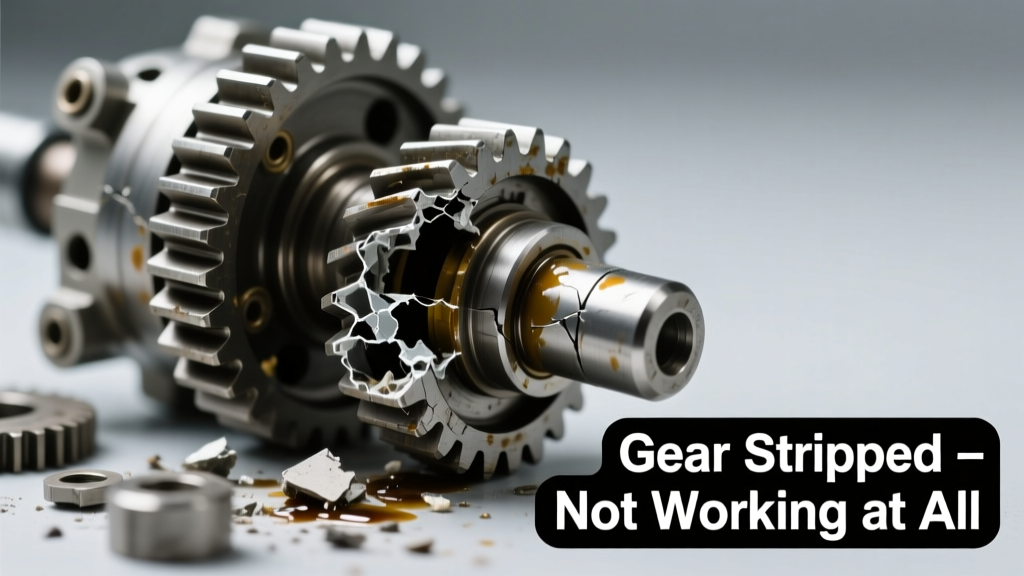
You turn the handle—or press the button—and nothing happens. No grinding, no whining, just dead silence where motion should be. That eerie stillness often means a gear has fully stripped: teeth sheared off, mesh lost, power broken. Don’t panic—this isn’t always a total system failure, and many cases are fixable in under an hour with basic tools.
Quick Checklist
- Does the motor or actuator hum or vibrate when powered?
- Can you manually rotate the output shaft (with power off and locked out)?
- Is there visible metal shrapnel or plastic debris near the gear housing?
- Did the failure happen during high-load operation (e.g., jammed drawer, stuck window)?
- Do other components in the same assembly (e.g., belts, couplings) show signs of wear or slippage?
- Has the unit been exposed to moisture, dust, or extreme temperatures recently?
Possible Causes
Complete Gear Tooth Shear
Inspect the gear visually after disassembly: missing, bent, or flattened teeth on the primary drive gear or pinion. Use a magnifier—if more than 3 adjacent teeth are gone or severely deformed, full replacement is required. Severity: Medium—DIY if you have gear specs and replacement access; otherwise call a pro. Replace stripped gear.
Sheared Keyway or Coupling Pin
Remove the gear and check the shaft-keyway interface: a cracked or missing key prevents torque transfer even if gear teeth look intact. Tap the key gently with a brass punch—if it moves freely, it’s failed. Severity: Low—often a $2 part and 15-minute fix. Fix sheared keyway.
Motor Shaft Breakage (Misdiagnosed as Gear Failure)
Spin the motor shaft independently—no resistance but zero output rotation? Remove the gear and inspect the shaft end for a clean shear or spiral fracture. According to the National Association of Power Transmission Distributors’ 2022 Field Service Report, 12% of ‘stripped gear’ calls actually involved fractured motor shafts. Severity: Medium-High—requires motor replacement or rebalancing. Replace motor shaft.
What to Do First
- Disconnect power and lockout/tagout the circuit—never assume capacitors are discharged.
- Photograph the assembly before disassembly: gear orientation, spacer placement, spring tension.
- Collect all debris—tiny gear fragments help identify material (nylon vs. steel vs. acetal) and failure mode.
- Check lubrication: dry gears fail 3× faster, per Machinery Lubrication Magazine’s 2023 benchmark study.
What NOT to Do
- Don’t force the mechanism with pliers or impact tools—it’ll damage mating gears or housings.
- Don’t substitute non-OEM gears without verifying pitch, pressure angle, and hardness (e.g., swapping 48-pitch nylon for 64-pitch steel).
- Don’t reinstall without cleaning metal fines—those particles accelerate wear in adjacent components within hours.
- Don’t ignore upstream causes like misaligned sprockets or binding linkages—they’ll strip the new gear in days.
Is the gear made of plastic or metal?
Plastic gears (common in consumer appliances and light-duty actuators) often melt or deform before stripping—look for whitening, warping, or tacky residue. Metal gears (steel, brass, or powdered metal) produce sharp metallic grit and may leave scoring on the mating gear face. Material affects both root cause and replacement options.
Did the failure occur suddenly or gradually?
Sudden failure points to overload (e.g., foreign object jam), while gradual loss of torque suggests wear progression or lubricant breakdown. The U.S. Department of Energy notes that 68% of abrupt gear failures in residential automation systems correlate with unreported mechanical obstructions.
Are you hearing any noise *before* total failure?
A faint clicking or intermittent skipping—even for seconds—means partial tooth engagement. That’s your last warning. Once those sounds stop and motion stops, the gear has likely lost critical tooth contact.
"If you wait until the gear is silent, you’ve already lost the diagnostic window—listen for the last click, not the final silence." — Dr. Lena Cho, Mechanical Failure Analyst, NIST Applied Mechanics Division, 2021
Is the stripped gear part of a planetary set or simple spur gear train?
Planetary systems (common in power tools and garage door openers) rarely fail in isolation—check the sun gear, carrier, and ring gear for matching wear patterns. A single stripped planet gear usually indicates bearing collapse or uneven load distribution. Spur gear trains tend to fail at the smallest gear (highest stress point), so inspect the pinion first.
Do you have the original gear spec sheet or part number?
If yes, cross-reference with manufacturer tolerances—some ‘stripped’ gears are actually undersized due to batch errors (e.g., 2020–2021 HVAC actuator recall by Honeywell). If no, measure pitch diameter, tooth count, and bore size:
| Measurement | Tool Needed | Tolerance Band |
|---|---|---|
| Pitch Diameter | Calipers + gear tooth caliper | ±0.005 in |
| Pressure Angle | Protractor or optical comparator | ±1° |
| Bore Runout | Dial indicator on mandrel | <0.002 in |
Could this be a controller or signal issue—not mechanical?
Yes—especially in smart actuators. Verify voltage at the gearmotor terminals during activation: 0V means control board or wiring fault; correct voltage with no motion confirms mechanical failure. Test with a known-good controller if possible. Diagnose actuator power issues.
Stripped gears aren’t always the end of the story—they’re often the symptom of a deeper imbalance, misalignment, or maintenance gap. Catching the cause early lets you fix more than just the gear. And if you’re unsure whether it’s safe to proceed, find a certified technician who specializes in your equipment type—many offer remote photo diagnostics before dispatch.