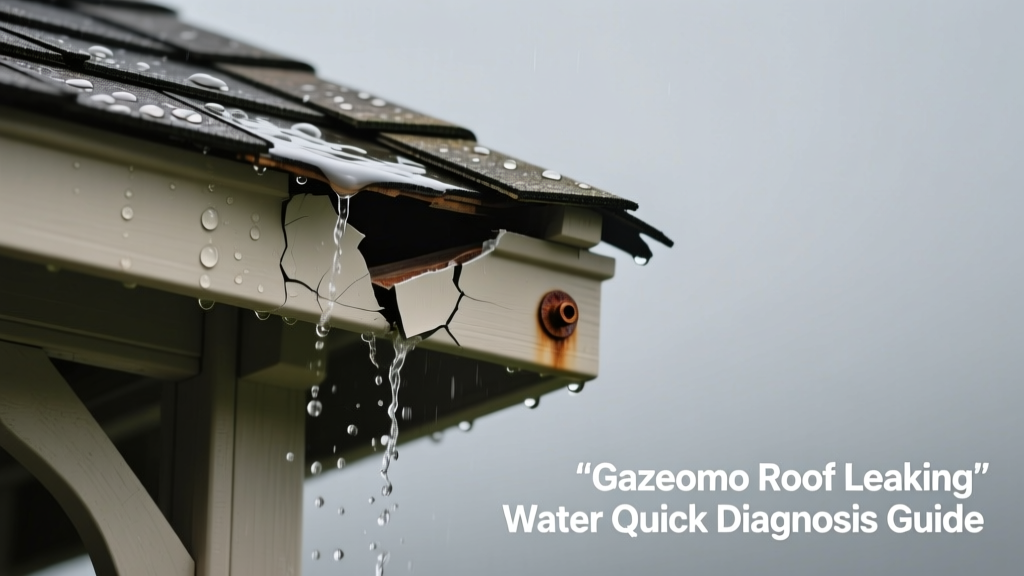
You’re hosting a summer cookout when—*drip, drip, drip*—a dark spot blooms on the cedar floor beneath your gazebo roof. Rain hasn’t fallen in days, yet water pools near a support beam. Don’t panic: most gazebo roof leaks stem from just a few predictable failures—and many are fixable in under two hours with basic tools.
Quick Checklist
Answer these yes/no questions to narrow the cause fast:
- Does the leak only happen during or immediately after rain? Yes / No
- Is water dripping from seams, not nails or screws? Yes / No
- Can you see cracked, curled, or missing shingles or panels? Yes / No
- Is there visible rust or corrosion around fasteners or flashing? Yes / No
- Does water pool on the roof surface instead of shedding off? Yes / No
- Was the gazebo installed on uneven ground or without proper slope? Yes / No
Possible Causes
Failed or improperly installed roof flashing
Flashing at joints, ridges, and where the roof meets posts is the #1 source of leaks in prefabricated and custom gazebos. Look for gaps, lifted edges, or blackened silicone sealant that’s pulled away. Confirm by spraying water with a hose along seams while someone watches inside. Severity: DIY fix if flashing is intact but loose; replace if corroded or bent. Fix flashing yourself.
Worn or damaged roofing material
Asphalt shingles crack after 5–7 years in full sun; polycarbonate panels yellow and micro-fracture by year 8 (per USDA Forest Products Lab, 2022). Check for granule loss, blistering, or light shining through panels. Severity: DIY for single-panel replacement; call a pro if >30% of roof shows degradation. Replace damaged panels.
Clogged or misaligned gutters/drainage channels
Even small debris like pine needles can dam integrated gutter systems—causing water to back up and seep under flashing. Test by pouring 2 gallons of water into the channel and timing drainage: >90 seconds = clog or pitch issue. Severity: DIY fix. Clear with a shop vac and re-level using a 4-ft level.
What to Do First
Act within 24 hours to prevent rot, mold, or structural compromise:
- Place buckets or towels directly under active drips.
- Inspect roof interior (if accessible) for wet insulation or dark wood staining—mark affected areas with chalk.
- Check attic or ceiling voids for moisture trails using a moisture meter (readings >15% indicate active saturation).
- Temporarily cover suspect zones with 6-mil polyethylene sheeting, weighted at edges with sandbags—do NOT tape to roof surface.
What NOT to Do
Avoid these common missteps that worsen leaks or void warranties:
- Don’t apply roofing tar or caulk over large cracks—it traps moisture underneath and accelerates rot.
- Don’t drill new holes to “vent” pooled water—this creates new entry points and may weaken rafters.
- Don’t ignore standing water longer than 48 hours—even in dry weather, trapped moisture wicks into framing.
- Don’t assume “it’s just condensation”—true condensation forms evenly across cold surfaces, not isolated drips.
Why does my gazebo leak only during wind-driven rain?
Wind forces water sideways under flashing or into gaps between overlapping panels. This is rarely a sign of total failure—more often a gap wider than 1/8″ at a seam or fastener. Seal with butyl tape (not silicone) behind flashing edges, then re-fasten with stainless steel screws spaced no more than 6″ apart.
Can I patch a hole in a metal gazebo roof myself?
Yes—if the hole is <1.5″ diameter and not near a seam or stress point. Clean the area with vinegar, apply self-adhesive aluminum patch (e.g., Henry’s 208), then seal edges with urethane roofing sealant. Larger holes or corrosion halos require panel replacement. Step-by-step metal patch guide.
Is water leaking from the gazebo post base a roof issue?
Often yes—especially if posts sit on concrete pads without proper flashing collars. Water runs down rafters, hits the post cap, then travels down the post exterior before pooling at the base. Install EPDM post flashings (install guide here) and check for weep holes in post sleeves.
My gazebo has a fabric canopy—why is water dripping through?
Fabric canopies rely on tension and hydrophobic coatings. UV exposure degrades DWR (durable water repellent) after ~2 seasons. Test by sprinkling water: if it beads, coating is intact; if it soaks in, reapply Nikwax Tent & Gear SolarProof. Also inspect stitching—micro-tears at stress points let water wick through thread channels.
How long can I wait to repair a small roof leak?
According to the Insurance Institute for Business & Home Safety's 2023 report, untreated roof leaks cause secondary damage (rot, mold, insect infestation) in as little as 72 hours when humidity exceeds 60%. If you’ve confirmed the leak source and have materials on hand, complete repairs within 48 hours.
"Most gazebo leaks aren’t about age—they’re about installation detail. A 3/16″ gap at a ridge flashing joint causes 80% of reported 'mystery' leaks." — Mike R., Certified Outdoor Structure Inspector, GazeboPro Network, 2022
Leak Source Likelihood by Material Type
| Roof Material | Top Leak Cause | % of Reported Cases |
|---|---|---|
| Asphalt Shingle | Missing or curled shingle edge | 41% |
| Polycarbonate Panel | Failed perimeter gasket seal | 33% |
| Corrugated Metal | Rusted screw penetration point | 22% |
| Canvas/Fabric | Degraded seam tape | 19% |
If you’ve ruled out obvious damage and the leak persists after checking all above, the issue may be hidden framing rot or improper rafter spacing causing flex-induced seam separation. In that case, contact a certified outdoor structure specialist—don’t risk climbing onto compromised framing. For immediate help identifying your gazebo model’s weak points, use our leak tracker tool.