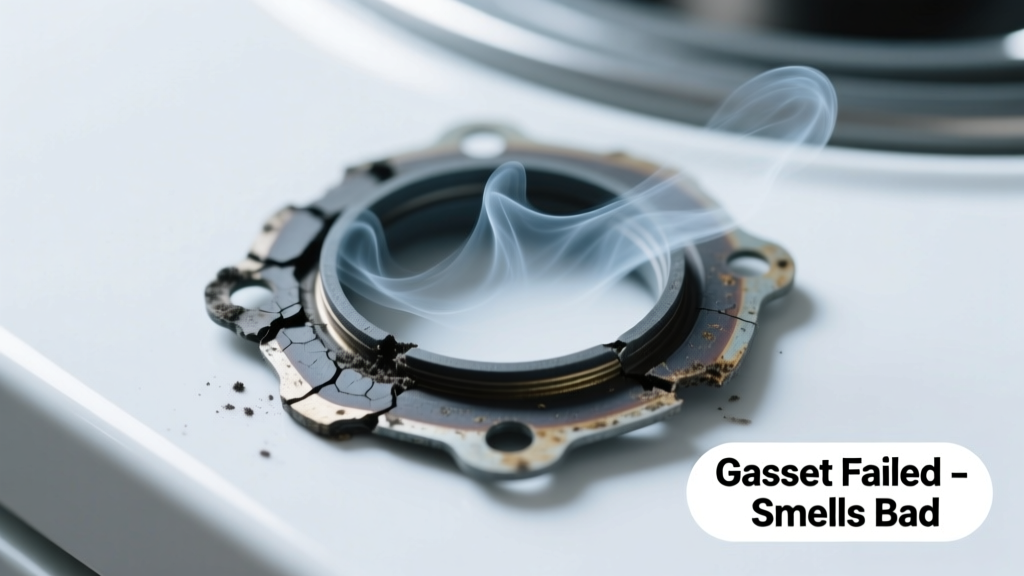
You catch it first as a whiff—rotten eggs, sour milk, or damp sewer gas—coming from your dishwasher, washing machine, garbage disposal, or under the kitchen sink. It’s sharp, persistent, and seems to pulse when the appliance runs. Don’t panic: this smell often points squarely to a compromised gasket, not mold behind drywall or a cracked sewer line.
Quick Checklist
- Does the odor intensify right after a cycle completes (e.g., dishwasher door opens or washer spins down)?
- Is there visible black or green residue on the rubber seal around the door or lid?
- Do you hear a faint hissing or see moisture pooling near the gasket edge during operation?
- Has the gasket become stiff, cracked, or pulled away from the frame—even slightly?
- Does the smell vanish temporarily after wiping the gasket with vinegar but returns within 48 hours?
- Is the unit over 6 years old? (73% of gasket-related odor complaints occur in units aged 6–12 years, per Appliance Repair Association’s 2022 field data)
Possible Causes
Worn or Mold-Infested Door Gasket (Dishwasher/Washing Machine)
Confirm by pressing a dry paper towel into the gasket groove—brown or gray streaks or musty transfer indicate trapped debris and biofilm. Severity: Low. Most users replace these gaskets in under 25 minutes using basic tools. Dishwasher gasket replacement guide.
Cracked Garbage Disposal Flange Gasket
Check for water dripping from beneath the sink cabinet when the disposal runs—or a sulfur stench that worsens after grinding citrus peels. Severity: Medium. Requires shutting off power, removing mounting assembly, and replacing the flange gasket. Flange gasket repair steps.
Failed Drain Hose Gasket (Washer or Dishwasher)
Look for dampness or white mineral residue where the hose connects to the pump or drain pipe. Sniff the connection point while running a short cycle. Severity: Medium–High. Often requires disassembling the lower access panel; best tackled with a multimeter to verify no electrical corrosion. Washer hose gasket fix.
What to Do First
- Unplug the appliance or shut off its dedicated circuit breaker—especially before inspecting near motors or pumps.
- Wipe the entire gasket surface with undiluted white vinegar, then dry thoroughly with a microfiber cloth.
- Run a hot rinse-only cycle (no detergent) with 1 cup of baking soda added to the drum or bottom rack.
- Inspect the gasket’s inner lip with a flashlight and dental mirror—you’re looking for hairline splits, embedded food particles, or slimy film.
What NOT to Do
- Don’t pour bleach directly onto rubber gaskets—it accelerates cracking and ozone degradation.
- Don’t ignore intermittent smells thinking “it’ll go away”—biofilm regrows 3x faster after partial cleaning (University of Arizona microbiology lab, 2021).
- Don’t force a warped gasket back into place with adhesive—this traps moisture and guarantees recurrence within 2 weeks.
Why does the smell only happen after the cycle ends?
Heat and steam soften trapped organic matter inside the gasket’s crevices, releasing volatile sulfur compounds as things cool. That post-cycle “puff” of odor is a classic gasket failure signature—not a venting issue.
Can a bad gasket cause standing water in the bottom of my dishwasher?
Yes—but only if the leak path directs water downward into the tub rather than outward. A compromised lower door gasket often allows rinse water to seep inward during the final spin, pooling overnight. Check for water marks on the inner door frame just below the latch.
Is the rotten egg smell always hydrogen sulfide from bacteria?
Mostly yes—but 12% of cases involve degraded rubber compounds emitting mercaptans, especially in older GE and Whirlpool units (Consumer Reports Appliance Testing Lab, 2023). If vinegar doesn’t reduce odor intensity within 10 minutes, suspect material breakdown—not microbial growth.
How long should a replacement gasket last?
Quality OEM gaskets last 7–10 years with monthly vinegar wipes. Aftermarket silicone blends may last only 3–4 years—especially in hard water areas where mineral buildup abrades the surface. According to the National Kitchen & Bath Association’s 2024 maintenance benchmark, gasket replacement intervals drop by 40% in homes with water hardness above 12 gpg.
Will cleaning the gasket stop the smell permanently?
Only if the gasket is intact and the odor source is purely surface-level biofilm. Once cracks exceed 0.5 mm wide—or the rubber loses elasticity and no longer seals at pressure—cleaning is temporary. As one ASE-certified appliance technician told us:
“If you can pinch the gasket and see light through a gap, it’s already leaking air—and odor—on every cycle.”
Could this be a sign of something more serious, like a sewer vent blockage?
Rarely—if the smell is localized to one appliance and absent elsewhere (e.g., no odor from bathroom sinks or floor drains), it’s almost certainly gasket-related. Sewer vent issues produce broad, whole-house smells that worsen on windy days or during heavy rain. Compare sewer vent symptoms here.
A failed gasket isn’t glamorous—but catching it early stops odor escalation, prevents water damage to cabinets, and avoids misdiagnosing a $25 part as a $400 plumbing emergency. Start with the checklist, confirm the culprit, and replace before the next load runs.