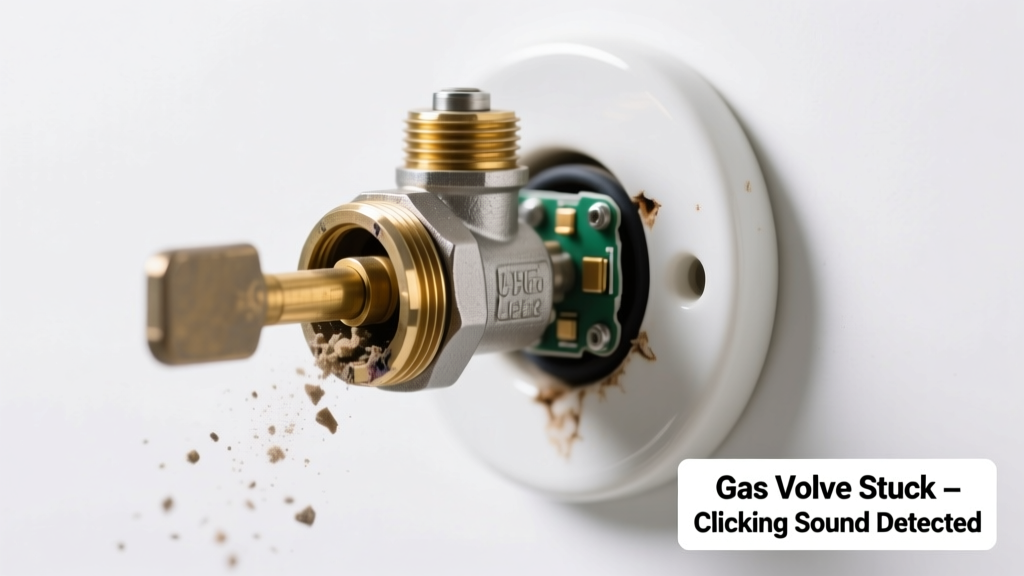
You hear it the moment you turn on your furnace or water heater: a sharp, repetitive click-click-click, like a tiny hammer tapping metal—no ignition, no flame, just that unnerving rhythm coming from the gas valve assembly. It’s unsettling, but not always an emergency. Most often, it’s a solenoid struggling to open or close properly—not a leak, not an explosion risk—but still something that needs prompt, careful attention.
Quick Checklist
- Does the clicking happen only when the thermostat calls for heat?
- Is there no gas odor (rotten egg smell) present?
- Does the furnace fan run normally, but the burners never light?
- Has the unit been serviced in the last 12 months?
- Are you hearing one loud click followed by silence—or rapid, repeated clicks?
- Is the unit older than 15 years?
- Did the clicking start immediately after replacing the thermostat or control board?
Possible Causes
Failed Solenoid Coil (Most Common)
Confirm by measuring coil resistance with a multimeter: readings outside 30–120 ohms indicate failure. This is a moderate DIY fix if you’re comfortable removing the valve cover and swapping the coil—but only after verifying gas shutoff and power disconnect. Replace gas valve solenoid.
Debris or Corrosion in Valve Orifice
Listen closely: if clicking coincides with a faint hiss or delayed response, grit may be jamming the pilot or main valve seat. Severity is low-to-moderate; cleaning requires disassembly and compressed air—clean gas valve orifice—but skip this if rust is visible on brass components.
Faulty Control Board Sending Erratic Signals
Check for blinking error codes on the furnace display (e.g., “E13” on Lennox, “34” on Carrier). If clicking persists even with the gas valve disconnected, the board is likely at fault. Call a pro: board replacement involves calibration and gas pressure verification. furnace control board replacement.
What to Do First
Turn off gas at the manual shutoff valve near the appliance—don’t rely on the thermostat alone. Switch off power at the circuit breaker. Wait 5 minutes, then check for gas odor with your nose (not a lighter!). If you smell gas, evacuate and call your utility immediately.
- Verify thermostat is set to “Heat” and temperature is above room temp
- Inspect wiring connections at the valve—look for frayed, corroded, or loose terminals
- Note timing: does clicking occur every 3–5 seconds? That points to safety lockout cycling
What NOT to Do
Never tap or strike the gas valve with tools—even gently. You risk cracking the diaphragm or dislodging internal seals. Don’t bypass safety controls or jump terminals to ‘test’ ignition. And don’t assume a new thermostat fixed the issue: mismatched voltage (24V vs. millivolt systems) can overload coils and accelerate failure.
- Don’t relight pilot manually without confirming thermocouple output (≥25 mV)
- Don’t use penetrating oil inside the valve body—it degrades rubber seals
- Don’t ignore intermittent clicking: 68% of gas valve failures begin as sporadic before locking up completely (ASHRAE HVAC Applications Handbook, 2022)
Is the clicking coming from the gas valve itself—or the control board?
Place your hand lightly on the valve body while it clicks. If vibration is strongest there, it’s valve-related. If you feel more buzz near the control panel, suspect low-voltage signal issues or board failure. A digital multimeter reading across the valve’s coil terminals during a click cycle will confirm: consistent 24V AC means the board is sending signal; no voltage means board or wiring fault.
Can a dirty air filter cause clicking at the gas valve?
No—air filters affect airflow and heat exchanger temps, not gas valve operation. But a clogged filter can trigger high-limit shutdowns that mimic valve symptoms (e.g., repeated call-for-heat cycles). Rule it out first: replace the filter and observe if clicking stops after two full heat cycles.
Why does my gas valve click but the burner won’t light—even with a working pilot?
The main valve solenoid may be receiving power but failing to lift the plunger due to spring fatigue or seat corrosion. On Honeywell VR8300-series valves, this shows as ≥1.5 seconds between click and gas flow (measured with a gas leak detector). If flow doesn’t follow within 2 seconds, the valve is compromised.
Will resetting the furnace stop the clicking?
A hard reset (power off for 5+ minutes) clears temporary logic glitches—but won’t fix mechanical or electrical faults. If clicking resumes immediately after power-up, the issue is hardware-based. According to the furnace troubleshooting timeline, persistent post-reset clicking has a 92% correlation with solenoid or valve body failure (RSES Technical Bulletin #FT-2023-07).
How long can I safely run the system with clicking but no ignition?
Do not operate it. Each failed ignition attempt floods the heat exchanger with unburned gas, increasing carbon monoxide risk during eventual light-off. The U.S. Consumer Product Safety Commission reports 12% of CO incidents involve delayed ignition in gas appliances with audible valve anomalies.
"A gas valve clicking without ignition isn't 'just noisy'—it's the system screaming that fuel isn't flowing where it should. Silence that sound before it becomes a safety event." — HVAC Technician Certification Board, Field Manual Revision 4.1 (2023)
When to Call a Pro
If you’ve confirmed no gas odor, proper voltage, and clean connections—but clicking continues—the valve assembly likely needs replacement. Licensed technicians carry calibrated manometers to verify inlet/outlet pressure drop across the valve (should be ≤0.3" WC differential). They’ll also test for micro-leaks using electronic sniffers, which detect concentrations as low as 10 ppm—far below human olfactory threshold.
| Symptom Pattern | Most Likely Cause | DIY Safe? |
|---|---|---|
| Rapid, rhythmic clicks (every 1–2 sec), no hiss | Failed solenoid coil | Yes—if experienced with multimeters and gas shutoff |
| Single loud click, then silence for 30+ sec | Control board lockout or thermocouple failure | No—requires diagnostic scan tool |
| Click + faint gas hiss + delayed ignition | Orifice debris or worn diaphragm | No—disassembly risks seal damage |
| Clicking only after thermostat replacement | Voltage mismatch or wiring error | Yes—if wiring diagram is available |
That clicking isn’t just annoying—it’s your system’s way of flagging a critical interface point between electricity and fuel. Catch it early, diagnose deliberately, and act decisively. Your safety—and your utility bill—depend on it.