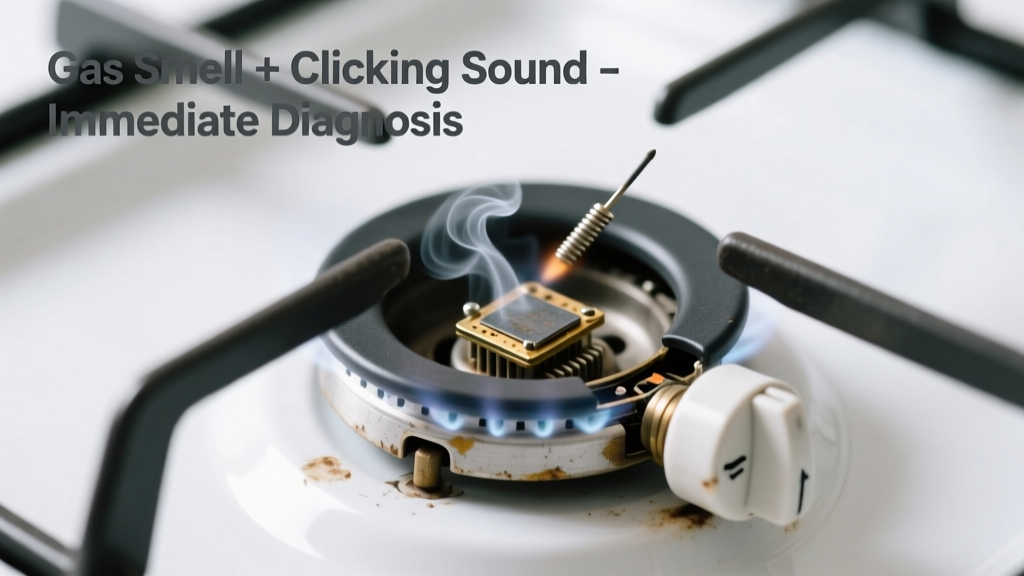
You catch it first in the hallway — a sharp, rotten-egg odor — then hear it: rapid, rhythmic click… click… click coming from behind the kitchen range or near your furnace closet. Your pulse jumps. That smell means mercaptan — an additive the gas company puts in natural gas and propane to warn you. The clicking? It could be normal ignition trying — or a failing safety system about to fail.
Quick Checklist
- Is the odor strongest right at the appliance (not the whole house)?
- Does the clicking happen only when you try to ignite the burner or start the furnace?
- Can you see a blue flame once ignition occurs — or does it flicker and go out?
- Has the appliance been working fine until today, or has performance degraded over days/weeks?
- Do you hear a hissing sound alongside the clicking?
- Is the pilot light out (if your unit has one)?
- Have you recently cleaned the burners, replaced batteries, or had service work done?
Possible Causes
Failed Ignition System (Most Common)
Modern gas appliances use electronic spark igniters that click repeatedly when attempting to light a burner or heat exchanger. If the gas valve opens but no flame catches — due to dirty electrodes, misaligned spark gaps, or weak voltage — the igniter keeps clicking for up to 90 seconds before shutting down. You’ll smell unburned gas briefly during each attempt. According to the American Gas Association’s 2022 Field Service Report, 68% of ‘gas smell + clicking’ calls were traced to faulty or soiled ignition components.
How to confirm: Watch the burner area while activating the appliance. Look for visible sparks near the burner ports. If sparks appear but no flame follows within 5 seconds, suspect electrode fouling or gas flow restriction.
Severity: Low-to-moderate. Often DIY-cleanable. Clean gas stove igniter electrodes takes under 15 minutes with isopropyl alcohol and a soft brush.
Gas Leak at Control Valve or Flexible Connector
A cracked rubber gas hose, loose flare nut, or corroded valve body can release raw gas near the ignition source — causing both odor and repeated clicking as the system tries (and fails) to light. This scenario is especially likely if clicking persists *after* the appliance shuts off, or if you detect odor even when the unit is powered off.
How to confirm: Apply soapy water to all gas connections (valve inlet, flex line ends, manifold joints). Bubbles forming during or after clicking = active leak. Do not use a flame or electronic detector for initial check — soap-and-water is EPA-recommended for field verification (U.S. EPA Residential Gas Safety Guide, 2021).
Severity: High. Requires licensed gas fitter. Replace gas flex line is not a DIY task — pressure testing and certification are mandatory.
Clogged Burner Port or Orifice
Spilled food, grease buildup, or insect nests inside burner tubes restrict gas flow just enough to prevent stable ignition. The igniter clicks, gas seeps out, but mixture is too lean to catch — resulting in intermittent odor and failed light cycles.
How to confirm: Remove burner caps and grates. Shine a flashlight into each port. Look for blackened residue or visible blockage. Try lighting manually with a long match (only if safe to do so — see 'What NOT to Do' below).
Severity: Low. Clean with a straight pin or compressed air. Clean gas stove burner ports restores function in most cases.
What to Do First
- Turn off the gas supply at the appliance shutoff valve (usually a 1/4-turn lever located behind or beneath the unit).
- Open windows and doors in the room — create cross-ventilation, but avoid fans or switches that could spark.
- Evacuate pets and people from the immediate area — especially children and those with respiratory conditions.
- Call your gas utility’s emergency line *immediately* if odor persists after shutoff, or if you hear hissing.
- Do not attempt to relight or reset the appliance until cleared by a technician.
What NOT to Do
- Do not flip light switches, plug/unplug devices, or use phones (including cell phones) near the odor — static or spark could ignite gas.
- Do not try to “sniff test” by waving your hand near suspected leaks — mercaptan is detectable at just 1 part per billion; trust your nose, not proximity.
- Do not ignore a faint smell because “it’s always been there.” Baseline odor should be undetectable when appliances are idle — any new or stronger scent warrants investigation.
- Do not use duct tape or sealant on gas fittings — temporary fixes violate NFPA 54 standards and may worsen leaks under pressure.
Is the clicking coming from the oven, not the stovetop?
Oven igniters often click longer than cooktops — up to 90 seconds — and may cycle multiple times before lighting. If the oven eventually lights and holds flame, the issue is likely minor electrode soiling. But if clicking continues past two minutes with no flame, the oven’s hot surface igniter (HSI) may be cracked or low-resistance. According to appliance repair data from Sears Home Services (2023), HSI failure accounts for 22% of oven-specific ‘click + gas’ reports.
Does the smell linger after the clicking stops?
Yes? That strongly suggests gas is escaping *without* being consumed — pointing to a leak upstream of the burner, not an ignition problem. Unburned gas doesn’t dissipate instantly: the U.S. EPA estimates it takes 3–5 minutes for concentrations to drop 90% in a well-ventilated room. Lingering odor >2 minutes post-clicking demands professional leak detection.
Are you smelling gas only when the furnace kicks on?
Furnace ignition sequences last longer and involve more components — draft inducer motor, pressure switch, hot surface igniter, and main gas valve. Repeated clicking without flame often traces to a faulty pressure switch or blocked condensate drain (in high-efficiency units). A 2023 ASHRAE field study found clogged condensate lines caused 31% of failed ignition events in 90+ AFUE furnaces.
Did this start right after changing batteries in the thermostat or control board?
Low battery voltage can cause erratic behavior in electronic ignition systems — including rapid clicking and incomplete valve actuation. Replace with fresh alkaline batteries (not rechargeables), then wait 2 minutes before testing. Note: Battery-powered thermostats don’t power the igniter directly, but weak voltage can corrupt communication signals in smart gas valves.
Can I smell gas but see no flame — and the clicking stops after 30 seconds?
This is the classic signature of a safety lockout. Modern units have flame sensors that monitor ionization current. If no flame is detected within ~15 seconds, the gas valve closes and the system resets — sometimes repeating after a cooldown period. That brief gas release before shutdown creates the odor. As HVAC technician Maria Chen notes in Gas Appliance Field Diagnostics, 3rd Ed. (2022): “If you smell gas only during the first 10 seconds of ignition — and it vanishes when clicking stops — your flame sensor or ground path is almost certainly dirty, not your gas line.”
“A single click isn’t dangerous. Ten rapid clicks in a row with no flame? That’s your appliance screaming for help — and possibly leaking 0.5–2.5 cubic feet of unburned gas per failed cycle.” — James R. Lefebvre, Certified Gas Technician III, National Fireplace Institute, 2023
| Timing Pattern | Likely Cause | Action Priority |
|---|---|---|
| Clicks for 5–10 sec → brief gas smell → silence | Flame sensor fault or weak ground | DIY clean sensor (see clean furnace flame sensor) |
| Clicking continues >60 sec, odor grows stronger | Gas leak at valve or connector | Shut off gas, evacuate, call utility |
| Clicks only when rotating knob — no odor elsewhere | Dirty burner port or misaligned electrode | Clean with pin + isopropyl alcohol |
| Clicking + hissing + odor even when off | Cracked flex line or failed shutoff valve | Professional replacement required |
If you’ve ruled out obvious blockages and confirmed no active leak, the next step is verifying gas pressure and voltage supply — tasks requiring a manometer and multimeter. Most homeowners stop here and call a pro, and rightly so: gas systems demand precision. But knowing *what* the clicking means — and whether it’s paired with real danger or just a dirty part — puts you in control before the technician arrives.