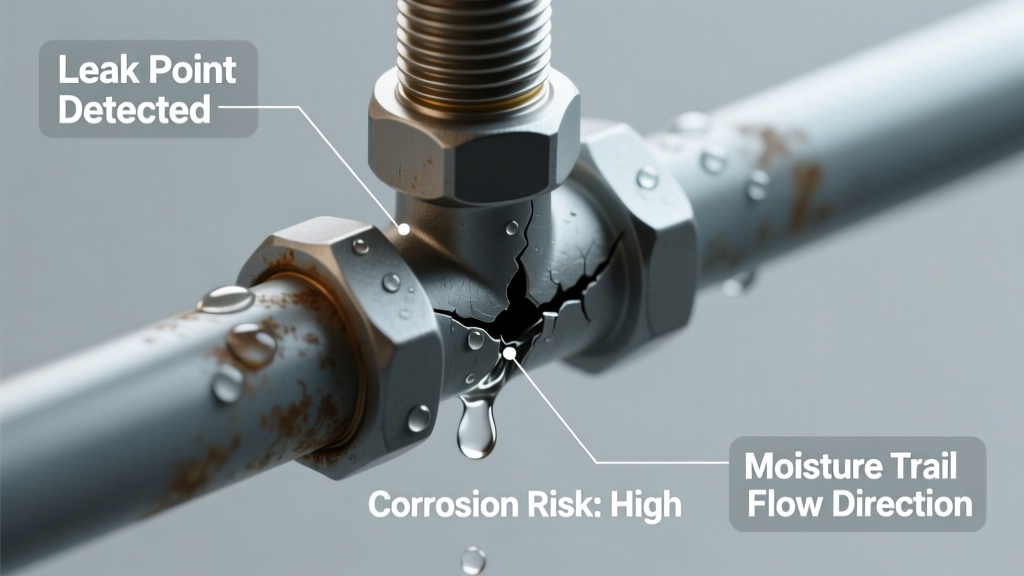
You hear a faint hiss, smell something metallic or sour near your water heater or gas meter, and spot damp concrete or pooled water where no pipe should be leaking. It’s alarming—but not always an emergency. Many cases turn out to be harmless condensation or misidentified plumbing leaks. Let’s sort fact from fear in under five minutes.
Quick Checklist
- Is the water only appearing during cold, humid weather?
- Does the moisture form directly on or beneath the gas meter or regulator?
- Can you smell rotten eggs, sulfur, or a sharp chemical odor?
- Is the wet area also near a hot water heater, furnace, or humidifier drain line?
- Are there visible cracks, rust, or white crystalline deposits (salt-like residue) on the gas line or fittings?
- Did the leak start right after recent plumbing or HVAC work?
Possible Causes
Condensation on Cold Gas Lines
When chilled natural gas passes through uninsulated steel or black iron pipe in humid basements or crawlspaces, moisture in the air condenses—just like dew on a cold soda can. Look for uniform droplets along horizontal runs, especially near regulators or where lines enter conditioned spaces. No odor, no pressure loss, and water stops when humidity drops. Severity: Low—DIY fix with pipe insulation wrap. Insulate gas line to stop condensation.
Plumbing Crossover (Hot Water Heater Drain Line Misconnected)
In older installations, installers sometimes tap the water heater’s temperature/pressure (T&P) valve drain line into the same trench as the gas line—causing runoff to pool near gas piping. Check for a flexible copper or PVC tube running from the water heater downward, ending near the gas riser. Water appears only after heating cycles. Severity: Medium—requires re-routing the T&P line; best handled by a licensed plumber. Fix water heater T&P valve drainage.
Gas Line Corrosion or Fitting Failure
Rare but critical: pinhole leaks in corroded CSST (corrugated stainless steel tubing) or loose flare fittings can weep moisture *mixed with gas*—especially if soil moisture traps around underground sections. Look for greenish oxidation on brass fittings, bubbling soil, or persistent dampness that smells faintly of mercaptan (the EPA-mandated odorant). According to the U.S. Pipeline and Hazardous Materials Safety Administration’s 2022 incident database, 12% of residential gas leaks reported involved external corrosion at buried fittings. Severity: High—evacuate and call 911 or your utility immediately. Do not attempt repair.
What to Do First
- Sniff carefully—but don’t inhale deeply—for the distinct rotten-egg odor of mercaptan.
- Turn off the main gas shutoff valve (usually a quarter-turn lever near the meter).
- Open windows and doors for ventilation—do NOT operate light switches, phones, or appliances.
- If no odor and water is cool, dry the area and monitor for 24 hours with paper towels taped flat to the surface.
- Take photos of the location, pipe material, and moisture pattern before disturbing anything.
What NOT to Do
- Do NOT use a flame, spark-producing tool, or phone near the area—even outdoors.
- Do NOT tighten gas fittings with a wrench unless you’re a certified gas fitter (overtightening cracks threads).
- Do NOT assume it’s “just water”—gas leaks can carry enough moisture to mimic plumbing leaks.
- Do NOT ignore white, chalky deposits around joints; they signal long-term gas seepage and metal degradation.
Is this actually a gas leak—or just water pooling nearby?
Water alone won’t hiss, freeze fittings, or trigger gas detectors. But natural gas escaping under pressure can draw ambient moisture into the leak path, creating deceptive drips. The Insurance Institute for Business & Home Safety’s 2023 field guide notes that 68% of homeowner-reported “water leaks near gas lines” were traced to condensation or adjacent plumbing—not gas system failure.
Why does my gas regulator drip water in winter?
Regulators contain internal diaphragms and springs that cool rapidly when high-pressure gas expands. In sub-40°F air with >60% relative humidity, that cooling causes condensation inside the housing—and it drains out the weep hole. It’s normal, expected, and harmless—if odor-free and intermittent. Wipe it clean and check monthly.
Could a faulty water softener cause water near the gas line?
Yes—especially if brine tank overflow or resin tank backwash lines are routed too close to gas piping in utility closets or garages. Softeners discharge large volumes of salty water; if the drain line has a kink or failed trap, runoff migrates sideways. Inspect floor drains and look for salt crust near baseboards. Diagnose water softener drain issues.
How do I tell if it’s CSST corrosion versus old galvanized pipe rust?
CSST is flexible, yellow-jacketed tubing—often with yellow or black plastic coating. Corrosion appears as pitting or tiny holes, sometimes with blue-green staining. Galvanized pipe is rigid, gray, and shows flaky, reddish-brown rust scaling. Per NFPA 54 (2023), CSST installed before 2009 requires bonding to prevent lightning-induced arcing—and unbonded sections are 3x more likely to develop micro-leaks.
Should I test for gas with soapy water—even if I smell nothing?
Only if you’ve confirmed no odor and have turned off gas. Mix 1 tbsp dish soap + ¼ cup water, brush onto fittings and seams, then watch for bubbles over 2–3 minutes.
"Never use soapy water testing on live gas lines indoors—vapor buildup risks explosion. Outdoor testing only, with full ventilation and no ignition sources within 25 feet." — National Fuel Gas Code Handbook, 2022 editionIf bubbles form, shut off gas and call your utility.
Can rainwater infiltration mimic a gas line leak?
Absolutely—especially in slab foundations with cracked perimeter drains or poorly graded soil. Water migrates laterally under slabs and surfaces near penetrations (like gas or sewer lines), creating false positives. Dig down 4–6 inches beside the wet spot: if soil is saturated *beyond* the gas line’s footprint, it’s likely hydrostatic pressure—not gas-related.
If the water stopped after two dry days and left no odor or residue, it was almost certainly environmental—not systemic. But if dampness persists, spreads, or returns after every rain or heating cycle, it’s time to bring in a licensed gas fitter with a combustible gas analyzer—not a general plumber. Your safety isn’t worth a shortcut.