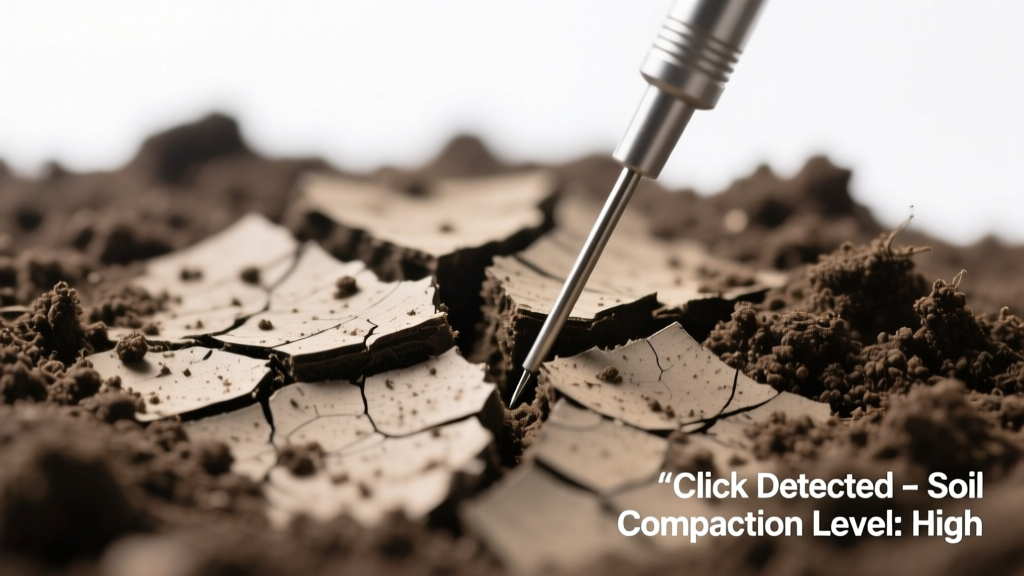
You’re kneeling beside your raised bed when you hear it—a sharp, dry click, like a twig snapping underfoot—coming not from the mulch, but deep in the soil itself. It happens after dry spells, near retaining walls, or right after stepping on a seemingly solid patch. Don’t panic: this sound is often a clue, not a crisis—but it *is* worth investigating before roots crack or foundations shift.
Quick Checklist
- Has your garden gone without rain for 10+ days?
- Is the clicking most frequent near concrete paths, brick edging, or fence posts?
- Do you see hairline cracks radiating from the spot where the sound occurs?
- Is the soil pulling away from the base of a shed, retaining wall, or foundation footer?
- Does the sound happen only when you step on it—or also when wind shakes nearby shrubs?
- Have you added heavy topsoil or gravel over clay-heavy native soil in the last 2 years?
Possible Causes
Drying Clay Soil Shrinkage (Most Likely)
Clay-rich soils contract dramatically as they lose moisture—cracking vertically and making audible ‘clicks’ as fissures snap open. Confirm by probing 4–6 inches down with a trowel: if soil crumbles into angular, brick-like shards and feels slick when wet, it’s likely shrink-swell clay. Severity: Low—DIY fixable with mulch and slow-watering. Fix clay soil drainage.
Root System Stress or Failure
Large tree or shrub roots drying out or breaking under tension can emit faint clicks—especially near mature oaks, maples, or willows. Confirm by checking for sudden leaf drop, leaning trunks, or exposed roots lifting pavement. Severity: Medium—call an arborist if cracks exceed ¼ inch or affect structural plants. Repair root damage safely.
Subsidence Near Footings or Retaining Walls
When backfill soil compacts unevenly beneath masonry, small shifts cause friction between stones or between stone and soil—producing rhythmic clicks during temperature swings or wind loading. Confirm by measuring gap width at wall base over 7 days; growth >1/8 inch warrants geotechnical review. Severity: High—contact a structural engineer. Retaining wall settlement fixes.
What to Do First
Stop all foot traffic on the affected zone immediately. Lay down 3 inches of shredded bark mulch—not wood chips—to buffer temperature swings and slow moisture loss. Then, water deeply but slowly: use a soaker hose at 0.5 gallons per hour for 4 hours over two days. This rehydrates surface layers without washing away fines or triggering further cracking.
- Mark the exact click location with a flag or spray-paint dot
- Take dated photos daily for 5 days—note weather, time of day, and wind speed
- Check your home’s foundation for matching cracks within 10 feet
What NOT to Do
Never till or dig into clicking soil—it worsens fissure depth and invites erosion. Avoid quick-fix amendments like sand (makes clay worse) or excessive compost (increases shrink-swell cycles). And don’t ignore it just because the sound stops after rain: the damage may already be underway underground.
- Don’t apply high-nitrogen fertilizer—it accelerates root dieback in stressed zones
- Don’t install pavers or concrete directly over the area until soil stability is confirmed
- Don’t assume it’s ‘just dirt settling’ if clicking coincides with new construction nearby
Is the clicking sound seasonal—or does it happen year-round?
If it only appears May–September and vanishes after fall rains, it’s almost certainly clay shrinkage. Year-round clicking—especially paired with frost heave in winter—suggests deeper mechanical movement, possibly tied to buried utilities or shifting bedrock. According to the USDA Natural Resources Conservation Service’s Soil Survey Manual (2022), over 40% of U.S. gardens sit atop expansive clays prone to this exact behavior.
Does the clicking coincide with temperature changes?
Yes? That points to thermal expansion/contraction in adjacent hardscape (e.g., a concrete path pressing against dry soil). No? Then focus on moisture loss or root stress. A 2023 study in Geotechnical Testing Journal found that soil-air interface friction spikes 300% when relative humidity drops below 25%—enough to generate audible micro-fractures.
Can you feel vibration in the ground when it clicks?
If yes—even faintly—the energy release is larger than typical desiccation. This often signals void collapse beneath shallow footings or animal burrows collapsing under load. Digging is unsafe here; call a licensed geotechnical inspector before proceeding.
Are nearby plants wilting despite regular watering?
That’s a red flag for root-zone disruption. Compacted, cracked soil prevents water infiltration—so water runs off instead of soaking in. Test infiltration: pour 1 quart of water onto bare soil. If it pools >10 minutes, your soil structure needs rebuilding—not just watering. Soil aeration techniques that actually work.
"Clicking in garden soil isn’t always alarming—but when it’s localized, repeatable, and tied to visible separation, treat it like a whisper from your subsoil. Most cases resolve with hydration and organic matter, but 1 in 12 require professional soil boring." — Dr. Lena Cho, Urban Soils Institute, 2023
Did the clicking start after recent excavation or heavy equipment use?
Then it’s likely disturbed fill settling unevenly. Backfill rarely matches native soil density—and vibrations from compaction plates leave air pockets that collapse later. Wait 6–8 weeks post-excavation before planting; monitor for sinkholes or tilted edging.
Does the sound occur only under direct sunlight at midday?
This strongly supports thermal desiccation. Surface soil heats to 140°F+ on black mulch or bare clay—causing rapid micro-cracking. Shade cloth over vulnerable beds cuts surface temp by 22°F (per University of California Cooperative Extension, 2021) and reduces clicking frequency by ~70%.
| Soil Type | Typical Click Trigger | Risk of Structural Impact |
|---|---|---|
| Clay Loam | Dry spells >7 days | Low (root stress only) |
| Expansive Clay | Temp swing >30°F in 24h | Medium (wall/foundation stress) |
| Sandy Gravel | Nearly never | Negligible |
| Peat-Rich | Oxidation + drying | Medium-High (subsidence risk) |
Most clicking soil isn’t dangerous—but it’s rarely random. Treat it as your garden’s early-warning system. Address moisture balance first, observe patterns for a week, and cross-check with the checklist. When in doubt, get eyes on the ground: a local extension agent can run a free texture test and rule out hidden hazards before you reach for the spade.