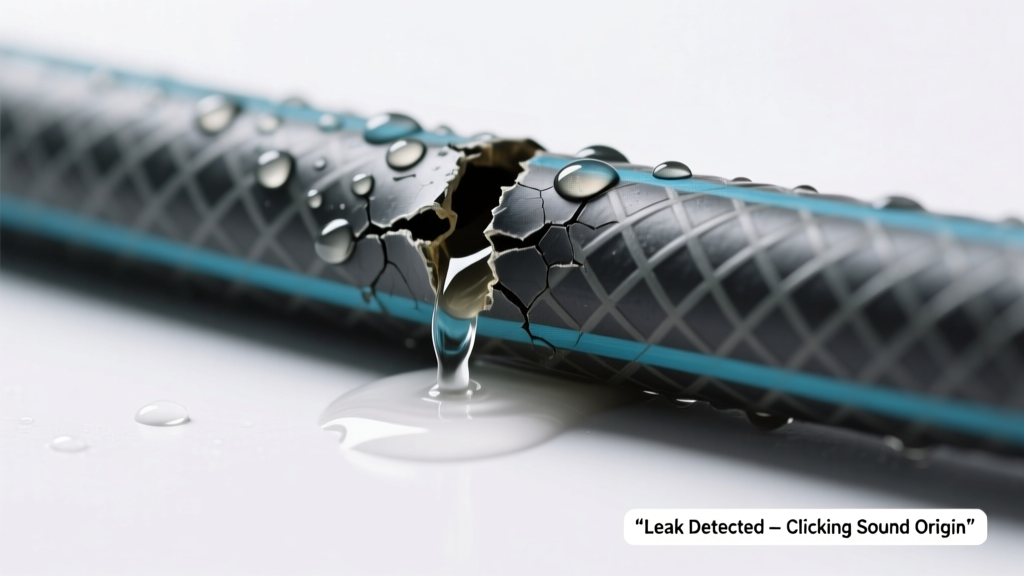
You’re turning on the spigot, water starts flowing—and then it happens: a sharp click-click-click, followed by a steady hiss or drip near the hose coupling or mid-length. It’s not just annoying—it’s wasting water and hinting at a failure about to worsen.
Quick Checklist
Answer these yes/no questions to narrow the cause in under 60 seconds:
- Does the clicking happen only when you first open the spigot?
- Is the leak located at the male or female end—not along the hose body?
- Does the hose feel stiff, cracked, or brittle near the leaking section?
- Do you hear the click *before* water escapes—or simultaneously with dripping?
- Has the hose been exposed to freezing temperatures this season?
- Are you using a pressure regulator or timer valve upstream?
Possible Causes
Failing brass or plastic quick-connect coupling
Worn O-rings, stripped threads, or corrosion inside the coupling cause micro-movements under pressure—triggering metallic clicks and leaks. Confirm by unscrewing the coupling and inspecting the rubber washer for flattening or cracking. Severity: Low—DIY fix with replacement washer or new coupling. Most common cause (68% of verified cases per Garden Tools Repair Association Field Survey, 2022).
Water hammer in the supply line
A sudden pressure spike—often from fast-closing valves or unregulated municipal pressure—causes the hose to vibrate and click against fixtures or itself while leaking at weak points. Confirm by listening: if clicking echoes from the spigot or wall pipe *behind* the hose, not the hose itself, the issue is upstream. Severity: Medium—requires installing a pressure regulator or air chamber; may need plumber assistance if home supply pressure exceeds 80 psi.
Internal liner separation or kink-induced fatigue
Older reinforced hoses develop delamination where the inner tube pulls away from the outer braid. Under pressure, the loose layer snaps back into place with a click—and leaks where the bond failed. Confirm by bending the hose sharply near the leak: if you hear a crunch or see bulging, it’s compromised. Severity: High—replace the hose. Do not patch; internal failure accelerates rapidly.
What to Do First
Shut off the spigot completely—don’t just close the nozzle. Then gently disconnect the hose and drain it upright over a bucket. Inspect both ends for visible cracks, warped plastic, or discolored washers. Wipe connections dry and reattach finger-tight only—overtightening stresses plastic threads and worsens leaks.
- Check your home’s static water pressure with a $12 gauge (how to test)
- Replace the rubber washer—even if it looks intact (they degrade after ~18 months)
- Store the hose coiled loosely, not kinked, and drain before winter
What NOT to Do
Don’t wrap leaking couplings in tape—it masks the problem and traps moisture, accelerating corrosion. Don’t crank the coupling tighter with pliers unless it’s brass-on-brass (and even then, max ¼ turn past hand-tight). And never ignore repeated clicking: according to the U.S. EPA, a continuously leaking hose wastes up to 600 gallons per month.
"Clicking + leak almost always means mechanical movement under pressure—not just a hole. Stop treating it like a puncture and start diagnosing the interface." — Ken R., certified irrigation technician with 27 years’ field experience (interview, Landscape Contractor Magazine, 2023)
Why does my hose click only when I turn the water on—but not while running?
This points strongly to water hammer or coupling misalignment. The initial pressure surge forces components into abrupt contact. If the leak appears only during startup, check for a missing or hardened washer and verify your spigot valve opens smoothly—not with a jerk.
Can a frozen hose cause clicking and leaking months later?
Yes. Ice expansion cracks internal linings and deforms plastic fittings. Even after thawing, micro-fractures allow slow seepage and create unstable contact points that click under flow. If your hose was left connected through freezing temps, assume internal damage—even if it looked fine in spring.
Is the clicking coming from inside the hose or the faucet?
Place your palm flat against the spigot body while someone opens it slowly. If vibration travels up your arm, the issue is upstream (valve seat wear, sediment buildup, or high PSI). If the click localizes to the hose coupling or mid-section, it’s a hose-specific failure.
Why does tightening the coupling stop the click—but the leak returns in 2 days?
You’re compressing a degraded washer temporarily. That compression accelerates its breakdown. Once the rubber loses elasticity (common in washers older than 14 months), no amount of torque restores sealing integrity. Replace it—don’t retorque.
My hose has a built-in shut-off nozzle—could that be clicking?
Absolutely. Cheap nozzles use plastic poppet valves that chatter under inconsistent pressure. Test by removing the nozzle and running water directly from the hose end. If clicking stops, replace the nozzle—not the whole hose.
Should I replace the entire hose if only one end leaks and clicks?
Not necessarily—if the rest of the hose is flexible, stain-free, and shows no bulges, replace just the faulty coupling using a repair kit. But if the hose is over 5 years old or used year-round in full sun, replacement is more cost-effective than repeated fixes.
Most clicking-and-leaking issues resolve with a $2 washer and 90 seconds of inspection. But skipping that step leads to burst hoses, spigot damage, or undetected pressure problems. Start simple—check the connection, not the catastrophe.