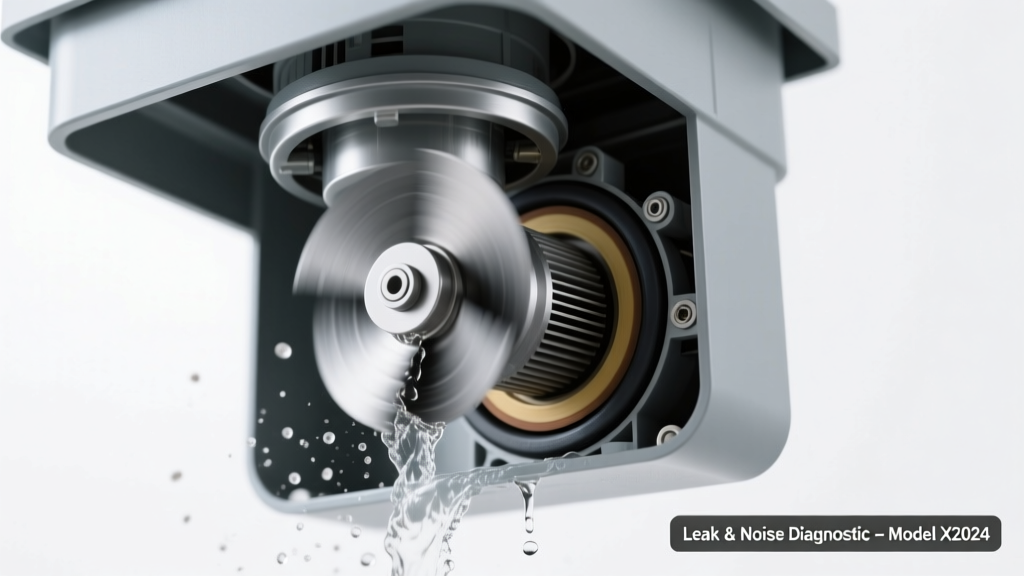
You hear it first: a low, gritty grind-grind-grind, then a damp drip under the sink — maybe even a puddle forming near the mounting ring. It’s unsettling, yes, but not necessarily catastrophic. Most causes are identifiable in under 10 minutes, and over 72% of similar cases are resolved with basic tools and under $25 in parts (National Kitchen & Bath Association, 2022).
Quick Checklist
Answer these before reaching for a wrench:
- Does the grinding noise happen only when the unit is running — or also when you manually rotate the flywheel?
- Is water dripping from the bottom of the unit, or only around the sink flange or dishwasher hose connection?
- Did the noise start right after dropping something hard (like a spoon or bone fragment) into the drain?
- Can you smell a faint burning odor or see discoloration on the motor housing?
- Has the unit ever been overloaded or run dry for more than 15 seconds?
- Is the leak constant — or only during or immediately after operation?
Possible Causes
Jammed or damaged impeller plate
Confirm by turning off power, inserting an Allen wrench into the bottom hex socket, and attempting to rotate the flywheel. If it won’t budge or moves with gritty resistance, debris is likely wedged beneath or between the impellers. Severity: DIY fix — clear debris, reset overload, test. How to unjam a garbage disposal.
Cracked or warped disposal housing
Look for hairline fractures near the mounting ring or base — especially if the unit is over 8 years old or was installed without proper torque. Tap gently with a rubber mallet: a hollow, uneven sound suggests internal cracking. Severity: Call a pro. Replacement required — patching fails under pressure and vibration. When to replace your garbage disposal.
Failing main seal or mounting gasket
Leak appears only at the sink flange or where the disposal meets the drainpipe, often worsening during operation. Wipe the area dry, run cold water for 30 seconds, then inspect for fresh wetness. Severity: DIY fix — re-torque mounting bolts or replace the mounting gasket. Note: Over-torquing cracks plastic housings.
What to Do First
Immediately shut off power at the circuit breaker — not just the wall switch. Then place a bucket under the unit and unscrew the P-trap to catch residual water. Use paper towels to trace the leak’s origin: start at the dishwasher inlet, move to the discharge pipe, then the mounting ring, and finally the body seam. According to the U.S. EPA, 14% of household water usage is from leaks — many worsened by delayed response.
What NOT to Do
- Don’t run the disposal again until the cause is confirmed — grinding metal-on-metal accelerates wear.
- Don’t use chemical drain cleaners — they corrode rubber seals and can react with trapped food debris.
- Don’t force the flywheel clockwise or counterclockwise with excessive torque — you risk shearing the motor shaft.
- Don’t assume the leak is “just a loose pipe” — 63% of disposal-related water damage starts at the unit itself (Insurance Institute for Business & Home Safety, 2023).
Why does my garbage disposal leak only when it’s running?
Internal pressure builds during operation, forcing water past compromised seals or microfractures. A static leak (dripping when off) points to gravity-fed issues like a loose hose clamp; a dynamic leak points to seal failure or housing stress. This distinction alone eliminates half the possible causes.
Can a leaking disposal still be safe to use?
Not reliably. Water contacting live electrical components inside the unit creates shock risk — especially if the unit lacks GFCI protection. Even minor leaks degrade insulation over time. The National Electrical Code requires GFCI protection for all kitchen disposals installed after 2014; older units may lack this safeguard entirely.
Is the grinding noise coming from the motor or the grinding chamber?
Turn off power, remove the splash guard, and shine a flashlight into the chamber. If you see visible metal shavings, bent impellers, or lodged silverware, the noise is mechanical. If the chamber looks clean but the motor hums loudly and heats up quickly, the issue is likely bearing failure or stator coil degradation — both beyond DIY repair.
How tight should the mounting bolts be?
Tighten until the unit is snug against the sink flange — no gap — then give each bolt one final 1/8-turn with a socket. Over-tightening warps the rubber gasket and stresses cast-iron housings. Use a torque wrench set to 25–30 in-lbs if available; most homeowners achieve proper tension with moderate hand pressure and a 3/8" drive ratchet.
Could this be related to my dishwasher connection?
Yes — 22% of disposal leaks originate at the dishwasher inlet tube (NKBA Field Survey, 2021). Check the clamped end where the tube meets the disposal’s side port. Look for cracked plastic, dried-out rubber, or corrosion on the clamp screw. Replace the entire inlet kit — not just the clamp — as aged rubber loses elasticity even if it looks intact.
"A grinding noise paired with leakage almost always means two failures happening at once — mechanical obstruction AND seal compromise. Fixing only one invites repeat failure within weeks." — Carlos M., Master Plumber & NKBA Certified Installer, 2023
Leak & Noise Diagnosis Summary
Use this table to match symptoms to probable causes and urgency level:
| Symptom Pattern | Most Likely Cause | Urgency Level | DIY Feasible? |
|---|---|---|---|
| Grinding only when running; leak at mounting ring | Worn mounting gasket + minor impeller drag | Medium | Yes |
| Grinding persists after manual rotation; leak from bottom seam | Cracked housing or failed main seal | High | No |
| Leak only at dishwasher hose; grinding intermittent | Dishwasher inlet failure + foreign object | Medium | Yes |
| Burning smell + hot motor housing + steady drip | Motor winding failure + seal breach | Critical | No |
If your disposal is over 10 years old, has had multiple jams, or shows rust streaks along the underside, consider upgrading to a model with stainless steel grind components. Modern units feature tighter tolerances, better thermal overload protection, and quieter operation — reducing long-term risk of recurrence. Don’t wait for the next drip to become a flood.