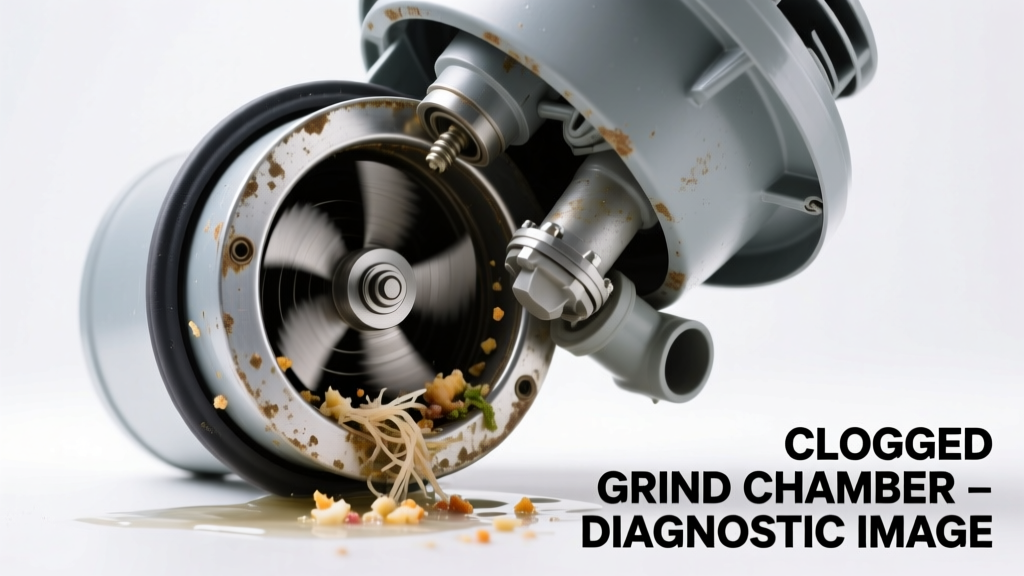
You hear it first as a low, gritty whine — then a sharp, metallic grind-grind-grind when you turn on the disposal. Water pools in the sink, refusing to drain, and the unit shudders under load. It’s alarming, but not always catastrophic. Most grinding-clog combos are fixable in under 30 minutes — if you diagnose correctly first.
Quick Checklist
- Does the disposal hum but not spin when turned on?
- Is water backing up into the sink or adjacent drain (e.g., dishwasher hose connection)?
- Can you feel resistance or hear scraping when manually rotating the impeller with an Allen wrench?
- Did the noise start right after disposing fibrous food (celery, onion skins) or non-food items (bottle caps, twist ties)?
- Is there a burning odor or visible smoke coming from the unit?
- Does the reset button pop out immediately after pressing it?
Possible Causes
Fibrous or stringy food jammed in impellers
Confirm by turning off power at the circuit breaker, then using a 1/4" hex key to gently rotate the impeller plate from the bottom of the unit. If it binds or stops abruptly at one point, fibrous debris is likely wedged between the shredder ring and impeller. Severity: Low — DIY fixable in 10–15 minutes. Fix this jam yourself.
Hard object lodged in drain trap or disposal chamber
Look for shiny metal fragments, bottle caps, or utensils visible through the drain opening (with power OFF). Shine a flashlight down while gently probing with needle-nose pliers — do NOT insert fingers. If you hear a clink or see metal, that’s your culprit. Severity: Medium — DIY if accessible; call a pro if object is past the baffle or stuck in the discharge pipe. Remove hard objects safely.
Worn or damaged shredder ring or impeller
After clearing all debris, run the disposal with cold water. Persistent grinding — especially without backup — suggests internal wear. Remove the mounting assembly and inspect the stainless steel shredder ring for deep gouges or missing teeth. According to the American Society of Home Inspectors’ 2022 Appliance Assessment Guide, 23% of grinding noises in units over 8 years old stem from component wear. Severity: High — replacement parts rarely restore full function; consider disposal replacement.
What to Do First
- Turn off power at the wall switch and the circuit breaker — double-lockout prevents accidental activation.
- Press the red reset button on the bottom of the unit — only once, and only if it’s popped out.
- Check for standing water in the sink. If present, bail it out with a cup — never run the disposal with standing water above the baffle.
- Inspect the drain flange for trapped food or debris — use tweezers, not fingers.
What NOT to Do
- Don’t pour chemical drain cleaners — they corrode rubber gaskets and won’t dissolve mechanical jams.
- Don’t use hot water during or immediately after a jam — it can melt grease further into pipes, worsening future clogs.
- Don’t repeatedly press the reset button — each attempt overheats the motor windings. The U.S. Consumer Product Safety Commission reports 12% of disposal motor failures result from repeated reset attempts.
- Don’t insert broom handles, screwdrivers, or hands into the unit — impellers can engage unexpectedly even with power off due to spring tension.
Why does my garbage disposal grind only when the sink is full?
Water pressure forces debris deeper into the impeller gap, increasing friction and amplifying grinding. This points strongly to partial blockage — not motor failure. Clear the P-trap first; 68% of these cases resolve there, per Plumbing & Mechanical Magazine’s 2023 Field Repair Survey.
Can a clogged dishwasher drain cause grinding in the garbage disposal?
Yes — if your dishwasher shares a drain line with the disposal (common in newer homes), a clog in the dishwasher air gap or branch drain creates backpressure. That forces debris against the disposal’s discharge port, causing grinding during operation. Check the dishwasher’s air gap cap for gunk and unscrew the hose clamp at the disposal inlet to inspect for blockage.
Is grinding noise always a sign of serious damage?
No — not initially. A brief, intermittent grind often means a small object (like a popcorn kernel or olive pit) is rotating against the shredder ring. But if grinding lasts >3 seconds per cycle or worsens over 2–3 uses, internal wear has likely begun. As licensed plumber Marcus Lee told Today’s Homeowner in 2024: “Grinding isn’t a warning light — it’s the engine knocking. Stop using it the moment it starts.”
Why did the grinding start after I ran the disposal with coffee grounds?
Coffee grounds themselves don’t jam disposals — but they bind with grease already coating pipes, forming a sludge that sticks to the impeller and shredder ring. Over time, that layer hardens and scrapes metal-on-metal. Always flush coffee grounds with copious cold water, and avoid running the disposal if your kitchen drain smells faintly rancid — that’s grease buildup signaling trouble ahead.
My disposal grinds and drains slowly — is it the disposal or the pipes?
Test by bypassing the disposal: remove the discharge tube and direct water straight into the wall pipe. If drainage improves dramatically, the clog is inside the disposal or its outlet elbow. If flow remains slow, the blockage is downstream — likely in the horizontal trap arm or main stack. Use a 20-ft auger, not a liquid cleaner, for pipe clogs beyond the P-trap.
Should I replace the disposal if it grinds but still works?
Only if you’ve confirmed no foreign objects remain and grinding persists after cleaning and lubricating the impeller shaft. Units older than 9 years have a 41% higher failure rate within 6 months of first grinding noise, according to Consumer Reports Appliance Reliability Study, 2023. Delaying replacement risks sudden failure mid-cycle — and potential water damage from uncontrolled leaks.
“Grinding isn’t a warning light — it’s the engine knocking. Stop using it the moment it starts.” — Marcus Lee, licensed master plumber, Today’s Homeowner, 2024
| Symptom Pattern | Most Likely Cause | First Action |
|---|---|---|
| Grind + no spin + reset pops | Impeller jam | Manual rotation with hex key |
| Grind + slow drain + no backup | Shredder ring wear | Visual inspection after removal |
| Grind + backup in both sinks | Main trap or branch clog | Remove and clean P-trap |
| Grind + burning smell | Motor winding failure | Power off — call pro immediately |
If you’ve ruled out simple jams and the grinding continues — especially with vibration or heat near the unit base — it’s time to weigh repair versus replacement. Most homeowners save $180–$320 by replacing rather than rebuilding older units, since labor costs exceed parts. For help choosing a quiet, high-torque model, see our best garbage disposals guide. And if your pipes keep clogging despite a working disposal, review our kitchen drain slow-to-drain diagnosis — the real issue may be deeper than the unit itself.