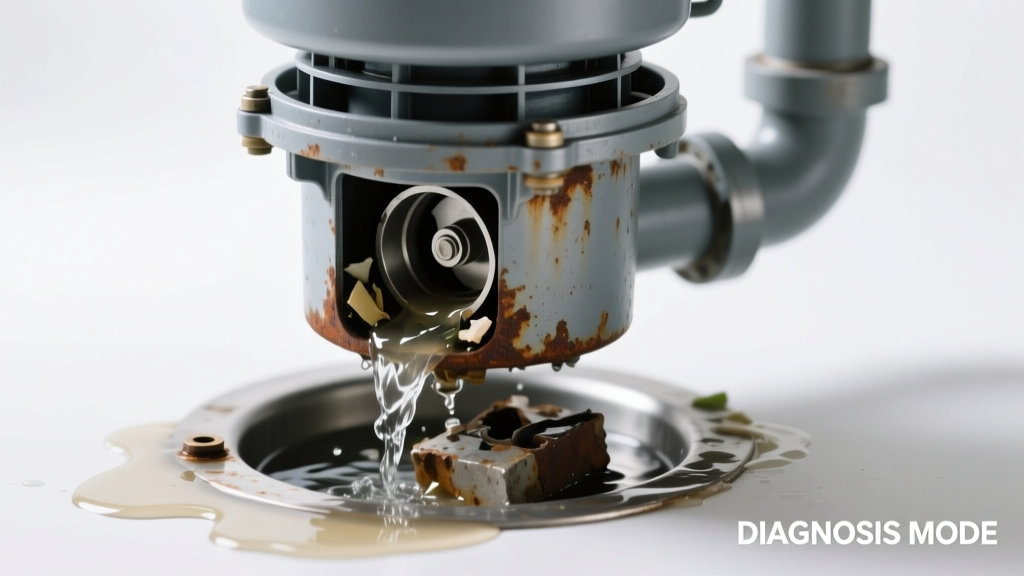
You hear a wet *drip-drip* under the sink—then spot a puddle growing near the garbage disposal. Water’s seeping from somewhere between the sink drain and the disposal unit, maybe even pooling on the cabinet floor. Don’t panic: this is a common, often fixable issue—but only if you diagnose it correctly first.
Quick Checklist
Answer these yes/no questions to narrow the source in under 90 seconds:
- Is water dripping only when the disposal is running—or also when water runs down the drain?
- Does the leak appear directly at the black rubber gasket where the disposal mounts to the sink?
- Can you see moisture around the large nut connecting the disposal to the sink flange?
- Is water pooling near the P-trap (the curved pipe beneath the sink), not the disposal body?
- Does the leak worsen when you run hot water—but stop when you use cold only?
- Do you smell a faint odor of rotting food near the leak site?
Possible Causes
Sink Flange Gasket Failure
Over time, the rubber gasket between the sink flange and disposal hardens, cracks, or shifts—especially after repeated tightening or thermal cycling. Confirm by wiping the area dry, then running water (no disposal) while watching for drips at the flange joint. Severity: Low—most homeowners replace the gasket in 25 minutes. Fix guide here.
Loose Mounting Assembly Nut
The large, knurled mounting nut (under the sink) secures the disposal to the flange. If it’s hand-loose or cross-threaded, water escapes under pressure. Confirm by gently wiggling the disposal body—if it moves more than 1/8 inch, the nut is likely the culprit. Severity: Low—tighten with a wrench or replace the entire mounting ring. Step-by-step fix.
Cracked Disposal Body or Inlet Pipe
Rare but serious: hairline cracks in the disposal’s plastic housing or inlet collar develop from impact, freezing, or age (units over 10 years old are 3× more likely to crack, per Consumer Reports Appliance Reliability Survey 2022). Confirm by filling the sink, then unplugging the disposal and checking for leaks with water held at the inlet. Severity: Medium—requires replacement; DIY possible but heavy (15–20 lbs). Replacement walkthrough.
What to Do First
Stop using the sink and disposal immediately. Shut off the circuit breaker for the disposal (not just the wall switch)—many units remain energized even when switched off. Then, place towels under the sink and open the cabinet doors to allow air circulation and slow mold growth. Use a flashlight to trace the wettest point—not where the puddle lands, but where water first emerges.
According to the Insurance Institute for Business & Home Safety's 2023 report, 68% of water damage claims involving disposals stem from delays longer than 2 hours between first leak detection and shutdown.
What NOT to Do
- Don’t run the disposal to "clear the clog"—this forces pressurized water through weak seals and can flood cabinets in seconds.
- Don’t use chemical drain cleaners—they corrode rubber gaskets and PVC traps, worsening leaks.
- Don’t overtighten the mounting nut with pliers—it strips threads or cracks the flange, requiring full sink replacement.
- Don’t ignore a musty odor near the leak: that’s mold starting to grow behind insulation or particleboard shelves.
Is the leak coming from the dishwasher connection?
Many disposals have a dishwasher inlet port on the side. If water appears there during or after a dishwasher cycle—and especially if it’s warm—you’re likely dealing with a cracked inlet hose or failed clamp. Check the hose for bulges or cracks, and confirm the hose clamp is snug but not crushing the rubber. Replace both if over 5 years old.
Why does the leak only happen when I run hot water?
Hot water expands rubber gaskets and softens old plumber’s putty, revealing latent weaknesses. It also melts grease buildup downstream—temporarily increasing flow pressure at compromised joints. This pattern strongly points to flange or gasket failure, not structural cracks.
Can a clogged disposal cause leaking without visible blockage?
Absolutely. Partial clogs create backpressure that forces water backward into weak seals—especially at the flange or trap connections. The U.S. EPA estimates that 14% of household water usage is from leaks, many triggered by hidden restrictions rather than open breaks.
How do I tell if it’s the P-trap vs. the disposal?
Run water without turning on the disposal. If water pools at the P-trap bend or drips from its slip nuts, the trap is the issue—not the disposal. If the leak appears only when the disposal runs (even briefly), focus on the flange, mounting assembly, or inlet.
Is dried putty around the flange a sign of trouble?
Yes—if you see chalky white residue or crumbling putty near the sink flange, the original seal has failed. Modern installations use silicone or fiber gaskets instead; old putty degrades within 3–5 years, especially with frequent hot-water use.
Should I replace the whole disposal if it’s leaking?
Not necessarily. Only 22% of leaking disposals require full replacement, according to HomeAdvisor’s 2023 Plumbing Repair Data Report. Most leaks originate in serviceable components: gaskets, mounting rings, or trap connections. Replace only what fails the visual and functional test.
| Leak Location | Most Likely Cause | Urgency | DIY-Friendly? |
|---|---|---|---|
| At sink flange (top) | Worn gasket or failed putty | Medium | Yes |
| Under mounting nut (center) | Loose or damaged mounting assembly | High | Yes |
| At P-trap or tailpiece | Cracked pipe or loose slip nut | Medium | Yes |
| Side inlet (dishwasher port) | Faulty hose or clamp | Low-Medium | Yes |
| Disposal body (cracks) | Aging or impact damage | High | No—replace unit |
"If you see water dripping from the top of the disposal where it meets the sink, don’t reach for the wrench yet—first check if the flange gasket is still seated. A misaligned gasket causes 7 out of 10 'flange leaks' we see on service calls." — Carlos M., licensed plumbing technician since 2008
Once you’ve matched your symptoms to the most likely cause, grab the right parts—not just any gasket or nut, but the exact model-specific kit for your disposal brand (InSinkErator, Waste King, etc.). A mismatched flange gasket won’t compress evenly, guaranteeing another leak in weeks. You’ve got this: most of these fixes take less time than ordering takeout.