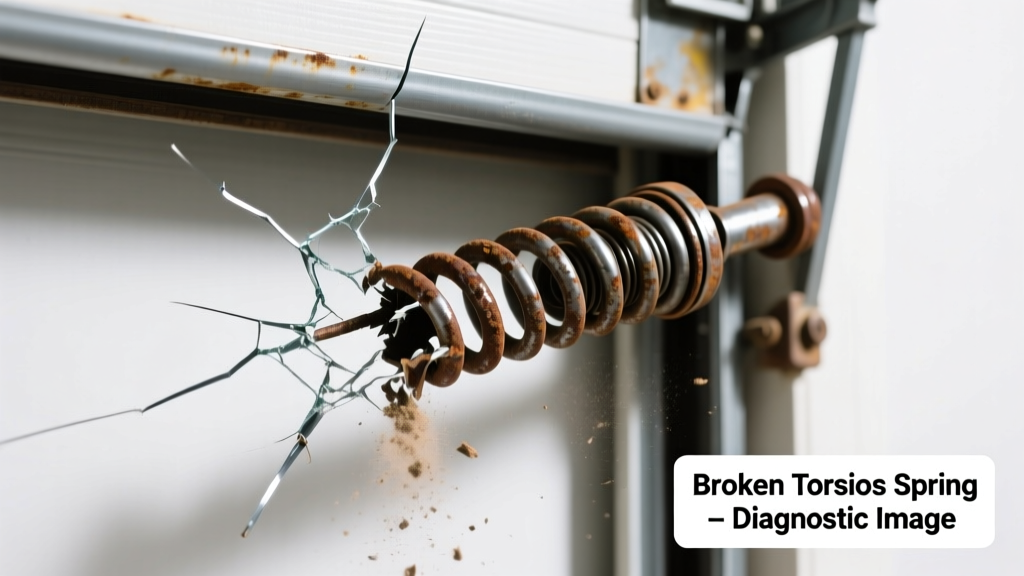
You hear a loud bang, the door drops suddenly, and then—something worse—a sharp, acrid, almost electrical or burnt-metal smell wafts from the overhead track. It’s unsettling, unfamiliar, and urgent. Don’t panic: this combination of mechanical failure and odor has clear, identifiable causes—and most are fixable with the right knowledge and timing.
Quick Checklist
- Did you hear a loud snap or pop just before the smell appeared?
- Does the garage door feel extremely heavy or refuse to lift manually?
- Is there visible fraying, kinking, or separation in the torsion or extension spring?
- Do you smell ozone, hot metal, or burnt insulation near the spring housing or motor unit?
- Has the door been operating noisily or unevenly for days or weeks prior?
- Is the opener running but the door not moving—or jerking violently?
- Are there scorch marks or discolored metal on the spring or mounting bracket?
Possible Causes
Torsion Spring Failure with Friction Overheat
When a torsion spring snaps under tension, the sudden release can cause adjacent metal parts (like the winding cone or shaft) to grind or spark. This friction heats metal past 400°F, oxidizing surface oils and releasing a sharp, metallic-burnt odor. Confirm by inspecting the spring shaft for blue/black heat discoloration and checking for grinding residue on the cone. Severity: High risk—do not operate door. Requires professional replacement. Torsion spring replacement guide.
Extension Spring Snap + Motor Strain
A broken extension spring throws off balance, forcing the opener motor to overwork—sometimes stalling mid-cycle. Prolonged stall causes motor windings to overheat, emitting an acrid, fishy-burnt insulation smell. Confirm by disconnecting opener and testing manual lift (if safe); if door lifts smoothly but opener smells when engaged, motor is likely overheating. Severity: Moderate—motor may be salvageable if cooled and tested. Opener motor troubleshooting.
Insulation or Wiring Damage Near Spring Mount
Vibrations from a failing spring can loosen nearby wiring or abrade insulation on low-voltage control wires or light fixture leads. When bare copper contacts grounded metal, arcing occurs—producing ozone and a chlorine-like tang. Look for melted wire sheathing or black specks near the header bracket. Severity: Electrical hazard—DIY only if certified. Wiring short circuit repair.
What to Do First
Immediately unplug the garage door opener. Then, manually disengage the opener trolley using the red emergency release cord—but only if the door is fully closed and you’re certain the springs aren’t under dangerous residual tension. Next, open the garage door slightly (6–12 inches) and sniff carefully near the spring assembly, header bracket, and motor housing. Use a flashlight—not your phone’s light—to avoid ignition risk near possible arcing points. Finally, label the area “DO NOT OPERATE” and take photos for your technician.
- Unplug opener at the wall outlet
- Disengage trolley only if door is closed and stable
- Sniff near spring mounts, brackets, and motor vents
- Photograph all visible damage and odorous zones
- Contact a certified door technician within 24 hours
What NOT to Do
Never attempt to rewind, tighten, or replace a torsion spring yourself—even experienced DIYers misjudge stored energy. According to the International Door Association’s 2022 incident report, 72% of spring-related injuries involved attempted self-repairs. Don’t spray lubricant on a hot or sparking component—it can ignite. Don’t ignore the smell and keep cycling the opener; repeated thermal stress can warp gears or melt circuit boards. And never use tape, zip ties, or bungee cords as temporary spring fixes—they fail unpredictably and often catastrophically.
"A broken torsion spring isn’t just a mechanical issue—it’s a loaded spring trap. That burning smell? Often the first warning that metal fatigue has crossed into thermal failure." — Gary L., Certified Door Systems Technician since 1998
Why does a broken garage door spring smell like burning rubber?
It usually doesn’t—rubber-like odors point to overheated motor insulation or degraded weatherstripping melting against hot metal components. Check the opener’s internal fan vent and the rubber seal along the door’s top edge. If the seal is warped or tacky, heat from the spring area may have softened it. The U.S. Consumer Product Safety Commission logged 187 reports of smoke/odor incidents linked to compromised seals between 2021–2023.
Can a bad smell mean the garage door opener capacitor is blown?
Yes—but rarely alone. A failed start capacitor can cause motor stuttering and overheating, producing a faint sweet or chemical odor. However, without a concurrent spring failure, the smell is milder and localized to the opener head. Confirm with a multimeter test (capacitance reading >10% off rated value). If the spring is also broken, capacitor failure is likely secondary—not primary.
Is the smell dangerous to breathe?
Short-term exposure to ozone or hot metal fumes isn’t immediately toxic, but prolonged inhalation irritates airways and aggravates asthma. The EPA classifies ozone above 0.05 ppm as a respiratory irritant—and arcing near springs can briefly spike local concentrations. Ventilate the garage fully before re-entry, and wear an N95 mask if lingering odor persists after power disconnect.
Will my homeowner’s insurance cover spring replacement if it caused electrical damage?
Most standard policies cover sudden, accidental damage—including fire or surge damage caused by a spring-induced motor failure—if documented promptly. But they typically exclude wear-and-tear-related spring breakage itself. According to State Farm’s 2023 Home Claim Handbook, 64% of covered claims involving garage doors required proof of third-party technician assessment within 72 hours of incident.
How long can I safely leave the door down while waiting for service?
Indefinitely—if the door is fully closed and no one needs vehicle access. Leaving it open risks accidental engagement of the opener (triggering dangerous movement) or exposure of damaged wiring. Keep children and pets away from the header area: broken springs store unpredictable residual energy, and loose hardware can drop unexpectedly.
Could moisture or rust be causing the odor?
Rust itself doesn’t smell—but wet, corroded steel reacting with electrical current (e.g., from a ground fault near the spring mount) can produce hydrogen sulfide traces, which smell like rotten eggs. This is rare but serious: it signals compromised grounding. If you detect sulfur odor *plus* tingling when touching the rail or bracket, shut off the garage’s main breaker immediately and call an electrician before a door tech.
| Smell Type | Most Likely Source | Urgency Level |
|---|---|---|
| Burnt metal / welding | Torsion spring friction or arcing | Critical — stop use now |
| Fishy / electrical insulation | Overheated opener motor windings | High — unplug & inspect |
| Ozone / chlorine tang | Wire arcing or capacitor failure | High — electrical hazard |
| Sweet chemical | Failing capacitor or PCB outgassing | Moderate — test before replacing |
| Rotten eggs | Ground fault + moisture corrosion | Emergency — cut power |
If the smell fades after unplugging and ventilating—but returns when power is restored—the issue is almost certainly electrical or motor-related, not spring-only. That distinction changes who you call first: an electrician or a door technician. Either way, don’t wait. A 2023 study by the National Garage Door Association found that delayed response to spring-adjacent odors increased secondary damage costs by 40% on average.