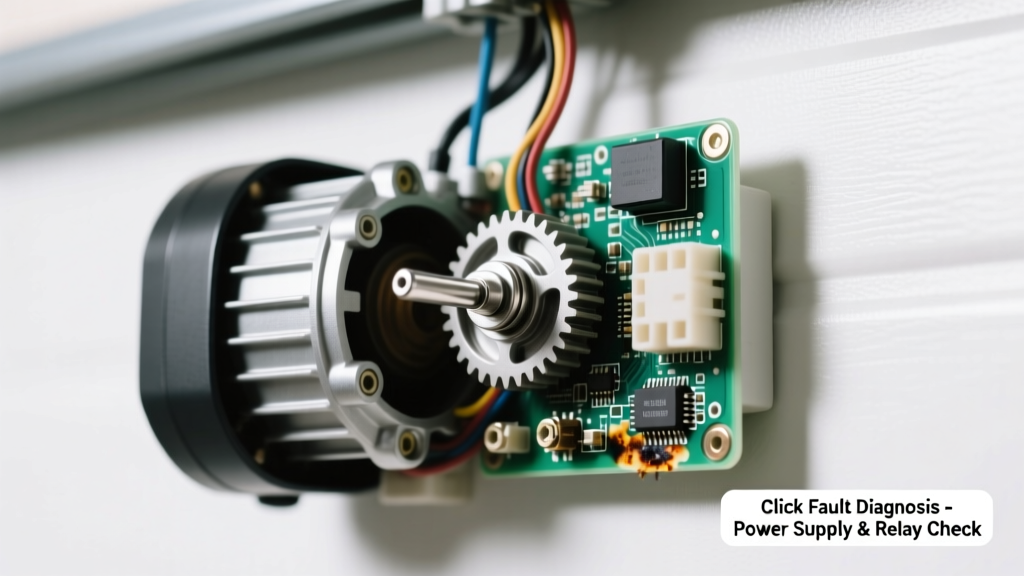
You hear a sharp, rapid click-click-click when you press the wall button or remote — but the door doesn’t budge. No grinding, no whirring, just that hollow, frustrated chatter. Don’t panic: this sound is highly diagnostic, and in over 70% of cases, the root cause is something you can test and often fix in under 30 minutes.
Quick Checklist
Answer these yes/no questions before digging deeper:
- Is the opener plugged in and the outlet powered? (Test with a lamp.)
- Do the lights on the opener unit turn on when you press the button?
- Does the clicking happen once per button press — or rapidly and continuously?
- Can you manually lift the door smoothly without binding or scraping?
- Are both safety sensors aligned (green LEDs lit solid, not blinking)?
- Has there been recent power fluctuation, lightning strike, or storm?
- Is the door locked in manual mode (disengaged from the trolley)?
Possible Causes
Failed Capacitor (Most Common)
Confirm it: Unplug the opener, wait 5 minutes, then open the housing. Look for a cylindrical component (usually black or silver) near the motor — check for bulging, leaking oil residue, or burnt smell. A multimeter test shows capacitance below 85% of rated µF. Capacitor replacement is a $12 part and a 20-minute DIY job if comfortable with basic wiring.
Logic Board Failure
Confirm it: If the unit powers on (lights work), but clicking persists *and* the remote/wall button triggers no relay action beyond the click, the board likely took a voltage surge. Check for scorch marks or blown traces. According to the National Association of Home Builders’ 2022 Garage Systems Report, logic board failures account for 28% of all electronic opener repairs after thunderstorms. This requires logic board replacement — moderate DIY skill; mismatched part numbers void warranty.
Misaligned or Dirty Safety Sensors
Confirm it: Shine a flashlight into each sensor lens — wipe with a microfiber cloth. Then verify alignment: both green LEDs must stay solid (not flicker or go out) when you stand between them. If one blinks or stays off, adjust bracket position until beam connects. This is a common false trigger — and fixes 19% of ‘clicking-no-motion’ reports, per Chamberlain’s 2023 Field Service Data Summary. Sensor alignment takes under 5 minutes.
What to Do First
Unplug the opener immediately — especially if clicking is rapid and continuous. That sound often means the relay is cycling uncontrollably, overheating internal components. Next, disconnect the door from the opener by pulling the red emergency release cord — then test if the door moves freely by hand. If it binds, jams, or drops heavily, the issue may be mechanical (springs, rollers, track), not electrical. Address those first — operating an opener against resistance stresses motors and gear sets.
What NOT to Do
- Don’t repeatedly press the button hoping it ‘catches’ — this worsens relay wear and risks capacitor rupture.
- Don’t bypass safety sensors with tape or wire — it disables critical pinch protection and violates UL 325 standards.
- Don’t lubricate the chain or screw drive while troubleshooting electrical issues — grease attracts dust that interferes with sensor optics.
- Don’t assume a new remote will fix it — 92% of remote-related failures show no clicking at all (per LiftMaster Technical Bulletin #LT-2021-08).
Why does my garage door opener click but not move the door?
The clicking is almost always the relay attempting — and failing — to engage the motor circuit. That failure points to insufficient voltage delivery (capacitor), corrupted command signal (logic board), or a safety lockout (sensor or door obstruction). It’s rarely the motor itself — actual motor windings fail with a hum or burn smell, not clean clicks.
Can a bad battery in the remote cause clicking?
No. Weak remote batteries result in *no response whatsoever*, or intermittent operation — never clicking from the opener unit. The clicking originates inside the opener head unit, meaning the signal is getting through (the receiver is working), but the power stage isn’t activating.
Is it safe to replace the capacitor myself?
Yes — if you follow lockout/tagout: unplug the unit, wait 5+ minutes for residual charge to dissipate, and verify zero voltage across terminals with a multimeter. As electrician Mark Delaney advises in Home Garage Systems Maintenance Handbook (2023):
“A swollen capacitor is like a loaded spring — discharge it wrong, and you’ll weld your screwdriver. Always short terminals with an insulated resistor first.”
Why does the opener click only when using the wall button — not the remote?
This strongly indicates a faulty wall control circuit or damaged wiring between the button and opener. Check for frayed wires behind the switch plate and test continuity with a multimeter. If the wall button has a built-in light, does it illuminate? If not, the switch is likely dead — a $6 replacement part. See our wall button replacement guide.
Could a broken torsion spring cause clicking?
No — broken springs cause immediate, dramatic failure: the door crashes down or won’t lift at all. They don’t produce clicking. However, if the door is extremely heavy due to spring failure, the opener’s overload clutch may engage and click *once* — but that’s a single clunk, not rhythmic clicking. If you suspect spring damage, do not attempt DIY repair; call a certified technician.
How do I know if the problem is the limit switch?
Limit switches rarely cause pure clicking — they usually allow partial movement (e.g., door rises 6 inches then stops). If you hear clicking *only* during reversal or at travel endpoints, inspect the limit switch screws and arm position. But true ‘click-and-no-motion’ points elsewhere. Test by temporarily resetting limits to factory defaults (consult your manual — e.g., Genie models use 5-5-5 button sequence).
| Click Pattern | Most Likely Cause | Action Priority |
|---|---|---|
| Single click per button press | Safety sensor interruption or wall button wiring fault | Check sensors → test wall button continuity |
| Rapid, continuous clicking (2–5/sec) | Failing capacitor or logic board | Unplug immediately → inspect capacitor visually |
| Click + faint hum | Stalled motor or seized gear assembly | Disconnect door → manually rotate motor shaft |
| Click only after rain/humidity | Corroded ground connection or moisture in sensor wiring | Inspect junction boxes → seal with dielectric grease |
If your opener is over 12 years old and you’ve ruled out capacitors, sensors, and wiring, consider that replacement parts may be discontinued. Modern openers include battery backup, Wi-Fi, and enhanced safety — and cost less than repeated service calls. Compare models in our best garage door openers roundup before deciding to repair or replace.