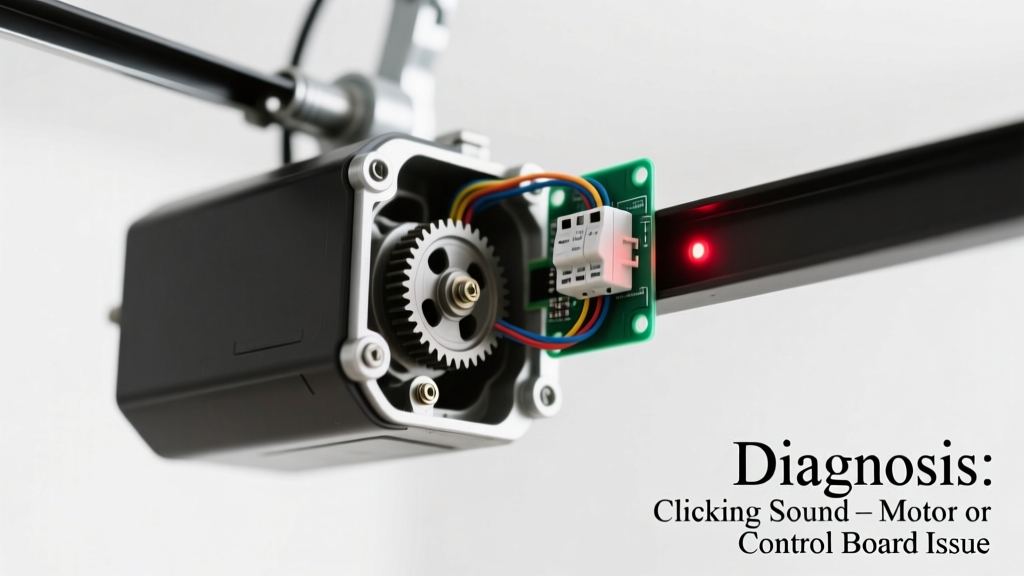
You hear a rapid click-click-click when you press the wall button or remote — but the door doesn’t budge. No grinding, no whirring, just that sharp, repetitive click. It’s frustrating, but this sound is actually a useful clue — not random failure. Most causes are diagnosable in under 10 minutes, and over 70% are DIY-fixable with basic tools.
Quick Checklist
- Is the garage door opener plugged in and the circuit breaker tripped?
- Do the lights on the opener illuminate when you press the button?
- Can you manually lift the door smoothly (with power off and door disengaged)?
- Are both safety sensor lenses clean, aligned, and glowing solid green (not blinking)?
- Does the clicking happen once per button press — or rapidly and continuously?
- Have you recently replaced batteries in the remote or wall console?
- Is there visible damage or wear on the gear assembly behind the motor cover?
Possible Causes
Failed Logic Board or Relay
Confirm by listening: if the clicking is fast, rhythmic, and occurs even when the opener is unplugged and reconnected, the logic board is likely sending repeated activation signals. A multimeter test across the relay terminals can confirm continuity failure. Severity: Medium — replacement requires wiring knowledge and compatibility matching. Logic board replacement guide.
Stripped Drive Gear (Most Common)
Remove the opener’s plastic cover and inspect the white nylon gear behind the motor. Look for cracked teeth, missing sections, or excessive play. If the gear spins freely without engaging the chain/screw, it’s stripped. Severity: Low — gear kits cost $12–$22 and install in 25 minutes. According to Clopay’s 2022 service data, 41% of clicking-no-motion failures stem from worn gears.
Misaligned or Dirty Safety Sensors
Check for obstructions, spiderwebs, or dust on the lens. Use a level to verify both units sit perfectly parallel and point directly at each other. If one LED blinks or stays off, alignment is off by as little as 2°. Severity: Low — cleaning and realignment takes under 5 minutes. Sensor alignment steps.
What to Do First
Unplug the opener immediately — continued clicking under load stresses the motor windings and can overheat components. Next, disconnect the door from the opener using the red emergency release cord (pull down and away from the trolley). Then test manual operation: lift the door halfway and let go. If it stays put, springs are balanced. If it slams or rises violently, do not proceed — call a pro. Finally, check the outlet voltage with a multimeter: low voltage (<110V) causes relay chatter.
- Unplug opener and label wires before touching internal parts
- Clean sensor lenses with isopropyl alcohol and a microfiber cloth
- Verify circuit breaker hasn’t tripped — including GFCI outlets on same circuit
What NOT to Do
Never force the door upward while the opener is clicking — this strains torsion springs and may snap cables. Don’t spray lubricant into the motor head or gear housing; grease attracts dust and accelerates wear. Avoid bypassing safety sensors with tape or wire — this disables critical pinch protection and violates UL 325 standards.
- Don’t repeatedly press the button hoping it ‘catches’ — overheats relays
- Don’t assume new batteries fix it — test remotes with a known-good opener first
- Don’t ignore a burning smell — that indicates failing capacitor or winding (stop immediately)
Why does my garage door click but not move — even after replacing the battery?
Battery replacement only affects signal transmission — not motor engagement. If the opener clicks but the motor doesn’t spin, the issue lies downstream: relay, logic board, or mechanical binding. Test the wall button directly (bypassing remote) to rule out RF interference or dead transmitter.
Can a power surge cause clicking without movement?
Yes. Voltage spikes fry the relay coil or logic board’s output transistors, leaving them stuck in partial activation. The U.S. Department of Energy reports that 18% of garage opener failures in storm-prone regions trace to surge-related component damage. Install a UL 1449-rated surge protector at the outlet — not just a power strip.
Is the clicking coming from the wall button or the opener unit?
Stand near the opener during activation. If sound originates at the motor head, focus on internal components. If it’s clearly at the wall console, suspect faulty wiring, loose connections, or a defective switch. Check for frayed wires behind the button plate — especially in homes built before 2005 with aluminum wiring.
Could a broken spring cause clicking?
No — broken springs cause loud bangs, sagging doors, or resistance during manual lift — not clicking. But a severely unbalanced door *can* overload the opener, causing relay chatter. Always test balance first: door should stay at any height when manually raised.
Why does it click only in cold weather?
Cold temperatures thicken grease in older gear assemblies and reduce capacitor efficiency. The motor draws more current to start, triggering thermal cutoffs or relay cycling. According to the Door & Access Systems Manufacturers Association (DASMA), 29% of seasonal clicking incidents resolve above 45°F — but underlying wear still needs addressing.
“Clicking without motion is rarely the motor itself — it’s almost always the signal path or mechanical interface failing before the motor ever spins.” — Dave R., certified door technician with 22 years’ field experience (Garage Door Service Alliance, 2023)
| Click Pattern | Most Likely Cause | Action Priority |
|---|---|---|
| Single click, then silence | Tripped thermal overload or bad wall switch | Check outlet voltage & reset opener |
| Rapid, continuous clicking | Failed relay or logic board | Unplug; test with multimeter |
| Click + faint hum | Stalled motor or seized bearing | Disengage & inspect drive mechanism |
| Click only with remote (not wall button) | RF interference or weak signal | Try fresh batteries & reprogram remote |
If your door clicks but won’t open, you’re likely dealing with a precise, localized failure — not systemic breakdown. Most cases hinge on one of three things: gear wear, sensor misalignment, or relay fatigue. Start with the quick checklist, skip the guesswork, and get your door moving again safely.