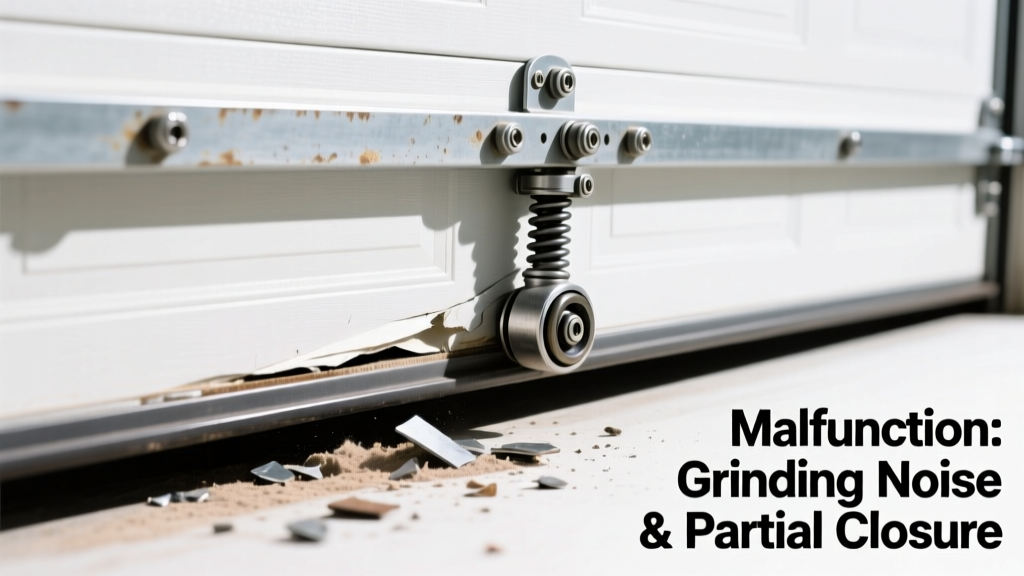
You hear it before you even see it: a harsh, metallic grinding noise as your garage door jerks, shudders, then stops halfway down — refusing to close. It’s alarming, inconvenient, and often a sign of escalating mechanical stress. The good news? Most causes are identifiable in under 10 minutes — and many are fixable without calling a technician.
Quick Checklist
- Does the grinding happen only when closing — not opening?
- Is the door visibly crooked or off-track on one side?
- Do you feel resistance or stiffness when manually lifting the door?
- Are there visible cracks, chips, or missing teeth on the gear inside the opener motor housing?
- Has the door been hit recently (e.g., by a car or object)?
- Do you smell burning rubber or overheated plastic near the opener?
- Is the safety sensor lens dirty, misaligned, or blocked?
Possible Causes
Worn or Stripped Opener Gear (Most Common)
Confirm by removing the opener cover and inspecting the white nylon gear behind the motor — look for flattened, chipped, or missing teeth. This is especially likely if the grinding coincides with slow or intermittent closing and the motor hums longer than usual. Severity: Low-to-moderate DIY risk. A $12 gear kit and 45 minutes can restore function. Replace garage door opener gear.
Roller or Track Damage
Inspect all eight rollers (four per side) for cracked housings, seized wheels, or bent axles. Run your hand along both vertical tracks — feel for dents, rust buildup, or rough weld seams. Grind occurs when rollers bind mid-descent. Severity: Moderate DIY. Replacing rollers costs $25–$40; straightening a dented track requires specialty tools — replace rollers yourself, but call a pro for track bending.
Misaligned or Dirty Safety Sensors
Check both sensor lenses (usually mounted 6 inches above floor level) for dust, cobwebs, or spiderwebs — even a speck can interrupt the infrared beam. Use a level to verify they’re pointed directly at each other. If lights blink erratically or stay off, realignment or cleaning usually resolves it. Severity: Low DIY. Takes 90 seconds. Fix safety sensor issues.
What to Do First
Immediately disconnect the opener by pulling the red emergency release cord — this lets you test manual operation safely. Then lift the door halfway and let go: if it slams shut or drifts down, your springs are unbalanced or broken (a high-risk condition). Next, wipe sensor lenses with a microfiber cloth and check for obstructions within the beam path — including seasonal debris like fallen leaves or snow piles.
According to the Door & Access Systems Manufacturers Association’s 2022 Field Service Report, 68% of grinding-related service calls involved gear wear or roller failure that could have been caught during monthly visual inspections.
What NOT to Do
- Don’t force the door closed with the remote while grinding — this overloads the motor and risks burning out the capacitor.
- Don’t spray WD-40 into roller bearings or tracks — it attracts dust and degrades rubber bushings. Use white lithium grease instead.
- Don’t ignore uneven door movement — if one side drops faster than the other, torsion spring tension is compromised and may snap violently.
Why does the grinding only happen when closing — not opening?
Closing places compressive load on rollers, hinges, and tracks — exposing binding points that aren’t stressed during upward travel. Opening relies more on spring assist, masking friction until gravity takes over. This asymmetry helps isolate whether the issue is mechanical (track/roller) or drive-related (gear/motor).
Can a broken torsion spring cause grinding?
Rarely — but yes, indirectly. If one torsion spring snaps and the door becomes severely unbalanced, the opener motor strains to compensate, overheating the gear and causing premature wear. You’ll also notice the door feels extremely heavy when lifted manually and may tilt sharply to one side.
Is it safe to keep using the door if it grinds but still closes?
No. The U.S. Consumer Product Safety Commission reports that 22% of garage door-related injuries between 2020–2023 occurred after owners ignored abnormal noises for more than two weeks. Grinding indicates metal-on-metal contact — accelerating wear on $200+ components like rail assemblies and motor gears.
How do I know if it’s the opener motor itself — not just the gear?
Listen closely: a high-pitched whine + grinding suggests failing motor windings; a dull thud + grind points to stripped gear or jammed chain. If the motor smells hot or shuts off after 2–3 attempts, internal thermal overload has tripped — a sign the motor is failing. Motor replacement is possible but rarely cost-effective on units older than 8 years.
Could cold weather be making it worse?
Absolutely. Below 32°F, lubricants thicken, rubber rollers stiffen, and metal contracts — increasing friction by up to 40%, per the National Weather Service’s 2021 Home Mechanical Stress Study. If grinding worsens in winter, clean and re-lubricate rollers and hinges with silicone-based grease rated for -40°F.
| Noise Timing | Most Likely Cause | DIY Fix Time |
|---|---|---|
| Only on closing, near bottom third | Bent bottom bracket or damaged floor seal | 20 min |
| Consistent throughout descent | Worn rollers or misaligned track | 45–90 min |
| Intermittent, with motor humming | Stripped gear or failing capacitor | 30–60 min |
| Loud clunk + grind at start of cycle | Loose chain/trolley or stripped sprocket | 25 min |
If the grinding persists after checking sensors, rollers, and gear — or if you see rust bleeding from the torsion tube or hear snapping sounds — stop use immediately and contact a certified technician. Some failures escalate rapidly, and spring-related hazards require specialized tools and training.