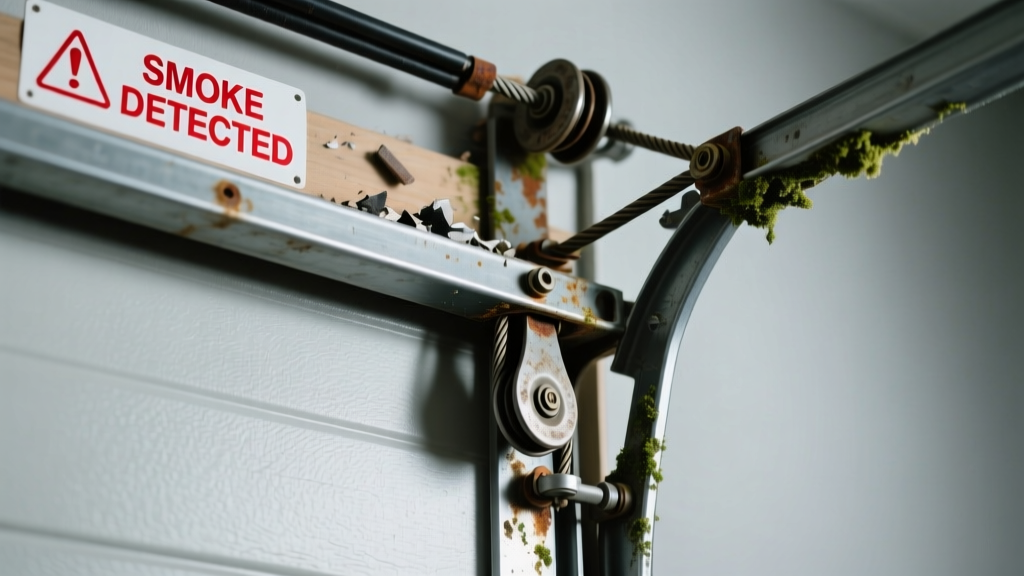
You hear a grinding screech every time the garage door opens—then catch a sharp, acrid whiff of burning rubber or hot metal. Or maybe it’s a musty, damp stench mixed with a high-pitched squeal. Either way, your garage door is sending urgent signals—and ignoring them risks motor failure, fire hazard, or structural compromise.
Quick Checklist
- Does the smell intensify right after operation (especially during cold starts)?
- Is the noise rhythmic—like clicking, grinding, or scraping—or erratic?
- Do you see visible rust, fraying cables, or blackened motor housing?
- Has the door been exposed to recent flooding, high humidity, or rodent activity?
- Does the opener stall or reverse mid-cycle, accompanied by smoke or ozone scent?
- Are there grease stains or oil drips near the rail or trolley assembly?
Possible Causes
Burnt-out motor winding or overheated capacitor
Confirm by sniffing near the opener’s motor housing while running—look for discolored wiring, bulging capacitors, or a distinct ozone/burning insulation smell. Use a multimeter to test capacitor capacitance (should be within ±6% of labeled value). Severity: Call a pro immediately—electrical faults risk fire and void warranties. Replace garage door opener motor.
Rusted or seized torsion spring bearings
Listen for a dry, metallic groan at the top of the door’s travel path; inspect bearing plates for orange powder or flaking paint. Spray penetrating oil and rotate manually—if resistance remains, bearings are fused. Severity: D.I.Y. fixable if experienced, but springs are under lethal tension—follow certified spring safety protocol or hire a technician.
Decaying rubber weatherstripping or degraded nylon rollers
Peel back the bottom seal—look for crumbling, black mold, or green algae growth. Check rollers for cracked, chalky surfaces or embedded grit. A sour, rotting-fruit odor often accompanies this. Severity: Easy D.I.Y.—replace seals and rollers in under 90 minutes. Roller replacement guide.
What to Do First
Stop using the door immediately. Unplug the opener and disconnect power at the circuit breaker. Open the door manually only if it moves smoothly—never force it. Wipe down all accessible metal components with a dry microfiber cloth to remove dust that could ignite when heat builds. Ventilate the garage for 15+ minutes before inspection.
- Check for standing water or damp insulation near the header track
- Inspect the opener’s thermal cutoff switch (usually red button on motor housing)—press if popped
- Photograph any discoloration, corrosion, or residue for technician reference
What NOT to Do
Don’t spray WD-40 into motor vents—it attracts dust and degrades internal insulation. Don’t ignore a sulfur-like odor (like rotten eggs); that indicates failing lithium-ion backup batteries or PCB corrosion. Never lubricate torsion springs with grease—it traps debris and accelerates wear. And never operate the door after smelling smoke—even once.
- Avoid using household cleaners on rubber seals—they accelerate UV degradation
- Don’t assume ‘just a little noise’ means ‘no danger’—the U.S. Consumer Product Safety Commission reports 20,000+ garage-door-related injuries annually (2022 data)
Is the smell strongest near the opener motor?
This strongly points to electrical overload, capacitor failure, or winding insulation breakdown. According to the National Fire Protection Association’s Electrical Equipment Fire Patterns (2021), 37% of garage-related electrical fires originate in openers showing prior odor or buzzing symptoms.
Does the noise happen only when the door reverses direction?
That’s classic gear stripping or stripped drive sprocket teeth—often paired with a burnt-plastic smell from friction heat. Inspect the plastic gear kit inside the opener head unit; if teeth are rounded or missing, replacement is urgent. Gear kit replacement steps.
Can you smell mildew even when the door hasn’t moved in days?
Then moisture is trapped behind the door panel or in wall cavities—likely from failed flashing or condensation buildup. Pull back base weatherstripping and check subfloor for soft spots or efflorescence. The EPA estimates 45% of residential mold cases begin in attached garages due to poor vapor barriers (EPA Indoor Air Quality Guide, 2023).
Is the odor metallic and the noise like grinding metal on metal?
That’s almost certainly worn-out roller bearings or misaligned track causing direct steel-on-steel contact. Measure roller wobble with calipers—if lateral play exceeds 0.015″, replace. Also check track alignment: use a 4-ft level across horizontal sections—any gap >1/16″ requires realignment.
Did the smell start after heavy rain or snow melt?
Water likely entered the opener’s control board or shorted low-voltage wiring. Look for white crystalline deposits (corrosion) on terminals. Disconnect all wires, clean contacts with electronic contact cleaner, and let dry 24 hours before reassembly. If error codes persist, the logic board needs replacement.
Do you hear a loud pop followed by silence and a sharp chemical odor?
That’s a failed capacitor exploding—common in units over 8 years old. Capacitors degrade predictably; the Department of Energy recommends replacement every 7–10 years regardless of symptoms.
"Capacitor failure isn’t if—it’s when. Replacing it preemptively costs $12; waiting until it fails mid-cycle can fry your entire opener circuit board." — Garage Door Service Manual, Overhead Door Corp., 2022 ed.
| Smell | Noise | Most Likely Cause | Urgency |
|---|---|---|---|
| Ozone / burning plastic | High-pitched whine + intermittent stutter | Failing capacitor or motor winding | Critical — stop use now |
| Mildew / wet cardboard | Squeak + drag | Rotted bottom seal + track corrosion | Medium — fix within 72 hrs |
| Rotten eggs | None or faint buzz | Failing battery backup or PCB corrosion | High — disconnect battery immediately |
| Hot metal / scorched oil | Grinding + vibration | Seized spring bearings or bent track | High — do not force door |
If you’ve ruled out obvious moisture and electrical signs but still detect intermittent sourness paired with jerky motion, suspect degraded nylon rollers releasing volatile organic compounds under friction heat. Replace all eight rollers—even if only two look bad—as mismatched wear causes harmonic resonance. When in doubt, record a 10-second video of operation (sound on) and share it with a certified garage door technician. Early intervention prevents $400+ repairs—and keeps your family safe.