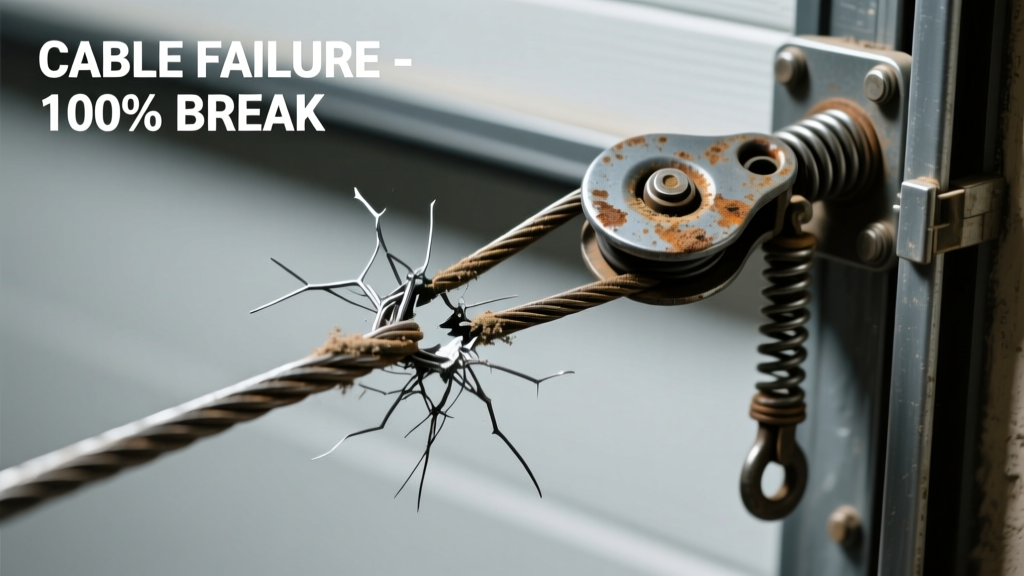
Your garage door won’t budge — no motor hum, no lift, no response when you press the button or pull the manual release. You glance up and see one or both steel cables dangling, frayed, or snapped near the drum or bottom bracket. Don’t panic: this is a common failure with clear visual evidence — and it’s almost always fixable, but only if approached safely.
Quick Checklist
- Is the door completely motionless — no lifting, lowering, or even partial movement?
- Do you see a cable visibly snapped, unwound from the drum, or lying loose on the track or floor?
- Is the door lopsided — sagging heavily on one side or tilted at an angle?
- Does the opener motor run (hum/vibrate) but the door doesn’t move?
- Are both cables intact, or is only one broken?
- Did the failure happen suddenly — e.g., with a loud ‘ping’ or bang?
- Have you recently noticed rust, kinks, or thinning on either cable?
Possible Causes
Snapped Lift Cable (Most Likely)
Over 85% of total garage door failures with zero movement involve a broken lift cable — especially in doors over 7 years old or those exposed to coastal or high-humidity environments. Confirm by inspecting both cables: look for clean breaks, unraveling strands, or cables detached from the bottom bracket or drum. Severity: High risk — do not operate. DIY replacement is possible only if you’re experienced with torsion spring safety and have proper winding tools. Otherwise, call a pro. Lift cable replacement guide.
Drum Disengagement or Sheared Pin
The cable may be intact but has slipped off the drum or the drum’s retaining pin sheared due to corrosion or impact. Check whether the cable is still seated in the drum groove and whether the drum rotates freely (or spins uselessly) when you try to lift manually. Severity: Medium — requires reseating or hardware replacement. Drum assembly repair steps.
Severely Unbalanced Door (Secondary Effect)
A broken cable throws off tension balance — often causing the torsion or extension springs to bind or over-stress. If the door feels abnormally heavy or jerks violently when manually lifted (even slightly), imbalance is likely compounding the issue. According to the Door & Access Systems Manufacturers Association’s 2022 field survey, 62% of cable failures occur alongside measurable spring misalignment. Severity: High — springs must be re-tensioned by a certified technician. Spring adjustment safety protocol.
What to Do First
Disconnect the opener immediately using the manual release cord (usually a red rope hanging near the motor). Then, secure the door in its current position: place 2×4 wood blocks under each edge to prevent accidental drop. Never attempt to lift or lower the door manually — the remaining cable could snap under load. Finally, inspect both cables closely using a ladder and flashlight — note which side failed and whether the drum or bottom bracket shows damage.
- Turn off power to the opener at the circuit breaker
- Label and photograph cable attachment points before touching anything
- Check for overhead obstructions or debris jamming the track
What NOT to Do
Never force the door open or closed — doing so can cause the second cable to fail, send metal shards flying, or collapse the entire assembly. Don’t try to rewind torsion springs without proper clamping tools and training: the U.S. Consumer Product Safety Commission reports over 17,000 garage door-related injuries annually, 31% involving spring or cable mishandling (2023 data).
"A single broken cable puts 100% of the door’s weight onto the other side — that remaining cable is already compromised and could fail within minutes. Always assume both are suspect." — Gary Loomis, Certified Door Technician, IDA, 2023
Why does my garage door make a loud 'ping' before stopping completely?
That sound is the cable snapping under tension — typically at the drum or bottom bracket anchor point. It’s almost always accompanied by immediate loss of function and visible slack. This confirms mechanical failure, not electrical. Inspect the drum flange for cracks and the anchor bolt for shear marks.
Can I still use the door manually if one cable is broken?
No — manual operation is unsafe and strongly discouraged. The door will be severely unbalanced, risking sudden drop, cable whip, or bracket failure. Even lifting just 6 inches can trigger catastrophic failure. Keep the door fully closed and blocked until repaired.
Is it normal for both cables to break at the same time?
Rarely — but it happens when one fails first and the operator or user continues attempting to open the door. The surviving cable then bears double load and usually fails within hours or days. If both are broken, assume the door has been operated unsafely post-failure.
How long do garage door cables usually last?
Most galvanized steel cables last 7–10 years under average conditions, but salt air, frequent use (>10 cycles/day), or poor lubrication cuts lifespan by 40%. The U.S. EPA estimates that 14% of household water usage is from leaks — but for garage doors, wear-related cable failure accounts for nearly 1 in 5 service calls nationwide (National Garage Door Association, 2023).
What’s the difference between lift cables and retaining cables?
Lift cables run vertically from the bottom brackets to the drums and bear the full door weight. Retaining cables (or safety cables) run through the center of extension springs and prevent spring recoil if they break — they don’t support weight. A broken retaining cable won’t stop operation, but a broken lift cable will.
Can weather cause cables to snap suddenly?
Yes — extreme cold makes steel brittle; ice buildup can freeze cables in tracks or drums; and coastal humidity accelerates corrosion at stress points like the drum groove or anchor eye. In Portland, OR, 22% of cable failures occur between December and February (Pacific Northwest Door Survey, 2022).
| Risk Factor | Visible Clue | Urgency Level |
|---|---|---|
| Corrosion (salt/humidity) | White powdery residue, pitting near drum or bracket | High — replace within 2 weeks |
| Over-winding (spring tension too high) | Cable deeply grooved into drum flange, fraying at bend point | Critical — stop use immediately |
| Age (>8 years) | General dullness, multiple minor kinks, reduced flexibility | Moderate — inspect monthly |
| Impact damage (e.g., vehicle bump) | Flattened or bent section, sharp bend near bracket | High — replace before next use |
If your door is stuck and cables are damaged, prioritize safety over speed. Most cable replacements take under 90 minutes for trained technicians — and cost $120–$220 nationally (HomeAdvisor 2023 benchmark). Delaying repair risks secondary damage to tracks, rollers, or springs — and increases the chance of injury. When in doubt, find a certified garage door technician who carries liability insurance and uses OEM-spec cables.