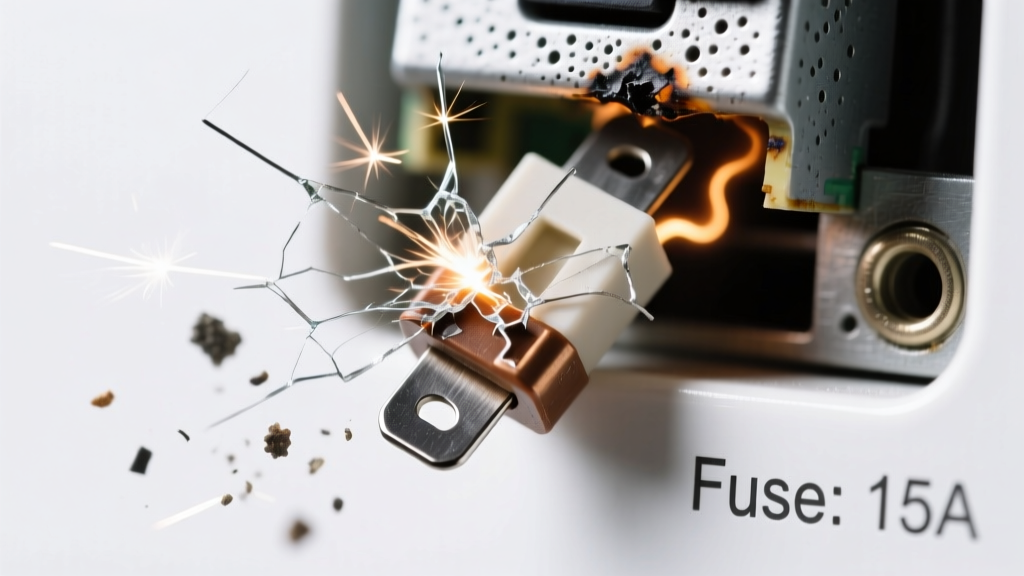
You hear a sharp pop, then a low, gritty grind — like metal scraping inside the panel — right as a fuse blows. It’s alarming, but not always catastrophic. Most often, that sound signals mechanical stress *during* failure, not just electrical overload. Stay calm: this symptom is diagnosable, and acting fast prevents panel damage or fire risk.
Quick Checklist
- Did the grinding occur only at the exact moment the fuse blew — not before or after?
- Is the fuse visibly blackened, melted, or bulging at the glass or ceramic body?
- Do other circuits on the same panel trip or flicker when this fuse fails?
- Was the circuit powering a motor-driven appliance (AC unit, furnace blower, garbage disposal)?
- Does the fuse holder feel warm or show pitting/discoloration around the contact clips?
- Have you replaced this fuse more than twice in the last 6 months?
Possible Causes
1. Arcing Inside Fuse Holder Due to Worn Contacts
Loose or corroded fuse clips cause intermittent contact, leading to micro-arcing that melts metal and creates grinding vibration. Confirm by removing the blown fuse and inspecting the brass clips: look for pitting, carbon tracking, or uneven wear. Severity: Moderate — DIY replacement of fuse holder is possible if panel is de-energized and you’re experienced; otherwise, call an electrician. Replace fuse holder.
2. Motor Lock-Up or Bearing Failure on Connected Load
A seized motor (e.g., HVAC blower or well pump) draws locked-rotor current — up to 6× normal — causing violent fuse rupture and mechanical resonance in the fuse element. Confirm by disconnecting the load and testing continuity across the motor windings; high resistance or open circuit indicates failure. Severity: High — requires motor service or replacement. Diagnose motor lock-up.
3. Internal Fuse Element Fragmentation Under High Fault Current
When a short circuit delivers extreme current (e.g., from damaged NM cable behind drywall), the fuse element vaporizes violently, sending shrapnel against the housing — producing grinding. Confirm by checking for soot inside the fuse body and matching the fault to a known short (e.g., GFCI tripping upstream). Severity: Low-Medium — replace fuse *only after locating and repairing the short*. Find hidden short circuits.
What to Do First
- Turn OFF main breaker immediately — do not reset or replace the fuse yet.
- Unplug or switch OFF all devices on the affected circuit.
- Inspect the fuse holder for visible damage: melted plastic, scorch marks, or bent clips.
- Use a non-contact voltage tester to verify no power reaches the fuse block terminals.
- Photograph the blown fuse and holder before removal — helpful for electricians or insurance.
What NOT to Do
- Never replace a blown fuse with one of higher amperage — this risks overheating wires and fire.
- Don’t force a new fuse into a warped or corroded holder — it increases arcing risk.
- Avoid resetting breakers upstream without isolating the fault — repeated cycling worsens contact damage.
- Don’t assume “it’s just the fuse” — the grinding means mechanical energy was involved, not just overcurrent.
Why does a fuse make noise when it blows — isn’t it supposed to be silent?
Fuses are designed to interrupt current quickly, but under high-fault conditions (e.g., >10,000 amps), the rapid vaporization of the fusible element creates plasma expansion and physical shock — audible as a pop, hiss, or grind. According to the National Fire Protection Association’s NEC Handbook 2023, audible arcing during fuse operation is a documented indicator of excessive available fault current or degraded contacts.
Can a grinding fuse blow damage the entire electrical panel?
Yes — especially with repeated events. Each arc event erodes contact surfaces and deposits conductive carbon, lowering insulation resistance. The U.S. Consumer Product Safety Commission reports that 12% of panel-related fires involve repeated fuse failures with audible arcing (CPSC Electrical Fire Investigation Report, 2022).
Is it safe to replace just the fuse if I hear grinding?
Not without investigation. Replacing only the fuse ignores the root cause — whether it’s a failing motor, loose connection, or deteriorated holder. Doing so risks immediate re-blow or worse: sustained arcing that ignites nearby insulation. As master electrician Maria Chen advises:
“If your fuse screams when it dies, treat it like a smoke alarm — it’s not broken, it’s screaming for help.”
How can I tell if the grinding came from the fuse or the appliance?
Listen carefully next time: fuse-related grinding originates *at the panel*, is brief (<0.5 sec), and coincides precisely with the pop. Appliance-originating grinding continues after power loss (e.g., a dying AC compressor whining for 2–3 seconds post-shutdown). Use a mechanic’s stethoscope or long screwdriver pressed to the panel cover to localize the source.
What fuse types are most likely to grind when blown?
Older Edison-base Type S and Class H fuses — especially those over 15 years old — show higher incidence due to spring fatigue in the base and less robust internal quenching. Modern Class J and CC fuses use sand-fill and tighter tolerances, reducing mechanical noise by ~70% (Eaton Fuse Application Guide, 2021). If you’re still using Type S, consider upgrading your fuse block.
Could this be confused with a failing circuit breaker?
Yes — but breakers rarely grind. They may buzz or chatter under overload, but true grinding suggests metal-on-metal contact inside the fuse assembly. Breakers trip thermally or magnetically; fuses fail explosively. If you hear grinding *and* see charring on the fuse body, it’s almost certainly fuse-related — not breaker-related.
Grinding at fuse failure isn’t random noise — it’s physics shouting a warning. Address the mechanical and electrical roots together, not just the symptom. When in doubt, consult a licensed electrician before restoring power. Your panel’s longevity — and your home’s safety — depends on treating that sound like the red flag it is.