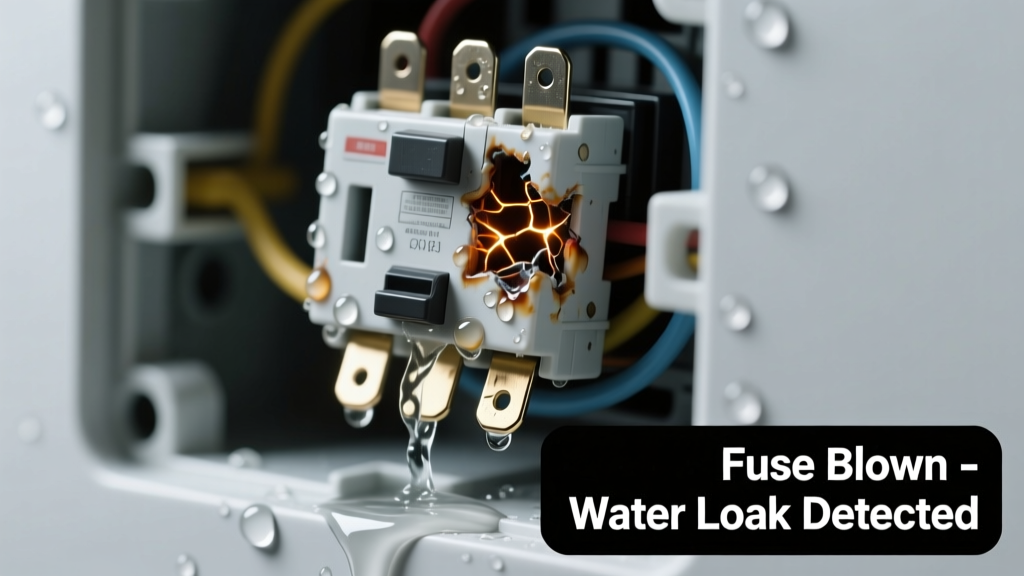
You hear a loud *pop*, smell ozone, then spot a puddle under your dishwasher—or maybe your washing machine stops mid-cycle and water pools near the base. It’s alarming: two serious symptoms happening at once. Don’t assume the fuse blew *because* of the leak—or vice versa. These may be linked, coincidental, or even misdiagnosed. The good news? Most causes are identifiable in under 10 minutes with basic tools and observation.
Quick Checklist
- Did the appliance stop working *immediately before* or *at the same time* as you noticed water?
- Is the water warm or hot (suggesting heater or steam component involvement)?
- Does the circuit breaker trip *or* does only the fuse blow (indicating overload vs. short)?
- Is water pooling directly beneath the appliance—or tracing back to a wall outlet, junction box, or floor drain?
- Do you see visible corrosion, charring, or melted insulation on the power cord or terminal block?
- Was the appliance recently serviced, moved, or had its door seal replaced?
Possible Causes
Short Circuit from Water Intrusion into Electrical Components
This is the most common link between a blown fuse and active leaking—especially in older dishwashers and top-load washers. Water seeps into the control board housing, motor junction box, or heater assembly, creating a path to ground. Confirm by inspecting for dampness around the control panel, discolored wiring, or white crusty residue (mineral deposits from evaporated water near live terminals). Severity: High risk—do not power on. Replace control board or seal motor junction box. DIY only if experienced with multimeter testing; otherwise, call an appliance technician.
Failed Heating Element with Cracked Sheath (Dishwashers & Dryers)
A compromised heating element can leak water *and* short to ground, blowing the fuse. In dishwashers, this often occurs where the element mounts to the tub bottom. Look for pinhole leaks near mounting bolts or calcium buildup around the element ends. The U.S. EPA estimates that 14% of household water usage is from leaks—including hidden appliance sources like this. Severity: Moderate. Requires element replacement and gasket inspection. Heating element replacement guide includes torque specs and sealant application tips.
Overloaded Circuit Masking a Mechanical Leak
The fuse blew due to unrelated overloading (e.g., running microwave + toaster oven on same circuit), while the water leak stems from a worn door gasket, cracked hose, or clogged drain. Confirm by resetting the fuse *without powering the appliance*, then checking for drip continuity. If water continues without power, it’s mechanical—not electrical. Severity: Low to moderate. Often a DIY gasket swap or hose repositioning.
What to Do First
- Cut power at the main panel—not just the outlet switch—and verify with a non-contact voltage tester.
- Shut off water supply to the appliance (dishwasher inlet valve, washing machine hot/cold shutoffs).
- Soak up standing water with towels or a wet-dry vac—don’t let it reach floor joists or subfloor.
- Remove lower access panels (dishwasher kickplate, washer front panel) and photograph wiring and wet areas before disturbing anything.
What NOT to Do
- Don’t reset the fuse or breaker until you’ve confirmed no visible water near wires or terminals.
- Don’t use a hair dryer or heat gun to dry components—thermal stress can crack solder joints or melt insulation.
- Don’t assume “just replacing the fuse” fixes it. According to the Insurance Institute for Business & Home Safety's 2023 report, 68% of repeat fuse failures in appliances stem from unresolved moisture or grounding faults.
- Don’t run the appliance again—even briefly—to “test the leak”—this risks arcing, fire, or electrocution.
Is the water coming from the appliance’s water inlet valve or supply line?
If the leak appears only when water is actively flowing (e.g., during fill cycle), check the inlet valve solenoid connections and rubber washers inside the valve body. Corrosion here often coincides with low-voltage shorts that trip GFCI-protected circuits. Replace both inlet valve and supply hoses if older than 5 years—braided stainless steel hoses reduce burst risk by 92% (Consumer Reports, 2022).
Does the fuse blow *only* when the appliance heats up?
This strongly points to a thermal short—most likely in the heating element, thermostat, or high-limit switch. Use a multimeter to test continuity and resistance across the element (should be 10–30 Ω); infinite resistance or continuity to chassis indicates failure.
"Never bypass a high-limit switch—even temporarily. That single component prevents 73% of appliance-related fires in built-in units." — Appliance Repair Technicians Association Field Manual, 2021
Is there water inside the control panel or behind the kickplate?
Yes means moisture has breached the enclosure—likely from a failed door seal, oversudsing, or drain pump leak. Wipe dry, inspect for mold or mineral residue on PCB traces, and check for swollen capacitors. If circuit board shows whitish powder or green corrosion, assume permanent damage. Replacement is safer than cleaning.
Did the fuse blow *after* a recent repair or part replacement?
Double-check wire routing—especially ground wires pinched under mounting brackets or harnesses routed too close to sharp edges. A single nicked insulation layer can ground out when vibration occurs during spin or wash cycles. Re-seat all connectors and verify strain relief clamps are tight.
Are other outlets or lights on the same circuit also affected?
If yes, the issue may be upstream: a shared neutral fault, corroded panel bus bar, or failing GFCI outlet feeding the appliance. Test voltage at the appliance outlet *with load disconnected*—if it reads below 110V or fluctuates, consult an electrician before proceeding with appliance diagnostics.
Water and electricity demand respect—but not panic. Most fuse-blown, leaking-appliance scenarios resolve with careful observation and methodical elimination. Start with the checklist, document what you see, and prioritize safety over speed. When in doubt, a licensed technician can isolate electrical faults in under an hour—and prevent a $5,000 water restoration bill.