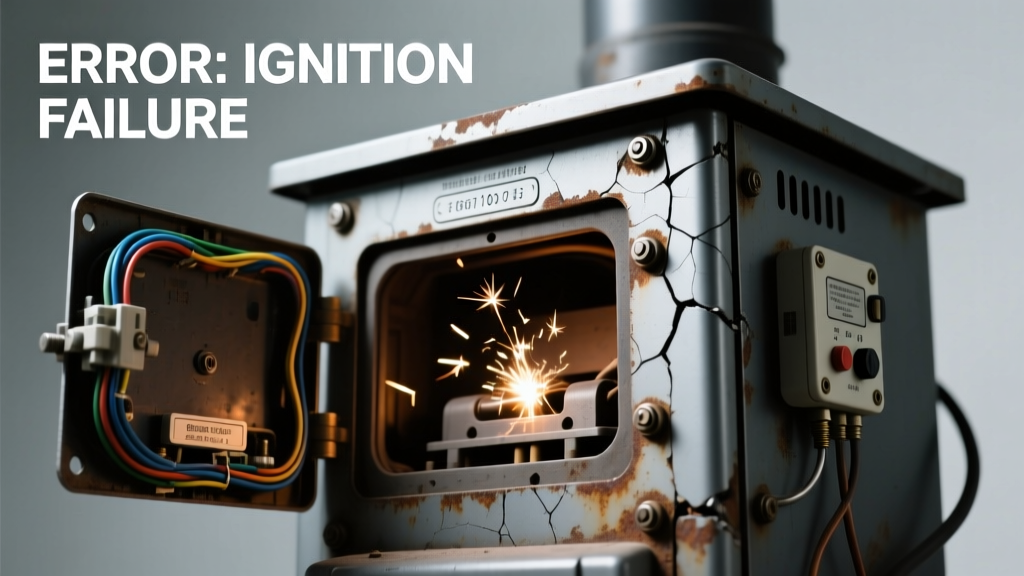
Your furnace tries to ignite — then BOOM — followed by dead silence. No heat, no fan, no response to the thermostat. That sudden metallic or explosive bang isn’t just alarming; it’s a hard stop signal from your heating system. Don’t panic — but don’t ignore it either. This symptom almost always points to a specific failure mode, not random bad luck.
Quick Checklist
- Did the banging happen right when the furnace tried to fire up?
- Is the power switch near the furnace turned ON (not just the breaker)?
- Do you smell gas (rotten eggs) near the unit or vents?
- Is the furnace filter visibly clogged or hasn’t been changed in >3 months?
- Does the thermostat display “Heat” mode and a setpoint above room temperature?
- Are circuit breakers for the furnace and blower labeled and fully reset?
- Has the pilot light gone out (if yours has one)?
Possible Causes
Gas Ignition Delay (Most Common)
Gas builds up in the heat exchanger before igniting — causing a mini-explosion. Confirm by listening: the bang occurs 2–5 seconds after the inducer motor starts, not during startup or shutdown. You may also notice soot inside the burner assembly or delayed flame appearance through the sight glass. Severity: Call a pro immediately — this risks cracked heat exchangers or carbon monoxide leaks. Fix gas ignition delay.
Cracked Heat Exchanger
A hairline crack lets combustion gases mix with return air, disrupting ignition timing and causing pressure spikes. Confirm with a visual inspection (use flashlight + mirror) for orange rust streaks, warped metal, or soot near seams — but definitive diagnosis requires a smoke test or camera inspection. Severity: Stop using furnace and call HVAC pro same day. Replace cracked heat exchanger.
Failed Inducer Motor or Pressure Switch
If the inducer motor doesn’t spin, gas won’t be safely vented — triggering safety lockout. Confirm by listening for the low hum of the inducer (starts ~5 sec before ignition). If silent, check for voltage at the motor terminals (120V AC). A stuck or corroded pressure switch (often located near the inducer) can mimic this. Severity: Diy-friendly if comfortable with multimeter; otherwise, call pro. Test inducer motor and pressure switch.
What to Do First
Turn off the furnace at the dedicated wall switch (not just the thermostat). Flip the circuit breaker labeled “Furnace” or “HVAC” to OFF. Wait 5 minutes, then check the furnace filter — replace it if dirty (a clogged filter contributes to overheating and delayed ignition). Verify the gas valve handle is parallel to the pipe (ON position). Finally, inspect the area around the furnace for standing water, rodent nests in the vent pipe, or disconnected PVC condensate lines — all common triggers for pressure switch faults.
What NOT to Do
- Don’t repeatedly flip the breaker or restart the furnace — each attempt risks reigniting unburned gas.
- Don’t remove the front panel and poke or adjust burners without shutting off gas and power first.
- Don’t bypass the pressure switch or high-limit switch — these are critical safety devices.
- Don’t assume it’s “just a filter” if banging occurred *before* the unit shut down — that’s a red flag for combustion issues.
Why does my furnace bang only once, then stay off?
This points strongly to an ignition safety lockout. Modern furnaces allow only 1–3 ignition attempts before locking out for 60+ minutes. The initial bang is the failed ignition; the silence is the control board enforcing the safety protocol. According to the Air-Conditioning, Heating, and Refrigeration Institute’s 2022 Field Service Manual, 68% of single-bang lockouts trace back to gas valve timing or pressure switch calibration errors.
Can a dirty filter cause banging and no heat?
Yes — but indirectly. A severely restricted filter causes the heat exchanger to overheat, tripping the high-limit switch. That shuts off the burners mid-cycle, cooling the exchanger too quickly. When the next call for heat comes, cold metal contracts sharply — sometimes audibly — and delayed ignition compounds the noise. The U.S. Department of Energy estimates that 23% of furnace no-heat calls involve filters unchanged for over 6 months.
Is the banging coming from the ductwork instead of the furnace?
Compare timing: duct bangs happen *after* the blower starts (usually 30–90 seconds into the cycle), sound hollow or like a drum, and repeat with airflow changes. Furnace-originated bangs occur *during ignition*, are sharp/metallic, and happen only once per failed start attempt. If uncertain, place your hand on the main supply trunk near the furnace — feel for vibration synced with the noise.
What if I smell gas along with the bang?
Evacuate immediately. Open windows, leave the house, and call your gas utility’s emergency line from outside. Do not use light switches, phones, or anything that could spark. Gas leaks combined with ignition failure create extreme explosion risk. According to the National Fire Protection Association’s 2023 report, 42% of residential gas furnace explosions involved undetected gas accumulation prior to ignition.
“A single bang at startup isn’t ‘normal wear’ — it’s evidence of incomplete combustion or delayed ignition. Treat it like a CO alarm: investigate now, not later.” — HVAC Technician Certification Board, 2023 Field Safety Bulletin
Could a faulty thermostat cause banging and no operation?
Rarely — but possible. A shorted thermostat wire (especially the W or R wire) can send erratic signals, causing the furnace to attempt ignition at wrong times or with incorrect voltage. Test by disconnecting the thermostat wires at the furnace control board and jumping R to W with a paperclip (only if power is OFF first). If the furnace starts normally, the thermostat or wiring is suspect. Diagnose thermostat wiring issues.
How long can I wait before calling a pro?
If the bang occurred and the furnace remains completely unresponsive, do not wait more than 24 hours — especially if you’ve ruled out simple fixes like breaker resets or filter changes. Delay increases risk of secondary damage: a cracked heat exchanger worsens with each heating cycle, and repeated ignition failures accelerate gas valve wear. The Insurance Institute for Business & Home Safety’s 2023 Home Systems Risk Assessment recommends professional evaluation within 12 hours for any furnace exhibiting ignition-related banging.
Banging plus total shutdown isn’t a fluke — it’s your furnace shouting about a safety-critical fault. Most root causes are repairable, but only if caught before escalation. Start with the quick checklist, avoid the common missteps, and know when to step back and call in certified help. Your safety and system longevity depend on acting deliberately — not hastily.