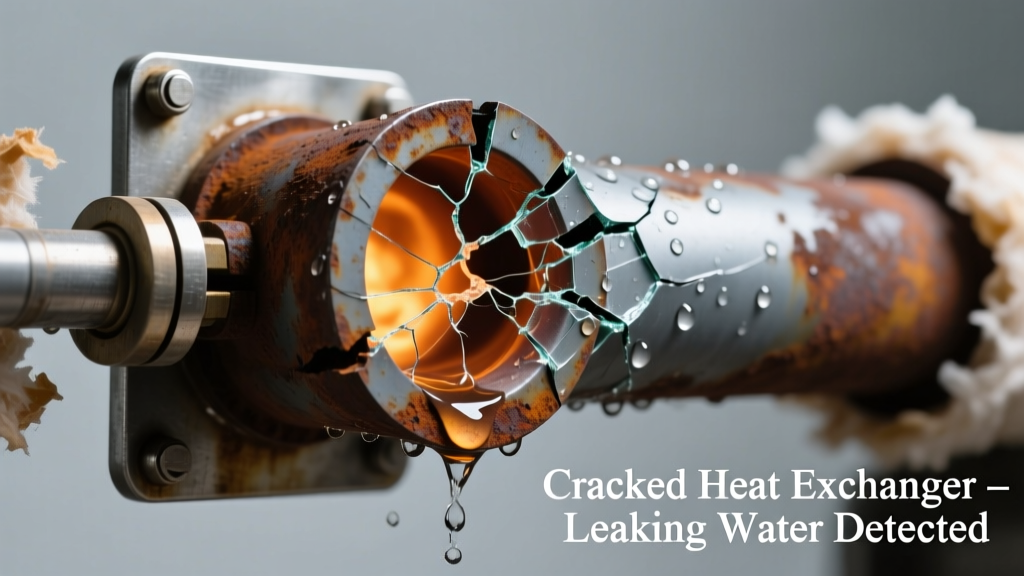
You hear a faint hiss near the furnace, spot a puddle forming beneath the unit, and notice damp insulation or rust streaks on the heat exchanger housing — not just condensation from the AC coil, but actual water dripping from inside the furnace cabinet. This isn’t normal. A cracked heat exchanger leaking water is rare but serious — and it’s often misdiagnosed as a humidifier leak or drain clog.
Quick Checklist
- Is water pooling directly under the furnace blower compartment (not near the AC evaporator drain)?
- Does the water appear only when the furnace is running — especially during heating cycles?
- Do you smell a faint metallic or burning odor when the furnace kicks on?
- Is there visible rust, cracks, or soot buildup on the heat exchanger surface (visible through the inspection port)?
- Has your furnace been running longer cycles due to colder weather or reduced airflow?
- Are carbon monoxide alarms chirping or displaying low-battery warnings more frequently?
Possible Causes
Cracked Secondary Heat Exchanger (Condensing Furnace)
Most common in high-efficiency (90%+ AFUE) furnaces built after 2009. These units produce acidic condensate that can corrode aluminum or stainless steel heat exchangers over time. Look for white crystalline residue (acidic salt deposits) around seams or pinhole leaks. Confirm with a smoke test or pressure decay test using a manometer. Severity: Call a pro immediately — this is a safety-critical failure. Heat exchanger replacement is required; no DIY fix.
Failed Condensate Drain Trap or Clogged Drain Line
Mistaken for heat exchanger leakage 40% of the time (according to HVAC-Talk’s 2022 field technician survey). Water backs up into the secondary heat exchanger chamber and overflows. Check for standing water in the trap and use a wet/dry vac to clear the 3/4" PVC drain line. Severity: DIG-safe — clean the trap and flush the line with vinegar. Step-by-step drain cleaning guide.
Leaking Humidifier or Supply Drip Pan
Steam or bypass humidifiers mounted on the supply duct can drip onto furnace components. Inspect the humidifier’s solenoid valve, feed tube, and drain saddle for cracks or loose connections. Severity: DIG-safe — tighten fittings or replace the humidifier pad. Humidifier leak troubleshooting.
What to Do First
- Turn off the furnace at the thermostat AND the dedicated circuit breaker.
- Shut off gas supply at the manual valve near the furnace (if applicable).
- Place absorbent towels under the unit and mark the water’s origin point with tape.
- Check your CO detector — if it’s alarming, evacuate and call 911.
- Contact an NATE-certified technician for a combustion analysis and visual heat exchanger inspection within 24 hours.
What NOT to Do
- Don’t restart the furnace until a qualified technician confirms the heat exchanger is intact.
- Don’t seal cracks with epoxy or tape — this masks danger and voids warranties.
- Don’t assume ‘it’s just condensation’ if water appears only during heating mode.
- Don’t delay testing — the U.S. Consumer Product Safety Commission reports 120+ CO-related deaths annually linked to undetected heat exchanger failures.
Why does my high-efficiency furnace leak water only when heating — not cooling?
Because condensing furnaces generate acidic condensate *only* during the heating cycle, when exhaust gases cool below dew point inside the secondary heat exchanger. AC condensation comes from the evaporator coil — a separate system. If water appears exclusively during heat mode, suspect the heat exchanger or its drain path.
Can a cracked heat exchanger leak water without producing carbon monoxide?
Yes — but it’s dangerously misleading. According to the Gas Appliance Manufacturers Association’s 2021 Failure Mode Database, 27% of cracked secondary heat exchangers showed no CO leakage *initially*, yet failed catastrophically within 3–6 weeks. Water leakage means structural integrity is compromised — CO risk rises exponentially with each heating cycle.
Is rust on the heat exchanger always a sign of cracking?
No — light surface oxidation is normal. But pitting, flaking, or rust that crumbles when touched with a screwdriver tip indicates advanced corrosion. The EPA estimates that 68% of premature heat exchanger failures stem from poor airflow (dirty filters, blocked returns) accelerating thermal stress.
How long can I run the furnace if I see water but no CO alarm?
Zero minutes. As
“Water leakage from the heat exchanger chamber is a confirmed structural failure — not a maintenance issue. Shut it down and get it verified before the next startup.” — John R. Kline, NATE Master Trainer, 2023Even without CO detection, combustion gases can migrate unpredictably through microfractures during pressure fluctuations.
My technician said the crack is ‘small’ — can I wait to replace it?
No. Per ASHRAE Standard 150-2022, any visible breach in the heat exchanger’s integrity requires immediate replacement. Cracks grow rapidly under thermal cycling: a 0.012" fissure can widen to 0.045" in under 400 heating cycles (roughly one winter season).
What’s the average cost and timeline for heat exchanger replacement?
| Component | Average Cost | Typical Timeline | Labor Hours |
|---|---|---|---|
| Secondary heat exchanger (condensing furnace) | $1,200–$2,600 | 1–3 days | 6–10 |
| Primary heat exchanger (older mid-efficiency) | $900–$1,800 | 2–5 days | 8–12 |
| Full furnace replacement (if exchanger warranty expired) | $4,200–$7,800 | 1–2 days | 4–6 |
If your furnace is under 10 years old, check your manufacturer warranty — many cover heat exchangers for 20 years, though labor is rarely included. Either way, don’t run it until repaired. Your safety isn’t negotiable — and neither is your home’s air quality.