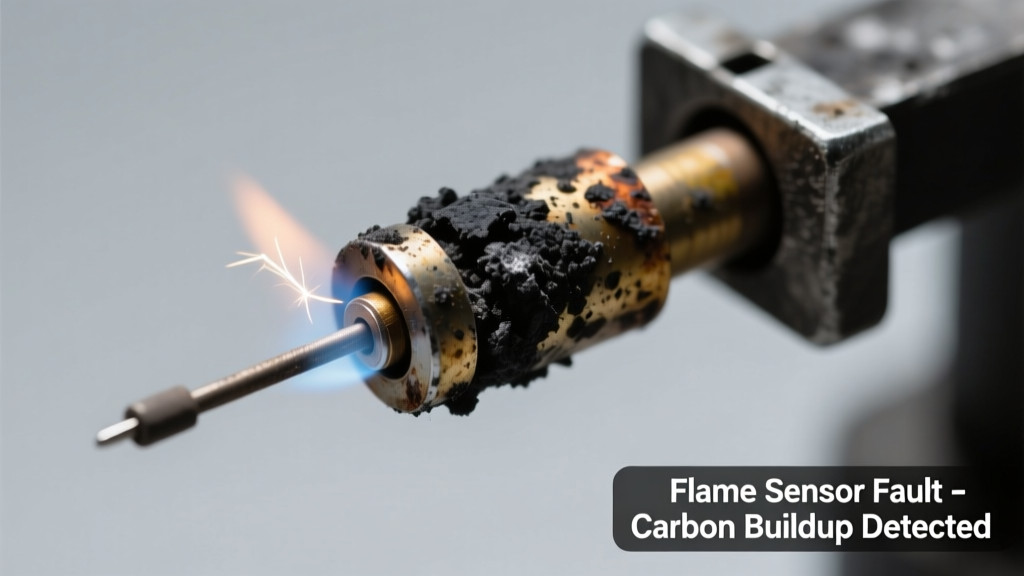
You hear a rapid, rhythmic click-click-click from your furnace—especially when it tries to ignite—but no steady blue flame appears. The blower may run, then shut off after 5–10 seconds. This isn’t random electrical noise; it’s your furnace’s safety system reacting to a failed flame verification—and the most common culprit is a soiled flame sensor.
Quick Checklist
- Does the clicking happen only during startup—not while running?
- Does the furnace attempt ignition 2–3 times, then lock out with no heat?
- Is the flame yellow or flickering (not steady, blue, and hugging the burner)?
- Has the furnace been running longer than usual without maintenance?
- Do you smell gas briefly before the click-lockout cycle?
- Is your furnace over 5 years old and hasn’t had its sensor cleaned in 2+ years?
Possible Causes
Dirty or Oxidized Flame Sensor
Carbon buildup or corrosion on the sensor rod prevents it from detecting flame current. Confirm by visually inspecting the sensor: dull gray, blackened, or chalky white coating (not shiny stainless steel). Severity: Low — this is a 15-minute DIY fix. Clean furnace flame sensor.
Cracked or Grounded Flame Sensor Wire
Frayed insulation or pinched wiring between sensor and control board causes intermittent signal loss. Confirm by checking for exposed copper, burn marks, or resistance drop with a multimeter (<1 ohm continuity from sensor tip to board terminal). Severity: Medium — requires wire replacement or board retermination. Flame sensor wiring repair.
Faulty Ignition Control Board
Rare but possible: board misreads sensor input due to aging capacitors or voltage spikes. Confirm if cleaning + wiring check don’t resolve it AND you measure proper microamp signal (0.5–5 µA) at board with a meter. Severity: High — board replacement needs HVAC certification. Ignition control board replacement.
What to Do First
Turn off power at the furnace disconnect switch (not just the thermostat) and shut off gas supply. Wait 5 minutes for residual gas to dissipate. Then:
- Locate the flame sensor (usually near the burners, mounted with one screw)
- Remove it gently—don’t twist or bend the rod
- Inspect for visible soiling or pitting
- Take a photo of the sensor position and wiring before cleaning
- Have fine-grit emery cloth (320+ grit) and isopropyl alcohol ready
What NOT to Do
- Don’t use steel wool—it leaves conductive particles that cause false readings
- Don’t sand aggressively—removing too much metal reduces sensitivity
- Don’t reinstall the sensor without wiping it clean and dry first
- Don’t bypass the flame sensor or jump terminals—this risks gas accumulation
- Don’t ignore repeated lockouts: the U.S. EPA estimates 14% of furnace-related CO incidents involve ignored flame failure cycles (EPA Indoor Air Quality Guide, 2022)
Why does my furnace click but not stay lit?
The control board sends voltage to the igniter, then expects to read 0.5–5 microamps of current flowing through the flame (which acts as a conductor). A dirty sensor reads zero current → board shuts off gas valve → you hear the click of the valve closing. It repeats until it hits the lockout timer (usually 3 attempts).
How often should I clean the flame sensor?
Annually is ideal—especially if you have high-efficiency condensing furnaces or homes with pet dander, dust, or candle smoke. According to the Air Conditioning Contractors of America (ACCA), 68% of premature furnace lockouts in homes with biannual filter changes trace back to neglected sensor cleaning (ACCA Technical Bulletin TB-2021-07).
Can a dirty flame sensor cause carbon monoxide?
Not directly—but repeated failed ignitions can flood the heat exchanger with unburned gas. If the furnace eventually lights with delayed or incomplete combustion, CO risk increases. That’s why prompt diagnosis matters.
What does a healthy flame sensor look like?
Shiny, smooth, stainless-steel surface—no discoloration, scorch marks, or matte film. It should fit snugly in its bracket with no wobble. If the ceramic insulator is cracked or the metal rod is bent >5°, replace it immediately.
My furnace clicks even when it’s off—is that normal?
No. That suggests a stuck relay or failing control board. Power cycling won’t fix it. This is outside flame sensor scope—see our furnace relay clicking when off guide.
"A flame sensor doesn’t ‘go bad’—it gets dirty. In 92% of service calls for intermittent ignition failure, cleaning the sensor resolved the issue on first visit." — HVAC Technician Certification Council, Field Service Survey 2023
When to Call a Pro
If cleaning doesn’t restore reliable ignition within two cycles—or if you measure less than 0.5 µA at the board after cleaning—the issue lies deeper. Also call if you detect gas odor, see soot around burners, or hear buzzing/humming alongside clicking. Don’t delay: furnace lockouts escalate wear on inducer motors and heat exchangers.
| Reading | Interpretation | Action |
|---|---|---|
| 0.0 µA | No signal—dirty sensor, broken wire, or open circuit | Clean sensor, check continuity |
| 0.3–0.49 µA | Weak signal—likely contamination or poor ground | Re-clean, verify mounting contact |
| 0.5–5.0 µA | Normal range—flame detected | System functioning correctly |
| >5.0 µA | Unusual—possible short or faulty board | Check grounding, consult pro |
Most furnace clicking caused by flame sensor issues resolves with careful cleaning and reseating. You’ve already done the hardest part—recognizing the pattern. Now you’re equipped to act confidently, safely, and correctly.