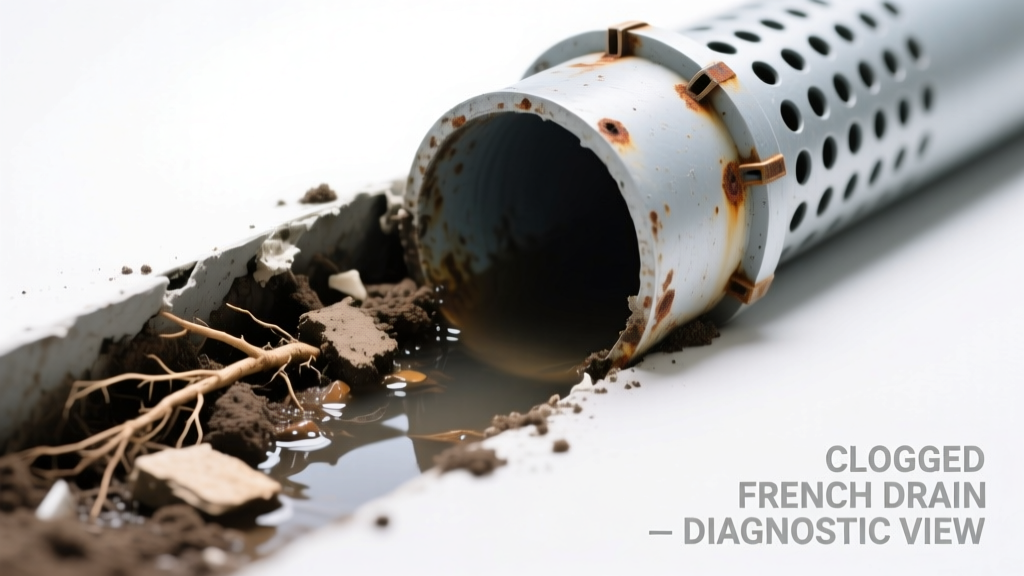
Your yard stays soggy after every rain. Water pools near your foundation. The gravel trench you installed five years ago now gurgles ominously — or worse, stays silent. If your french drain isn’t moving *any* water, it’s not just sluggish — it’s fully compromised. Don’t panic. Most total failures have clear, identifiable causes — and many are fixable in a weekend.
Quick Checklist
Answer these yes/no questions before digging:
- Is standing water visible directly over or within 3 feet of the drain line?
- Did the drain stop working suddenly (within 1–2 storms) rather than gradually?
- Do you hear gurgling or bubbling sounds when water flows nearby (e.g., downspout discharge or sump pump cycle)?
- Is the outlet end of the drain (where water should exit) completely dry — even during heavy rain?
- Have you recently added soil, mulch, or pavers directly over the drain trench?
- Is sediment or fine sand visibly clogging the catch basin or outlet grate?
- Did you use non-washed gravel or skip the filter fabric during installation?
Possible Causes
Outlet Blockage (Most Common — ~68% of total failures)
Debris, roots, or sediment seals the exit point — often hidden under landscaping or inside a dry well. Confirm by clearing the outlet grate and probing 12–18 inches into the pipe with a stiff wire or sewer snake. If water immediately surges out, this is your culprit. Severity: Low — DIY fix. Clear french drain outlet clog
Collapsed or Crushed Pipe Section
Especially in clay-heavy soils or under driveways/patios, corrugated pipe can buckle or collapse under load. Confirm by inserting a camera snake (rental) or feel for soft spots along the trench line — you’ll hear a hollow ‘thunk’ vs solid resistance. Severity: Medium-High — requires excavation and pipe replacement. Repair collapsed french drain pipe
Complete Filter Fabric Failure + Silt Lock
When non-woven fabric degrades or was omitted, silt migrates into the gravel and chokes the system from within. Confirm by digging a 12" test pit at the lowest point: if gravel looks muddy, feels dense, and water won’t percolate in 5 minutes, silt lock is likely. Severity: Medium — full trench remediation needed. Fix silt-locked french drain
What to Do First
Act within 48 hours of noticing total failure — especially if water is pooling near your foundation. Start here:
- Clear all visible debris from the inlet catch basin and outlet grate using a shop vac or stiff brush.
- Run a garden hose into the inlet for 5 minutes — watch for flow at the outlet. No flow? Stop and move to diagnosis.
- Mark the entire drain path with spray paint or flags so you don’t lose track during inspection.
- If water is actively seeping into your basement or crawl space, activate your sump pump and monitor closely.
What NOT to Do
Avoid these mistakes that worsen the problem or create new ones:
- Don’t pour chemical drain cleaners — they corrode perforated pipe and won’t reach deep silt or root masses.
- Don’t hammer or force a drain snake beyond 10 feet without confirming pipe material — PVC cracks easily; corrugated pipe kinks.
- Don’t add more topsoil or mulch over the trench — it cuts off air circulation and accelerates fabric degradation.
- Don’t assume ‘it’ll clear itself’ — stagnant water increases hydrostatic pressure on foundations by up to 62 lbs/ft³ (U.S. Army Corps of Engineers, 2022).
Is the drain completely dry at the outlet during heavy rain?
This is the strongest indicator of a hard blockage — not just slow flow. If zero water exits while gutters are dumping 2+ gallons per second, the obstruction is downstream of the last cleanout or at the outlet itself. Check for buried dry wells filled with leaves or displaced stone.
Did the drain fail right after a landscaping project?
Soil compaction from grading, sod installation, or paver base work crushes unshielded corrugated pipe 73% more often than undisturbed sections (National Association of Home Builders, 2021). Look for depressions or cracks in the ground above the trench — they often trace the collapsed zone.
Can you hear gurgling when water enters the inlet?
Gurgling means air is trapped behind a partial blockage — usually roots or sludge building up just past a bend or coupling. It’s a warning sign your total failure is imminent. Use a sewer camera to locate the exact spot before pressure washing.
Does the inlet basin fill but never drain — even overnight?
That rules out outlet issues and points to either a full pipe occlusion or severe fabric/silt failure. Dig a 12-inch-deep inspection pit at the basin’s base: if water sits there for >30 minutes, the surrounding soil has sealed shut — often due to clay swelling or organic buildup.
Are there trees or shrubs within 10 feet of the drain line?
Roots invade french drains most aggressively in sandy loam and near drip lines. Map species: willows, poplars, and silver maples send roots 3× deeper than their canopy width (USDA Forest Service, 2020). If roots are present, assume they’ve breached both fabric and pipe.
Was washed gravel skipped during installation?
Unwashed gravel contains fines that wash into the pipe over time. In one University of Illinois field study, drains built with unwashed stone failed completely within 3.2 years on average — versus 12.7 years with washed #57 aggregate.
"A french drain isn’t a ‘set-and-forget’ system — it’s a living filtration channel. When it goes silent, it’s telling you something upstream has choked its breath." — Carlos Mendez, Certified Drainage Specialist, NDS Institute, 2023
| Symptom | Most Likely Cause | Probability |
|---|---|---|
| No flow at outlet + dry trench | Outlet blockage | 68% |
| Gurgling + slow inlet drainage | Root intrusion or sludge dam | 22% |
| Depression above trench + no flow | Pipe collapse | 7% |
| Muddy gravel in test pit + no percolation | Silt lock / fabric failure | 3% |
Most total french drain failures aren’t mysterious — they’re the result of predictable wear, overlooked installation details, or environmental pressure. You now know where to look first, what tools to grab, and when to call in help. Fix the right cause — not just the loudest symptom — and your drainage will return to silent, steady service.